




Description
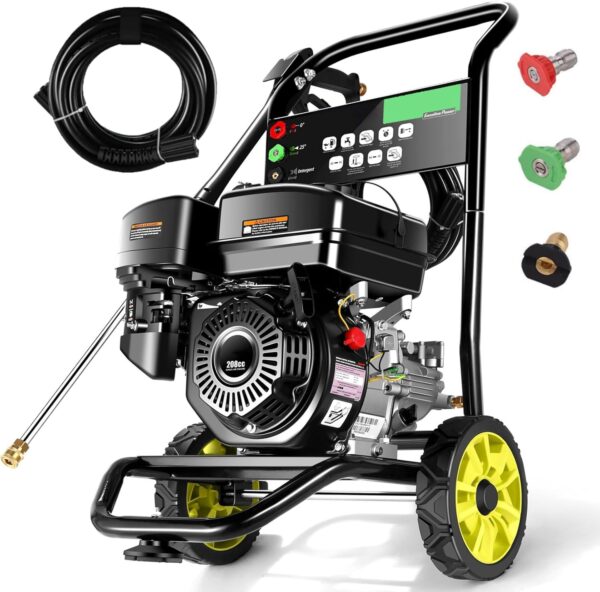
The TEANDE gas pressure washer is listed at 4000 PSI and 2.6 gallons per minute from a 208cc engine, and it is marketed simultaneously as a commercial machine and a homeowner machine. Its listing is one of the least complete in this catalog: several structured fields are empty, one is stored in scientific notation, and the feature bullets are largely unreadable. This review works from what is published and names the gaps. We do not own or operate the machine.
Carbon monoxide comes first on any gas machine
A gasoline engine produces carbon monoxide, which is colorless, odorless and can kill before anyone notices a problem. Never run this or any gas pressure washer indoors, in a basement, in a crawl space, in a shed, or in a garage. A garage with the door open is still a garage and is still not safe. Run it outdoors, well away from open windows, doors and vents, and keep the exhaust pointed away from the building and away from anywhere people are working.
Fuel handling matters too. Let the engine cool before refueling, refuel outdoors, and keep gasoline away from the hot exhaust and muffler. This is the single largest difference between owning a gas machine and owning anything in the corded electric section, and it is not a formality.
Who this machine is for and what it settles
At a published 4000 PSI and 2.6 gallons per minute, this machine is aimed at people whose jobs are too big for an electric washer: long driveways, large concrete pads, paint preparation on a whole exterior, and heavy machinery. It is also the point at which a pressure washer stops being a household appliance and becomes equipment that can do serious damage to a building.
The listing names home, yard, garden, car, driveway and fence as target uses. A 4000 PSI machine on a car is a poor match. If your list is mostly vehicles and furniture, the honest recommendation is a lower pressure unit; the machines in the gas powered section at 3200 to 3400 PSI, or a corded electric, are better suited.
The specifications that matter
Published figures are 4000 PSI, 2.6 gallons per minute, a 208cc engine that TEANDE rates at 7.0 horsepower, a 25 foot hose, two 8 inch wheels, a stated weight of 68.3 pounds and frame dimensions of 22.44 by 17.72 by 19.69 inches. The certification field reads CARB and EPA, which means the engine is stated to meet California Air Resources Board requirements as well as federal ones. That is worth noting, because several competing gas machines in this catalog are 49 state compliant only and cannot be sold new in California.
Pressure and flow decide cleaning speed together. At 2.6 gallons per minute this machine moves more than twice the water of a typical corded electric, and that is what makes large flat concrete practical rather than tedious. Do not read the 4000 PSI figure alone as the reason.
The published output leaves no margin against the engine rating
Producing 4000 PSI at 2.6 gallons per minute requires roughly six horsepower at the pump outlet before accounting for any pump or drive losses. TEANDE rates the engine at 7.0 horsepower. Those two figures are close enough that the headline pressure and the headline flow are very unlikely to be delivered together in continuous use. As with most listings in this category, 4000 PSI should be read as a peak figure rather than a working pressure. TEANDE does not publish a separate working pressure, so there is nothing to compare it against.
The structured field itself is stored as “4E+3”, scientific notation for 4000. That is a data import artifact rather than a manufacturer statement, and it is a reminder that this listing was assembled by machine.
Using it correctly
At this pressure the jet can cut into skin on contact and drive water and contaminants deep into tissue. Injection injuries from pressure washers frequently look like a small puncture and require emergency surgical treatment. Never aim the wand at a person or an animal under any circumstances. Never hold an object in your hand while spraying it. Wear eye protection and sturdy footwear, and keep everyone else out of the working area.
The listing supplies three nozzles: 0 degrees, 25 degrees and soap. The 0 degree tip concentrates the entire output into a single point and, at a published 4000 PSI, will cut wood, remove mortar, destroy paint and strip the surface off concrete. It has essentially no legitimate use on a house. The 25 degree tip is the gentlest working option in the box, which is a real constraint: there is no 40 degree wide fan for siding, vehicles or painted surfaces. Budget for one separately, and confirm the connector type first.
Surface damage is the ordinary failure mode at this pressure. High pressure water strips paint, splinters softwood decking, erodes mortar joints and drives water behind lap siding when directed upward. Always work downward and diagonally on siding, keep the tip moving, and test on a hidden section of any surface you have not cleaned before.
Limits and gaps in the published data
This listing publishes less than any other gas machine in this catalog. The feature bullets arrive as unreadable character sequences: the seller used decorative mathematical unicode for the headings and the text has not survived import, so several bullets convey nothing at all. The stored product attributes contain only four fields, and brand, power source, maximum pressure and flow rate are all missing from that record even though they appear in the specification block.
There is no published pump type, no fuel tank capacity, no run time, no oil type or capacity, no detergent tank capacity, no soap system description and no warranty term. Country of origin is given as Malaysia and the manufacturer field simply repeats the brand. Customer feedback is recorded at 4.5 out of 5 from 23 ratings, with sales rank fields placing it 1,069th within pressure washers and 280,252nd across patio, lawn and garden at the time of capture. Twenty three ratings is a very small sample from which to draw conclusions.
How it compares within this catalog
Against machines with fuller documentation, the Simpson ALH4440 publishes a named pump, an aluminum frame and 4.0 gallons per minute at a comparable pressure class. The Westinghouse WPX3400 and the DEWALT 61147S both sit a step lower on pressure with far larger feedback histories, which matters when the specification sheet is thin. The Simpson CM61083 is another 208cc machine at a lower published pressure, which makes the horsepower question easier to reconcile.
Who should buy it and who should not
Buy it if you need high flow for large concrete work, you want CARB and EPA compliance stated, and you are comfortable buying from a listing whose published data is incomplete. Do not buy it if you want a documented pump, fuel tank capacity and warranty before purchase, if your work is mainly vehicles and siding, or if you were expecting 4000 PSI and 2.6 gallons per minute to be available at the same time. Whatever you buy, run it outdoors only.