Description
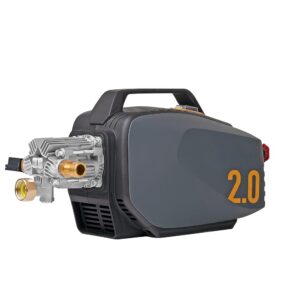
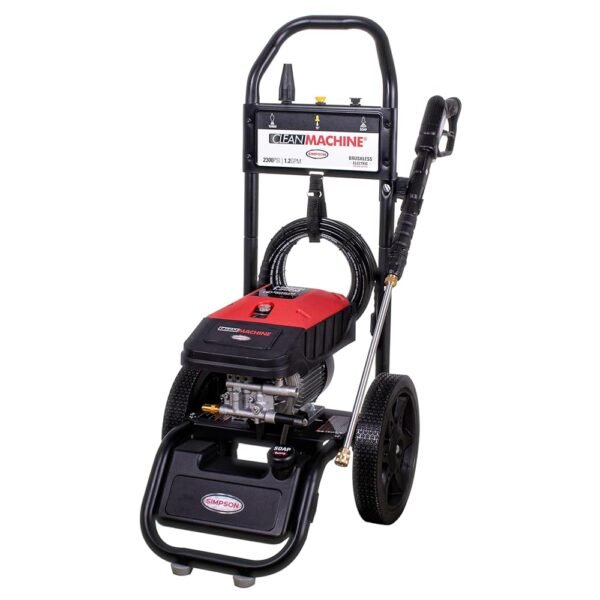
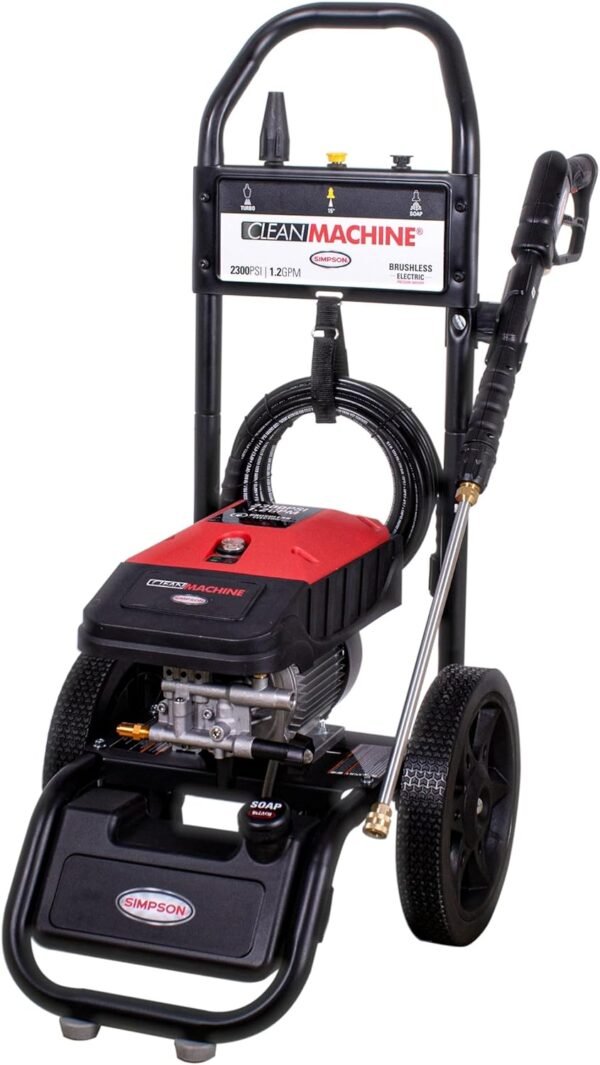
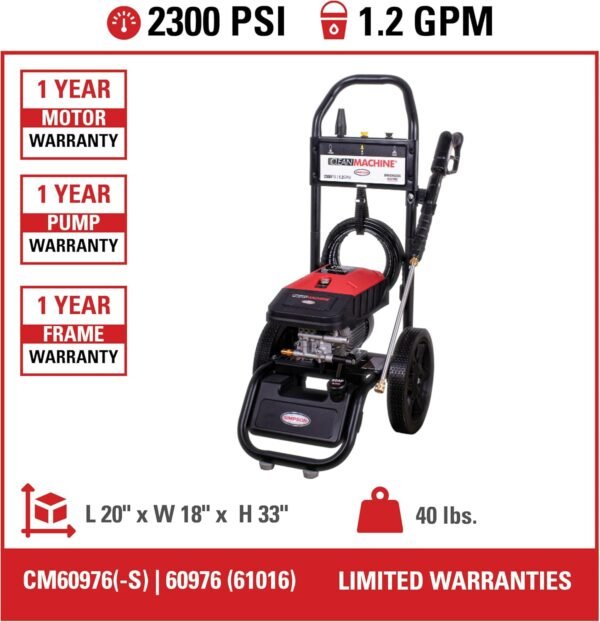
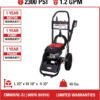
The Simpson 61016 Clean Machine is a corded electric pressure washer rated in the listing at 2300 PSI and 1.2 gallons per minute, running on a 120 volt supply. It is one of the heaviest electric units in this catalog at a published 55 pounds, and that weight is the clue to what Simpson is selling here. This review is written from the published specification fields and feature bullets only. We do not own or operate the machine.
Who this machine is for and what it settles
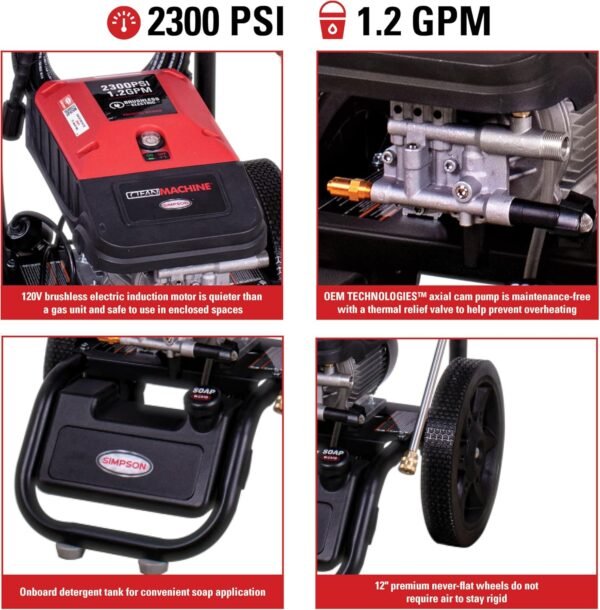
The 61016 settles whether you can get a metal framed, serviceable looking pressure washer without moving to gasoline. Most corded electrics at this price are plastic shrouded and light enough to carry with one hand. Simpson has instead built a powder coated steel frame with 12 inch never flat wheels and hung an OEM Technologies axial cam pump on it, and the result weighs 55 pounds. You roll this machine, you do not carry it.
That trade is worth making if the unit will live in a garage and be dragged out for regular work on fences, walls, sidewalks and vehicles, which is the use Simpson names in its own copy. It is the wrong trade if you need to lift the machine into a truck bed or carry it up steps, in which case the compact end of the corded electric section is a better place to look.
The specifications that matter
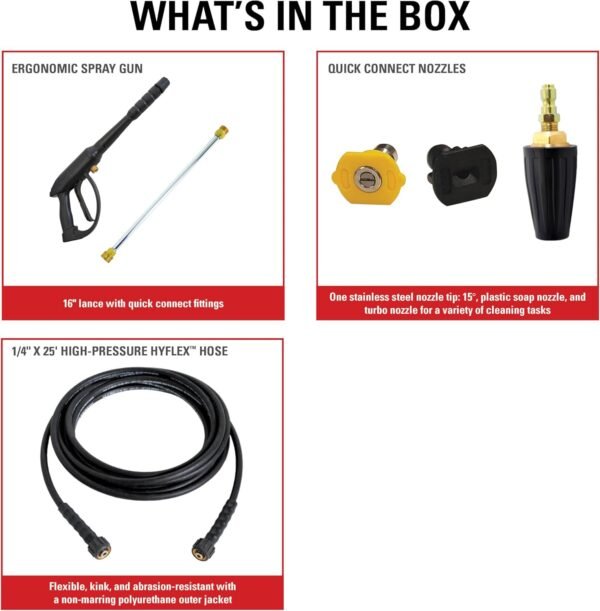
Simpson publishes 2300 PSI at 1.2 gallons per minute, a maintenance free OEM Technologies axial cam pump, a 25 foot HyFlex quarter inch high pressure hose described as flexible and non marring, a powder coated steel frame, 12 inch never flat wheels and an onboard soap tank. Frame dimensions are 19.37 inches long by 15.66 inches wide by 21.61 inches high. Customer feedback is recorded at 4.3 out of 5 across 1,882 ratings.
Cleaning power depends on pressure and flow together. At 2300 PSI the 61016 is above most of the sub 2000 PSI machines here, but 1.2 gallons per minute is the same flow as those machines. The extra pressure will loosen more stubborn material; the flow to sluice it away is unchanged. This is the single most useful thing to understand about where the 61016 sits.
Only three nozzles, and none of them is a wide fan
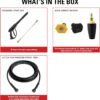
The spray tips shipped with this unit are a turbo, a 15 degree and a soap nozzle. There is no 25 degree and no 40 degree tip in the box. That is a real limitation rather than a detail. The 15 degree tip is a narrow, aggressive fan appropriate for concrete and heavy grime, and the turbo is more aggressive still. Neither is a sensible default for a painted vehicle, for softwood decking, or for vinyl or fiber cement siding, where a 40 degree tip is the usual starting point.
If your work list includes any of those surfaces, budget for a wide angle quick connect tip separately and confirm that it matches the wand’s fitting. Working around the shortfall by backing away from the surface with the 15 degree tip is possible but far less controlled.
Using it correctly
Water leaving a 2300 PSI nozzle can inject through skin. The resulting injury often looks like a small puncture and is a genuine emergency underneath, because the water carries contaminants deep into tissue. Never aim the wand at a person or an animal, never hold an object in your hand while spraying it, and wear eye protection every single time. Keep bystanders and pets clear of the work area, including behind you, since the jet ricochets.
Start every new surface with the least aggressive tip you own, hold the wand well back, and close the distance gradually rather than reaching for a narrower nozzle. High pressure water strips paint, raises the grain on wood, cuts into old mortar and drives water behind siding when sprayed upward. On lap siding work downward and diagonally. On decking keep the tip moving and parallel to the boards.
The soap tank draws detergent only when the soap nozzle is fitted, which is normal for this design and worth knowing before you conclude the tank is not working. Use detergents rated for pressure washer pumps; general purpose cleaners with solvents can damage seals.
Limits and gaps in the published data
The listing does not publish the motor’s amperage draw. It does not publish a power cord length. It does not say whether a GFCI protected outlet is required, and it does not state an extension cord policy. For a 120 volt outdoor machine these are the four electrical facts that decide where you can actually use it, and none of them appears in the data. Extension cord use is restricted by many manufacturers in this class because voltage drop over undersized cord overheats the motor, so confirm the policy with Simpson rather than assuming.
The field labelled “Specification Met” reads “oem”. That is not a standard. OEM Technologies is Simpson’s own pump brand name, and it appears to have been dropped into a field intended for certifications such as CETA or PWMA. Read it as an import error, not as a compliance claim. Similarly, the “Tank Volume” field reads 1.2 gallons, which is identical to the machine’s flow rate in gallons per minute. The same duplicated value appears on several unrelated listings in this catalog, so treat the soap tank capacity as unpublished.
The 2300 PSI figure is given without a companion working pressure figure, so read it as a maximum. Simpson publishes no duty cycle, no maximum inlet water temperature and no maximum inlet pressure here either. Cold water only is the safe assumption.
How it compares within this catalog
The obvious cross shop at similar published pressure is the Sun Joe SPX4800, whose listing publishes a brushless motor and a five nozzle set rather than three, and the Westinghouse WPX3000e, which claims a higher maximum pressure and a higher flow rate on a similar steel frame. Buyers who want a European style compact with a hose reel usually compare the Karcher K5 Premium. If 1.2 gallons per minute is the real obstacle, the step is not to another electric machine but to a gas unit such as the Simpson ALH4440, which is rated at more than three times the flow and carries its own carbon monoxide restrictions. The gas powered section covers those machines.
Who should buy it and who should not
Buy it if you want a steel framed electric machine that rolls rather than one you carry, if 2300 PSI at 1.2 gallons per minute matches your work, and if you are willing to add a wide angle nozzle to the three that ship in the box. Do not buy it if you need to lift the machine regularly at 55 pounds, if you intend to run a surface cleaner that needs more than 1.2 gallons per minute, or if you need the amperage and cord specification published before you buy.