Description
What this tool is and what it settles
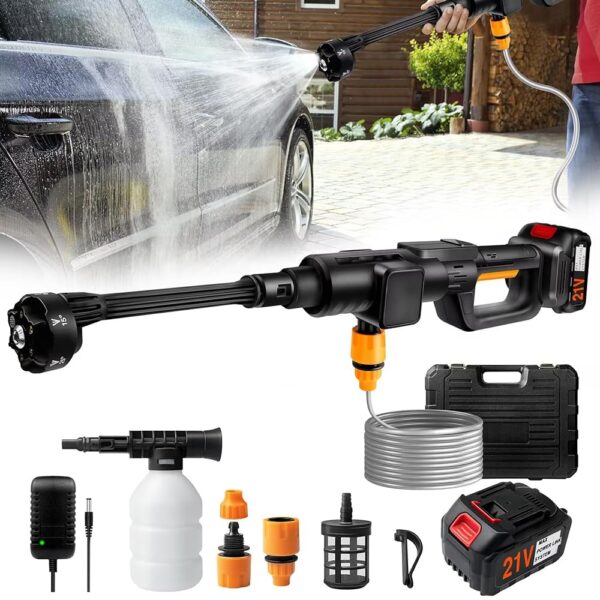
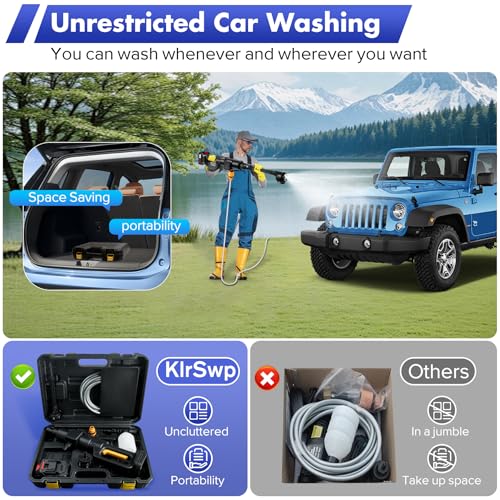
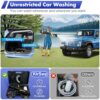
The KlrSwp cordless power washer gun is a handheld battery tool listed at a maximum of 900 PSI, supplied with a detachable battery, a five metre draw hose and a storage box. It draws its own water rather than needing a tap, so the case for it is location: a car parked away from a hose, a bike after a muddy ride, gear at a campsite, a patio at a property with no outdoor spigot. KlrSwp specifically notes the organizer box can live in a vehicle trunk, which is the intended use pattern.
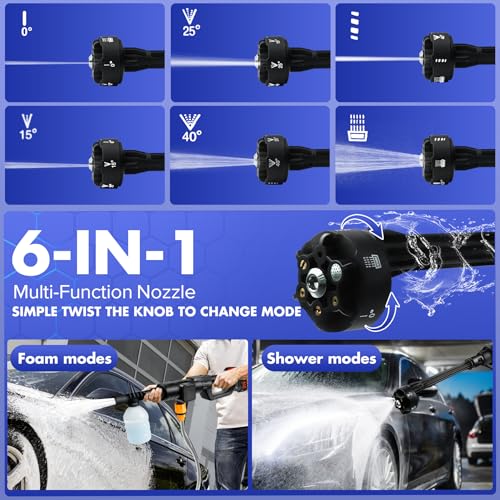
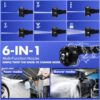
At 8.62 pounds it is held rather than wheeled. The nozzle is a single 6-in-1 head adjusted by twisting a knob, covering angles from 0 to 40 degrees plus foam and shower modes, so there is nothing to swap and nothing to lose. Operation is a single button. Assembly is described as a few minutes from the instructions.
The specification that is missing entirely
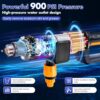
There is no flow rate anywhere on this listing. Not in the title, not in the five feature bullets, not in the specification block. For a pressure washer of any size that is the more consequential of the two performance numbers, because flow is what carries loosened dirt away and what determines whether a surface actually rinses. A pressure figure quoted without a flow figure describes half the machine.
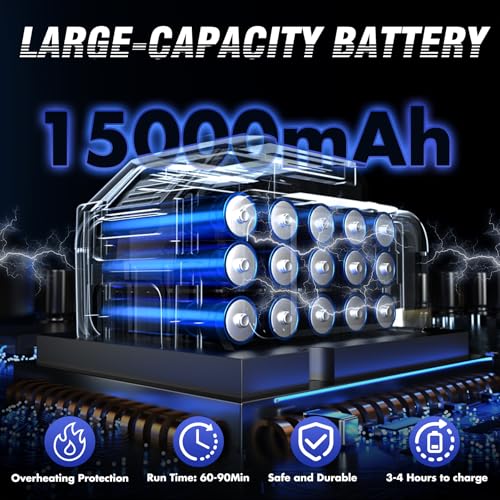
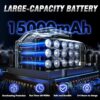
The second missing figure compounds it. KlrSwp advertises a 15000 mAh battery, which sounds substantial, but milliamp hours mean nothing without a voltage. The same 15000 mAh figure describes about 55 watt hours at a single cell voltage and roughly 320 watt hours at a typical multi cell tool voltage, a difference of nearly six times in stored energy. No voltage appears anywhere in the record, and neither does a runtime estimate. Charge time is published at three to four hours, which is the only battery figure that can actually be used.
Compare that with the WORX Hydroshot WG644 review, which publishes 450 PSI on High and 290 PSI on Low, 0.9 GPM, and names the packs as two 20V 2.0Ah batteries. That is enough information to work out what the tool will and will not finish. This listing is not.
What 900 PSI means in practice
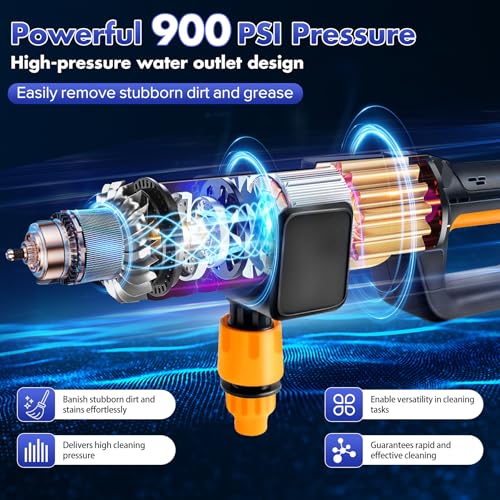
Entry level corded pressure washers start around 1,700 PSI. Cordless tools from the established brands in this catalog sit between 450 and 550 PSI. A 900 PSI claim sits between those, which is plausible for a battery tool with a decent pack, and it is worth understanding what that band is for.
At this level the tool rinses. It removes loose mud, road film, dust, sap and light grime from vehicles, bikes, tools, boots and garden furniture. It does not strip a driveway, remove algae from decking or take paint off anything, and that is a point in its favor for automotive use. Higher pressure is not better on clear coat, and the manufacturers who are candid about this say so directly.
Using it correctly
A water jet can force water and surface contaminants through skin. The risk at these pressures is lower than on a corded machine but the rule does not change: never aim the nozzle at a person or an animal, never test the spray against your hand, and wear eye protection because grit blasted off a surface returns toward the operator. Use the shower or wide settings around anything delicate and reserve the 0 degree setting for hard material.
The intake matters more than anything else on a draw hose tool. Pulling from a bucket, a barrel or a pool brings silt and debris through the pump on the way to the nozzle. Keep the intake off the bottom of the source, rinse the tool through with clean water afterward, and stop rather than letting the pump run dry when the source empties. Store the battery at moderate temperature rather than leaving the box in a cold or hot vehicle for months.
The detachable battery is worth a second thought before buying. A removable pack is normally an advantage, because it can be swapped for a charged one and replaced when it wears out. That only holds if replacements are actually available, and here there is no model number, no voltage and no stated pack designation to order against. Treat the supplied battery as the whole service life of the tool unless the seller confirms otherwise, and factor a three to four hour charge into how you plan a session, since a second pack may not be obtainable.
One more habit applies to the foam mode. Detergent left standing in a foam attachment dries and blocks the pickup, so run clean water through it at the end of a session rather than putting a part full unit back in the box.
Limits and gaps in the published data
The record is unusually incomplete even by the standards of this catalog. The item model number field reads Cordless Pressure Washer, which is a product category rather than a model number, so there is nothing to cross reference against a manufacturer specification sheet. There is no UPC, no country of origin, and no description field at all, so the five feature bullets are the entire product information.
Beyond flow rate and battery voltage, the following are not published: runtime on a full charge, the battery chemistry beyond lithium ion, whether spare or replacement batteries are available, the warranty term, whether detergent can be used through the foam mode, and the maximum inlet water temperature. The hose is given as five metres, roughly 16.4 feet, which is short enough that the tool has to be repositioned around a vehicle.
Amazon showed a rating of 3.9 out of 5 across 116 ratings at capture, ranked 12,665th in Patio, Lawn and Garden and 76th in pressure washers. A sub 4.0 average on a small sample is worth weighing. Listed dimensions are 17.32 by 13.78 by 5.2 inches, which describes the storage box rather than the gun.
Alternatives worth comparing
Within the same budget cordless format, the Dreambetter DR-JH006 review, the San Yare 550 cordless review and the SLENJADFIN cordless review cover directly comparable tools. Compare all of them on published battery voltage, capacity in watt hours and flow rate rather than on headline PSI, because that is what determines whether a job finishes.
For a tool with a full specification behind it, the DEWALT DCPW550B review covers a lower pressure cleaner that publishes what it does. The corded alternatives are in the electric pressure washer category.
Who should buy it and who should not
Buy it if you want a cheap tool that carries its own water for rinsing vehicles and gear, and you accept that the flow rate and battery energy are not published. Do not buy it expecting to clean concrete or decking. Do not read 15000 mAh as a meaningful capacity figure without a voltage, and do not expect to source a replacement battery easily from a listing that does not carry a model number.