



Description
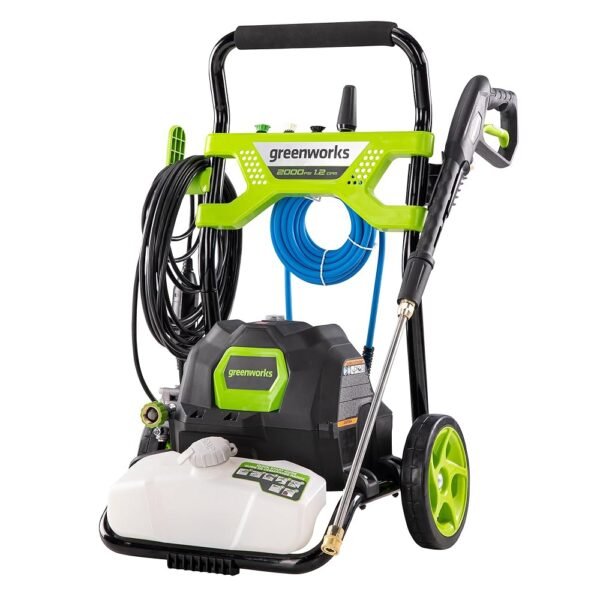
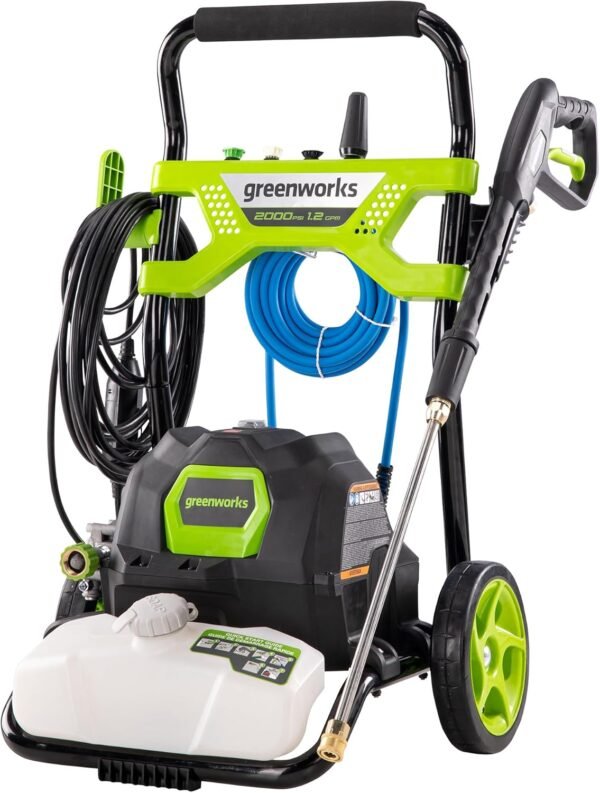
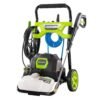
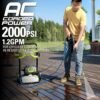
The Greenworks GPW2003 is a corded electric pressure washer built on an open frame, and the listing rates it at 2000 PSI with a flow of 1.2 gallons per minute. Everything in this review comes from the published listing fields, the manufacturer feature bullets and the places where those two disagree. We do not own or operate this machine, so nothing here is a use report.
Who this machine is for and what it settles
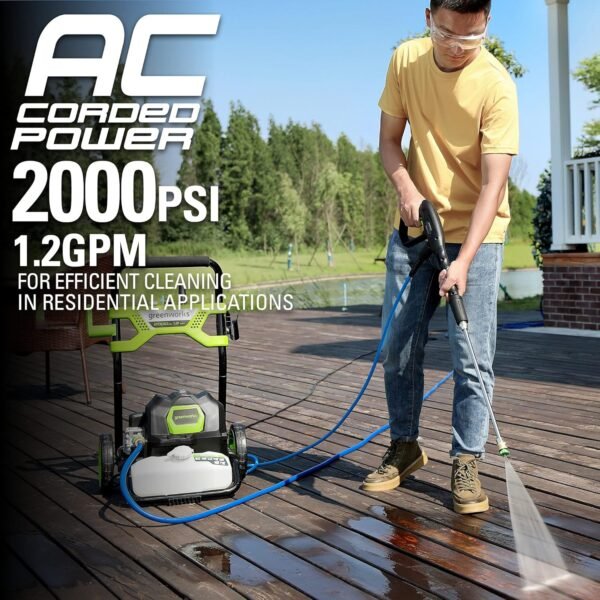
The decision the GPW2003 settles is whether a homeowner can skip a gas unit entirely. At 2000 PSI and 1.2 GPM, the published numbers put it in the middle of the residential electric band. Greenworks describes it in its own bullets as suited to medium duty projects including patio furniture, grills, walkways and vehicles, and that is the honest ceiling of the specification. It is not a driveway stripping machine and it is not a paint preparation machine.
Cleaning power is a function of pressure and flow together, not pressure alone. A common shorthand multiplies PSI by GPM to compare machines, and on that basis the GPW2003 sits well below the gas units in the same catalog. If your work list includes a long concrete driveway, oil staining or a two story exterior, the honest comparison is against a gas machine such as the 3300 PSI DEWALT gas unit reviewed elsewhere on this site, which the listing rates at 2.4 GPM. That is double the flow, and flow is what moves loosened dirt off a surface.
The specifications that matter
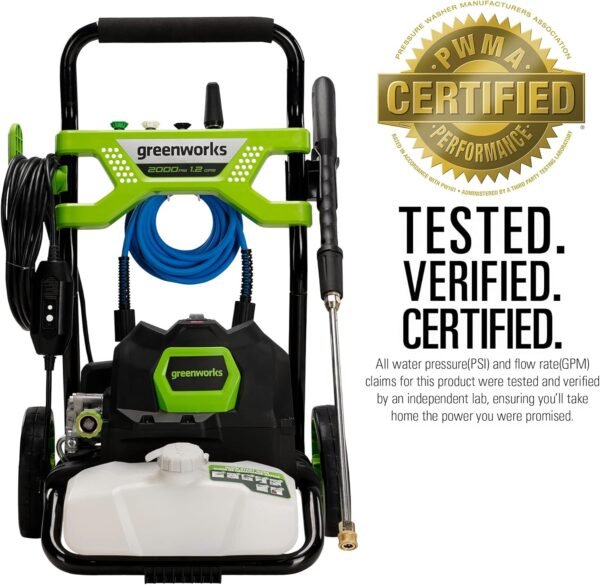
Greenworks publishes a 14 amp motor, a 25 foot high pressure hose and an onboard soap tank that feeds automatically when the soap tip is fitted to the wand. The frame measures 19.29 inches long by 17.32 inches wide by 31.73 inches high. The listing states the unit is rated in accordance with PWMA standards, which is a trade association test protocol for pressure washer performance claims. That is the manufacturer’s statement and a reader who cares about it can check the PWMA certification listing independently.
Where the published data contradicts itself
Two weight figures appear in the same specification block. One field gives 12.6 kilograms and another gives 27.7 pounds. Those are the same mass expressed in two units, so this one is harmless, but it shows the listing is assembled from more than one source. A second field is not harmless. The listing publishes a “Tank Volume” of 1.2 gallons, which is numerically identical to the 1.2 gallon per minute flow rate. A detergent tank that holds exactly one minute of the machine’s own output is implausible, and the far more likely explanation is that a flow figure was copied into a capacity field during import. Treat the soap tank capacity as unpublished until Greenworks states it directly.
The listing also does not publish a power cord length, and it does not publish whether the unit must be plugged into a GFCI protected outlet. Both matter. Cord length decides whether you can reach the far corner of a driveway, and manufacturers of corded electric pressure washers commonly restrict or prohibit extension cord use because voltage drop starves the motor. Confirm both points with Greenworks before ordering if either affects your setup.
Using it correctly
A pressure washer jet is not a strong garden hose. Water at 2000 PSI can penetrate skin and cause an injection injury that looks minor on the surface and is serious underneath. Never aim the wand at a person or an animal, never brace a workpiece with your free hand near the spray path, and wear eye protection because the jet throws grit back at the operator. Keep bystanders and pets out of the working area.
Nozzle selection does most of the work. The narrow tips concentrate the same 2000 PSI into a smaller area and will etch softwood, cut into mortar and strip paint on contact. The wide angle tips spread that pressure across a larger footprint and are the correct starting point for siding, vehicles and painted surfaces. On lap siding, spray downward and across rather than upward, because water driven upward under the laps gets behind the cladding and stays there. Test any new surface on a hidden section first and increase aggressiveness only if the wide tip is not doing the job.
The start and stop system shuts the motor down when the trigger is released, which the listing frames as an energy and pump life feature. In practice it also means the machine is live whenever it is plugged in, so engage the wand safety catch whenever you set it down. If you plan to add a rotating surface cleaner for flat concrete, check the attachment’s flow requirement against the 1.2 GPM this unit delivers, because most surface cleaners are specified for higher flow and will simply spin slowly and clean poorly below their rating. Our review of the Westinghouse PWSC12 surface cleaner attachment covers what those flow ratings mean in practice.
Limits and gaps in the published data
The 2000 PSI figure is published as a maximum pressure. Manufacturers commonly measure peak pressure at initial discharge rather than sustained working pressure, and the listing does not distinguish between the two. Read it as a ceiling, not as what the wand delivers continuously. Greenworks does not publish a separate working pressure figure at all here, which is worth knowing before you compare it against a machine that does.
The customer rating field records 4.4 out of 5 across 1,281 ratings, and the sales rank field places it 70th in the pressure washer category and 13,438th across patio, lawn and garden at the time the data was captured. Ranks move constantly and should be treated as a snapshot. Country of origin is listed as Vietnam and the model number as GPW2003.
What is missing from the listing is as informative as what is present. There is no pump type, no stated duty cycle, no inlet water temperature limit and no maximum inlet pressure. Cold water only is the safe assumption for a residential electric machine unless the manual says otherwise.
How it compares within this catalog
Against its own family, the step up is the Greenworks GPW3001, which carries a higher published pressure on a similar frame concept. Buyers cross shopping brands at this level usually land on the Sun Joe SPX3000 for its dual detergent tanks, or on the CRAFTSMAN CMEPW2100, whose listing publishes a longer cord specification than this one does. If portability matters more than pressure, the RYOBI RY141820VNM is a far smaller unit at a lower published pressure. The wider corded electric pressure washer section lays the published specifications out side by side, and the gas powered section is the place to start if flow rate is your limiting factor.
Who should buy it and who should not
Buy it if your cleaning list is patio furniture, a grill, a walkway, a fence panel and the family car, and you want a machine you can plug in and store on a shelf. Do not buy it if you need to strip a driveway, run a large surface cleaner, or work far from an outlet, because the flow rate is modest and the listing publishes neither a cord length nor an extension cord policy. Confirm the soap tank capacity and the GFCI requirement with Greenworks before you commit.