

Description
What this machine claims and what to check first
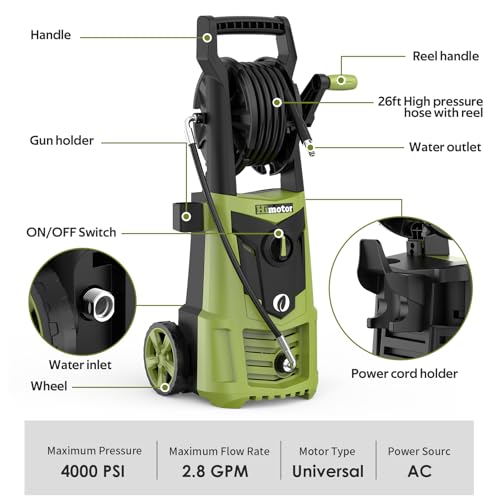
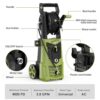
The Himotor S5HM-HP01 is a compact electric pressure washer listed at 4000 PSI and 2.8 GPM from a motor Himotor states is 1800 watts. It weighs 14.5 pounds and measures 10.5 by 8.2 by 17.6 inches, which is a small unit by any standard. Before the accessory list matters, those three numbers need checking against each other.
Hydraulic power is pressure multiplied by flow. At 4000 PSI and 2.8 gallons per minute the water leaving the nozzle would carry roughly six and a half horsepower, or about 4,900 watts. A motor rated at 1800 watts cannot deliver 4,900 watts of output, because no pump exceeds 100 percent efficiency and real pumps lose a significant share to friction and heat. An 1800 watt machine has on the order of 1,500 watts of water power available. The published combination overstates that by nearly three times, and we are naming it rather than repeating the headline.
For scale, the Greenworks GPW3001 we review draws 14 amps, weighs 51.7 pounds and states 3000 PSI, with its claims tested by an independent laboratory under PWMA certification, and it separates a 2.0 GPM maximum from a 1.1 GPM rated flow. A 14.5 pound machine is not carrying the pump and motor that a 51 pound machine carries.
The specifications that are genuinely useful
Setting the headline aside, this listing publishes several things that most of its competitors do not. The maximum inlet water temperature is stated as 104 degrees Fahrenheit, which is the figure that stops people feeding a machine from a hot tap and cooking the seals. A GFCI plug is included, so the ground fault protection travels with the machine rather than depending on the outlet. The unit carries an IPX5 waterproof rating, and Himotor states a two year limited service and parts warranty with a 30 day return.
The reach figures are good for the size: a 26 foot pressure hose and a 35 foot power cord. Himotor also states the machine can either connect to a faucet or draw water from a bucket, which widens where it can be used considerably. An auto stop feature idles the pump when the trigger is released.
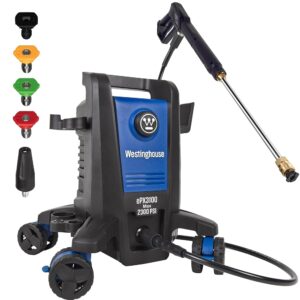
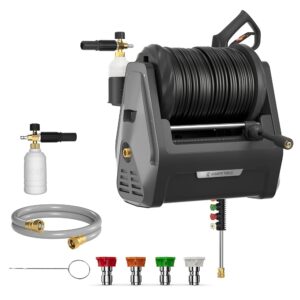
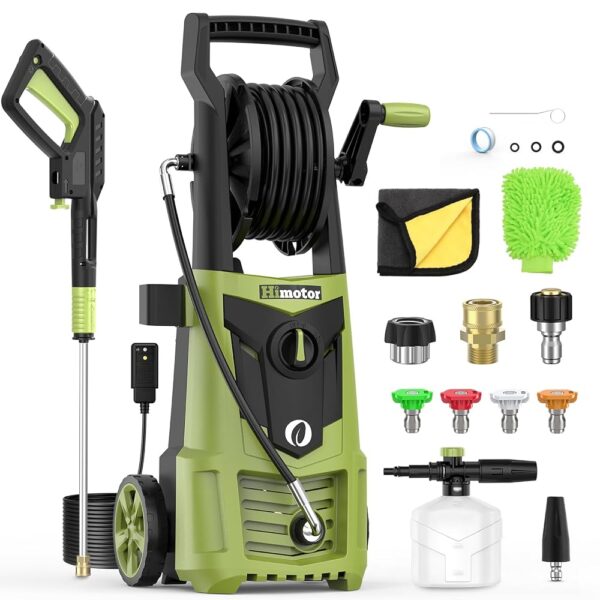
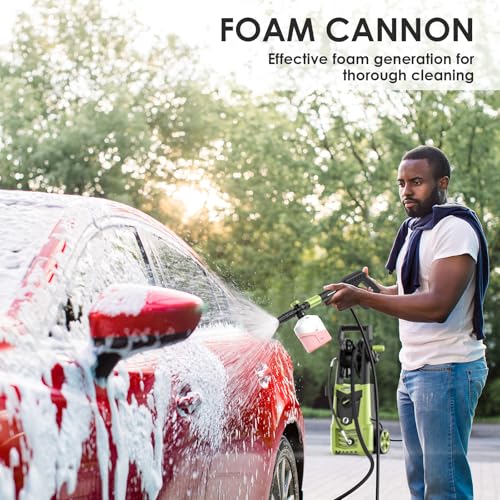
The bundle is unusually complete. Alongside the gun and hose there are four quick connect nozzles at 0, 15, 25 and 40 degrees, a separate turbo nozzle, a foam cannon, a car wash towel, a microfiber wash mitt, a pair of quarter inch quick connect couplings and a roll of PTFE thread tape. Including thread tape is a small thing that says someone expected the fittings to need sealing.
A warning in the manufacturer’s own words
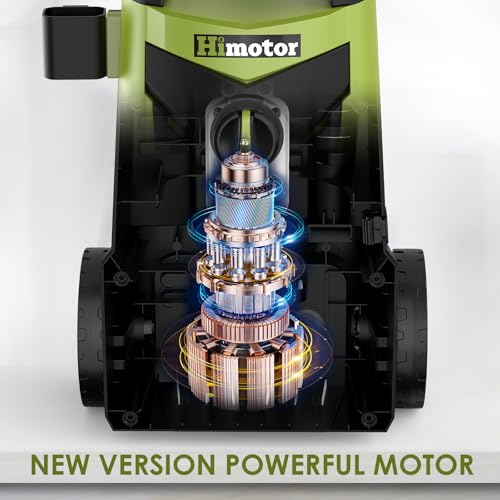
Himotor’s customer service bullet carries an instruction worth quoting in substance. Before connecting to the power supply, the buyer is told to check whether their voltage meets the range in the product manual and to stop using the machine if it does not, and if any motor abnormality occurs during use, to cut the power immediately and contact the company. A voltage compatibility warning on a product sold into a single market is unusual, and it points to the same hardware being distributed across regions with different mains voltages. Read the manual and confirm the voltage range before the machine is first plugged in.
Using it correctly
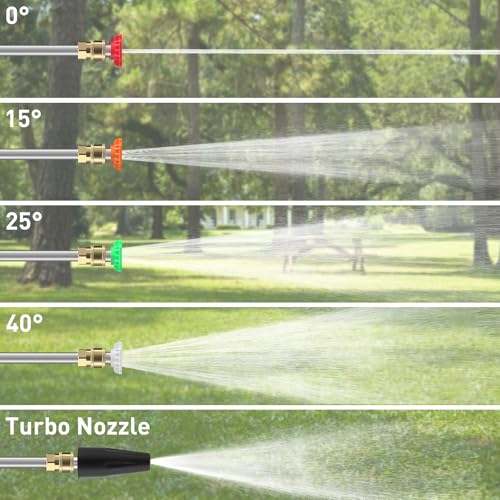
Use the 40 degree tip for siding, vehicle paint and softwood decking, the 25 degree tip as the general purpose choice, and 15 degrees for bonded dirt on hard material. The zero degree tip concentrates everything into a single point and will gouge wood, strip paint and etch concrete. The separate turbo nozzle rotates a narrow jet in a cone, which clears concrete faster and marks softer surfaces just as fast.
A pressure washer jet can force water and surface contaminants through skin, and an injection injury needs immediate medical attention even when the entry wound looks small. Never aim the wand at a person or an animal, never test the spray against your hand, and wear eye protection because grit blasted off a surface returns toward the operator. On exterior walls angle the spray downward and keep working distance, since water driven up behind siding does not drain.
When drawing from a bucket rather than a tap, keep the intake off the bottom so silt is not pulled through the pump, and do not let the pump run dry if the bucket empties.
The published inlet temperature limit is worth acting on rather than noting. Feeding a pressure washer from a hot tap or a solar warmed hose that has been lying in the sun can push the supply past 104 degrees Fahrenheit, and seals and valves in a consumer pump are not built for that. Run the hose off for a few seconds before connecting on a hot day. Similarly, if the machine is stored anywhere that freezes, drain the pump before winter, because water left inside can crack a housing and no warranty covers freeze damage. Neither point appears in the feature bullets, though the inlet figure at least gives you the number to work from.
Test every tip on an inconspicuous corner before working across a full surface. The damage a narrow tip does to wood, paint or a decal is not reversible, and starting further back than seems necessary costs nothing.
Limits and gaps in the published data
The product title describes a power washer with a hose reel, but no hose reel appears anywhere in the feature bullets or the specification block. A hose reel is a physical component that would be obvious in the description, and its absence from everything except the title is worth naming.
The description field is empty, so everything above comes from the title and the six feature bullets, one of which is a Spanish translation of the customer service bullet rather than new information. Not published: the amperage draw, the required circuit rating, the required supply pressure and flow, the pump type, the foam cannon capacity, or the extension cord policy. There is no UPC in the record.
Country of origin is China, the model is S5HM-HP01, and Amazon showed a rating of 4.1 out of 5 across 314 ratings at capture, ranked 5,857th in Patio, Lawn and Garden and 32nd in pressure washers.
Alternatives worth comparing
The same brand’s other machine is covered in our Himotor S5HM-VC01 review. The same pattern of a large headline pressure figure on an 1800 watt motor appears on the Fengrong review and the Le Hao Tool review, both at 5000 PSI, and on the REAPP review at 3000 PSI. Reading them together makes the pattern across the electric pressure washer category obvious.
Who should buy it and who should not
Buy it if you want a small machine with a genuinely complete accessory bundle, a published inlet temperature limit, a GFCI plug and the ability to draw from a bucket, and you set your expectations from the 1800 watt motor rating rather than the 4000 PSI headline. Do not buy it expecting a hose reel on the strength of the title, and do not plug it in before confirming the voltage range in the manual, since the manufacturer specifically asks buyers to check.