Description
Who this machine is for and what the numbers claim
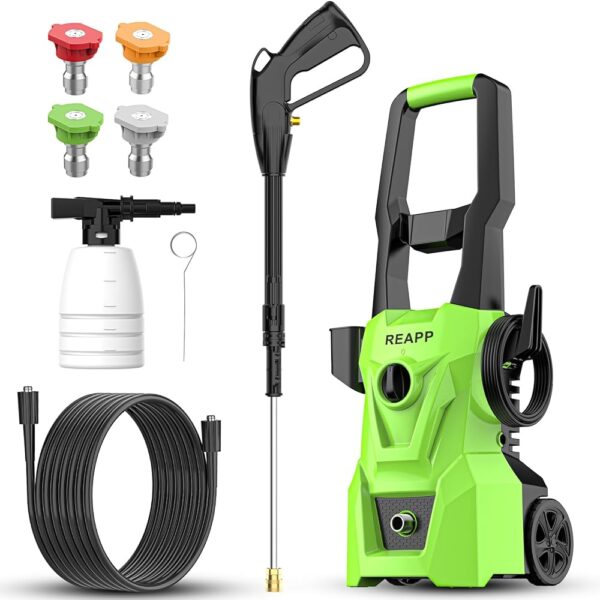
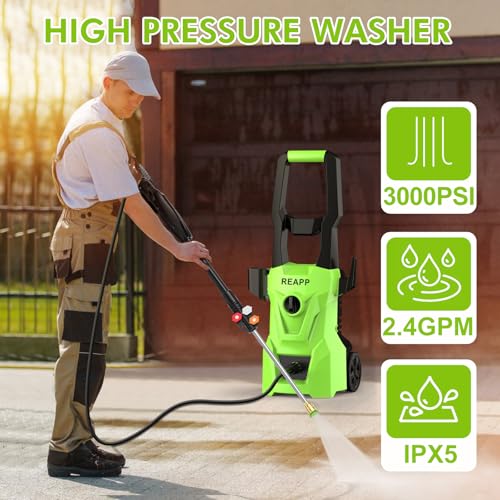
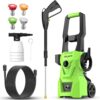
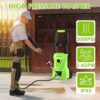
The REAPP REAPP1001 is a compact two wheel electric pressure washer sold on a 3000 PSI headline with 2.4 GPM of flow, from a motor the manufacturer states is 1800 watts. It is a small unit, listed at 14.82 pounds and 10.24 by 10.24 by 17.32 inches, which is roughly the footprint of a large bucket. The buyer it is aimed at wants a real machine that stores on a shelf rather than occupying floor space.
Before the features, the headline needs a check. Hydraulic power is pressure multiplied by flow, and 3000 PSI at 2.4 gallons per minute works out to roughly four horsepower, or about 3,100 watts of water power. A motor rated at 1800 watts cannot produce 3,100 watts of output, because no pump exceeds 100 percent efficiency and real pumps lose a meaningful share to friction and heat. The published pressure, flow and motor rating are not compatible, and the overstatement is roughly a factor of two. We are naming that rather than repeating the headline.
What a comparison shows
The useful benchmark is a machine that publishes independently tested figures. The Greenworks GPW3001 we review draws 14 amps, weighs 51.7 pounds, states 3000 PSI, and separates its 2.0 GPM maximum from its 1.1 GPM rated flow, with those claims tested by an independent lab under PWMA certification. The Sun Joe SPX3000-XT1 review covers a 14.9 amp machine whose certified rated figures are 2200 PSI at 1.1 GPM.
Both of those are near the ceiling of what a 120 volt household circuit supports, both weigh three or four times what this machine does, and neither claims 2.4 GPM at 3000 PSI. Weight is a reasonable proxy in this category, because the pump, the motor and the frame are where the mass goes. A 14.82 pound machine is not carrying the same hardware as a 51 pound one.
The specification that is simply swapped
The hose length field in the specification block reads 29.5 feet. The fourth feature bullet says something different and more specific: a 16.5 foot pressure hose and a 29.5 foot power cord. Read together, the 29.5 foot figure belongs to the power cord, and the high pressure hose is 16.5 feet. The two values have been swapped somewhere in the import, and the shorter hose is the one that matters in use, because it sets how far you can work from the machine before moving it.
That distinction is worth stating plainly. A 16.5 foot hose is short by the standards of this category, where 20 to 25 feet is normal. Combined with a 29.5 foot cord, the working radius is set by the hose rather than by the electrical reach, so the machine has to be moved more often than the cord length suggests.
What comes with it and how to use it correctly
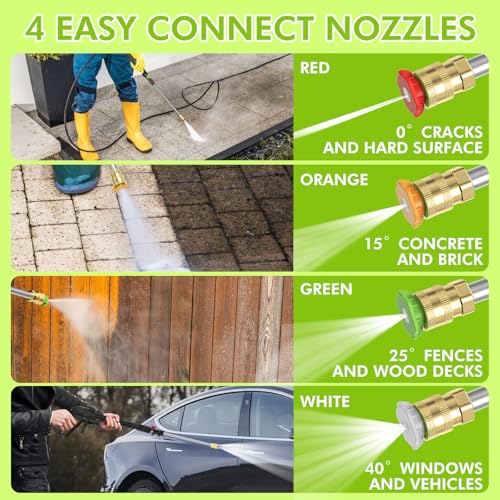
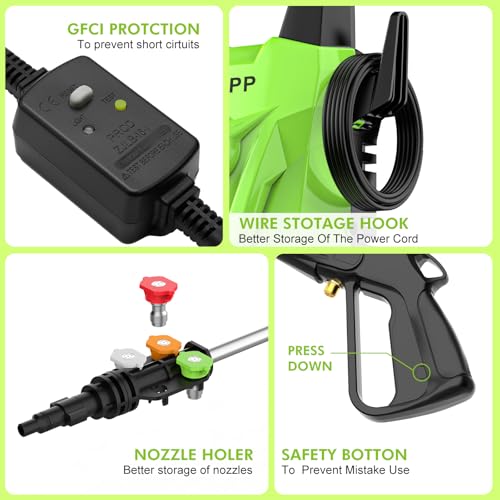
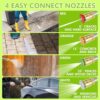
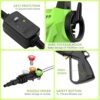
The kit includes four quick connect metal spray nozzles at 0, 15, 25 and 40 degrees and a foam cannon. REAPP states a Total Stop System that shuts the pump off when the trigger is released, along with overload and overheating protection for the pump. Assembly is described as taking minutes, and the two wheel design is meant to keep the unit stable when parked.
On nozzle choice, use the 40 degree tip for siding, vehicle paint and softwood decking, the 25 degree tip as the general purpose angle, and 15 degrees only for bonded dirt on hard material. The zero degree tip concentrates the entire flow into a single point and will gouge wood, strip paint and etch concrete. Metal nozzle bodies are a real advantage over plastic, since they survive being dropped on concrete.
A pressure washer jet can force water and surface contaminants through skin, and an injection injury needs immediate medical attention even when the entry wound looks small. Never aim the wand at a person or an animal, never test the spray against your hand, and wear eye protection because grit blasted off a surface returns toward the operator. On exterior walls, angle the spray downward and keep working distance so water is not driven up behind the siding. Squeeze the trigger after shutdown to release the pressure still held in the hose before disconnecting a fitting.
Two more habits are worth the small effort they cost. Test every tip on an inconspicuous corner before working across a full surface, because the damage a narrow tip does to wood, paint or a decal is not reversible. And where a machine is stored somewhere that freezes, drain the pump before winter, since water left inside can crack a housing and no warranty covers that. Neither of those is mentioned anywhere in this listing, which publishes no storage or winterizing guidance at all.
Limits and gaps in the published data
The power source field reads ac_dc, which cannot be right for a corded machine with a mains power cord, and the description field is completely empty, so everything above comes from the title and the five feature bullets. Not published: the amperage draw, the required circuit rating, whether a GFCI protected outlet is required, the extension cord policy, the maximum inlet water temperature, the required supply pressure and flow, the pump type, the foam cannon capacity, or the warranty term.
The rating history is thin and the rank is not. Amazon showed 4.5 out of 5 across just 69 ratings at capture, while placing the listing 3,174th in Patio, Lawn and Garden and 19th in pressure washers. A 19th place category rank on 69 ratings means the listing is selling faster than its review history has accumulated, which is a reason to treat both numbers cautiously rather than as confirmation. The manufacturer is listed as Hangzhou Yongsheng Technology, country of origin is China, the model is REAPP1001 and the UPC is 796647567296.
Alternatives worth comparing
The same pattern of a large headline pressure figure paired with an 1800 watt motor appears repeatedly in the electric pressure washer category. The Fengrong review and the Le Hao Tool review both advertise 5000 PSI on the same motor rating, which is a larger overstatement than this one.
For a machine in the same broad size class with published certification, the Greenworks GPW2300 review covers a PWMA certified unit at 2300 PSI with a 35 foot cord and inline GFCI.
Who should buy it and who should not
Buy it only if you want a very small machine and you set expectations from the 1800 watt motor rating rather than from the 3000 PSI headline, since those two figures are not compatible with 2.4 GPM. Do not expect a 29.5 foot high pressure hose, because that figure is the power cord and the hose is 16.5 feet. Confirm the amperage, circuit and GFCI requirements in the manual before plugging it in, since none of them appear in the listing.