



Description
Who the AQESO A01-BL is for, and what it settles
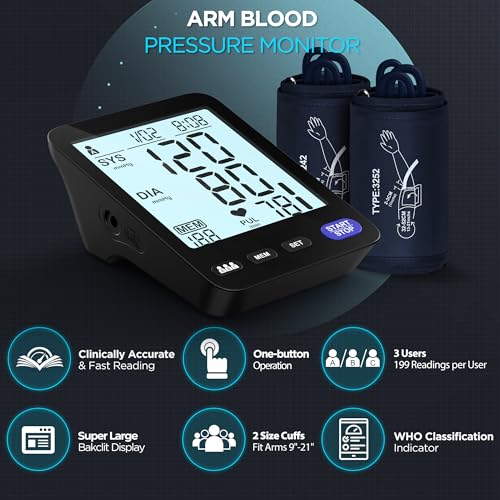
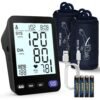
Three user profiles, 199 readings each, and two cuffs covering 9 to 21 inches of upper arm. That combination puts this machine at the top of the catalog for households rather than individuals: three separate records, close to six hundred stored readings, and enough cuff coverage that three differently built adults can share one device without anyone compromising on fit.
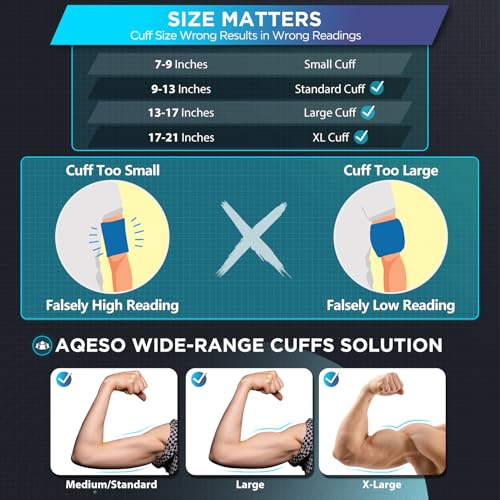
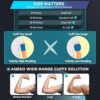
Cuff fit is the largest variable a home user controls. A band that has run out of adjustment, or one so oversized it cannot lie flat, produces wrong numbers on a monitor that is working exactly as designed. A device that supplies two sizes rather than selling the second one separately is addressing the right problem.
The device measures and records. It does not diagnose, it does not replace professional medical care, and every reading is one input for the clinician who manages your health.
The specifications that matter
The two cuffs
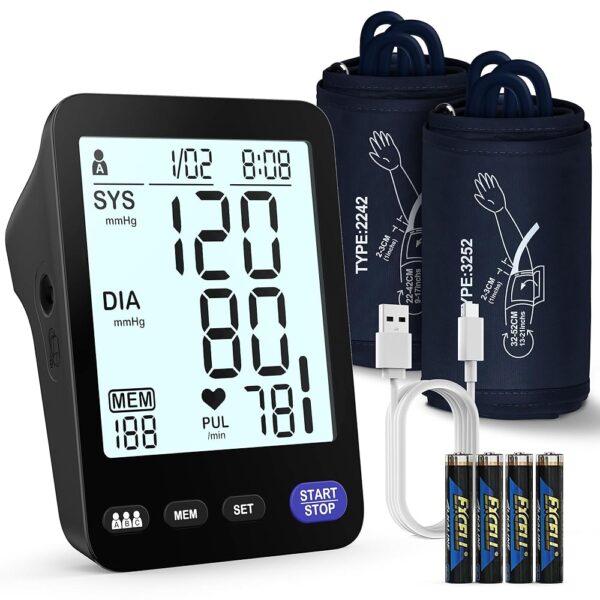
A medium and large band at 9 to 17 inches and an extra large at 13 to 21 inches, both fitted with a D-ring so they can be tensioned one handed. The ranges overlap between 13 and 17 inches, and where they overlap the smaller band that still closes with room to spare is usually the better choice, because excess length is harder to lay flat.
Measure the midpoint of your upper arm, halfway between shoulder and elbow, with a soft tape and the arm relaxed at your side, before assuming which cuff you need. Note that neither band goes below 9 inches, so this is not a machine for a very slim arm.
Memory and users
Three profiles at 199 readings each. For a household of three that is roughly three months of daily measurements per person before anything is overwritten, and it is the deepest per person storage of any machine in this part of the catalog after AQESO’s own U80B.
Display and power
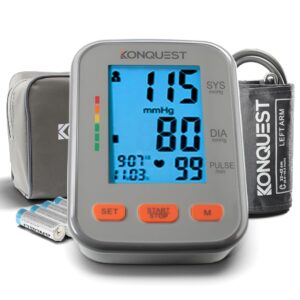
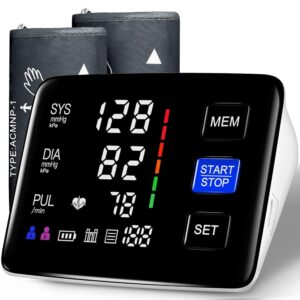
A 5 inch LCD with a soft white backlight and one touch operation. Power comes from four AAA batteries, supplied, or a USB Type-C cable, and AQESO states plainly that the 5 volt 1 amp wall plug is not included. That is the kind of clarification most sellers leave out, and it means you should plan on supplying your own plug if you intend to run the machine from the mains.
The claim about the classification bar
The opening bullet describes the World Health Organization classification bar on the screen as helping you understand your readings with confidence. That is the one line in this listing we will not pass along.
A classification bar sorts a single number into a band. It does not account for your history, your medication, the time of day, how you slept, or anything else a clinician weighs when interpreting a set of readings. It is a display feature, not an interpretation, and a colored bar is not a reason to feel confident or to feel alarmed. What a run of readings means for you is a question for a clinician who knows your circumstances.
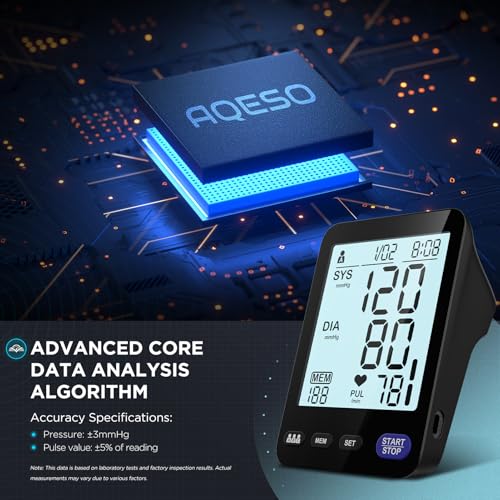
AQESO also describes advanced oscillometric technology delivering accurate, consistent results. Oscillometric measurement is simply the method every automatic home monitor uses, so that phrase describes the category rather than distinguishing this device. No validation protocol is named, no clearance number is quoted, and no accuracy tolerance is published anywhere in the listing. We make no accuracy claim about this device in our own voice, and validation status can be looked up independently through the lists that medical societies publish.
Contradictions and gaps
The contents field is corrupted, holding a block of raw page script left behind by the import with the real packing list appended. Read out of that mess, it names a user manual, the medium and large cuff, the machine, the extra large cuff, a USB Type-C cable and four AAA batteries. A feature bullet then adds a carrying case that appears nowhere in the contents list. Confirm the packing list with the seller if the case matters.
The listed weight is 8 ounces, given elsewhere as half a pound, which is the same figure. For a machine plus two cuffs plus four batteries that seems light, so treat it as describing the base unit rather than the boxed kit.
No irregular heartbeat flag is described, no averaging mode is mentioned and no positioning check is named. Several cheaper machines in this catalog publish all three, and for a device otherwise this well equipped their absence is worth noting before you order.
One further thing worth knowing. The manufacturer named on this listing is ShenZhen GoodlyMed Technology, while AQESO’s other machines in this catalog name Shenzhen Urion Technology. One brand across two factories is ordinary in this category, and it means that experience with one AQESO device does not necessarily transfer to another, even where the feature lists look similar. Our AQESO U80B three cuff review and our AQESO U80BH review cover machines from the other factory.
Using it correctly
Rest for five minutes before measuring, sitting with your back supported, both feet flat on the floor and legs uncrossed. Bare the upper arm rather than pushing a sleeve up, since a rolled sleeve acts as a second cuff. Place the lower edge of the band about an inch above the elbow crease with the artery marker over the inside of the arm, feed the end through the D-ring and pull until two fingers slide underneath with mild resistance. Rest the arm on a table so the cuff sits level with your heart, and stay quiet and still.
With three users and two cuffs in one household, label the bands and agree who uses which. Confirm the correct profile before pressing start, because a mixed log across 199 slots cannot be untangled afterwards. Write readings down with dates and times regardless, since a page of dated numbers is what a clinician can scan in seconds.
Alternatives worth comparing
For the same two cuff arrangement with 500 readings per user across two profiles, read our AQESO U80B two cuff review. If any arm in the household is above 21 inches, the KIKEANG BP362A ships a band reaching 55 centimeters. For a single cuff machine with 199 readings for two users, our CareLiving monitor review is the comparison. The full home blood pressure monitor section lists them with cuff ranges attached.
Who should buy it, and who should not
Buy the A01-BL if three people will share one machine, if their arms fall between 9 and 21 inches, and if deep separate records matter more to you than extra features. Skip it if anyone needs a band below 9 inches, if you want an irregular heartbeat flag or an averaging mode, or if you were reading the classification bar as something that explains your readings. It does not, and that explanation is a clinician’s to give.