Description
Who the CareLiving monitor is for, and what it settles
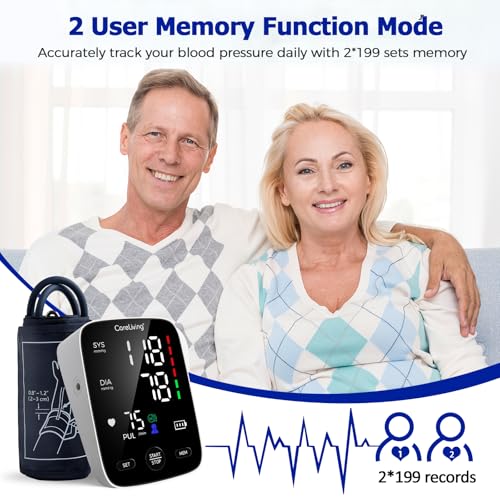
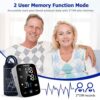
The headline specification here is memory. Two user profiles hold 199 readings each, for 398 in total, which is the deepest storage of any single cuff machine in this part of the catalog. If a clinician has asked for a long run of home readings, or if two people are each building a record over months rather than weeks, that number is the reason to look at this device.
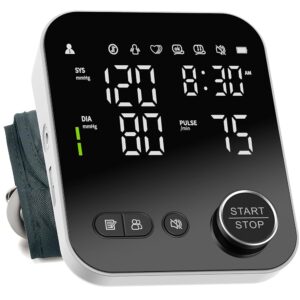
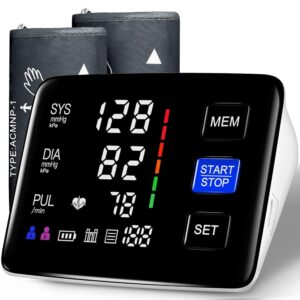
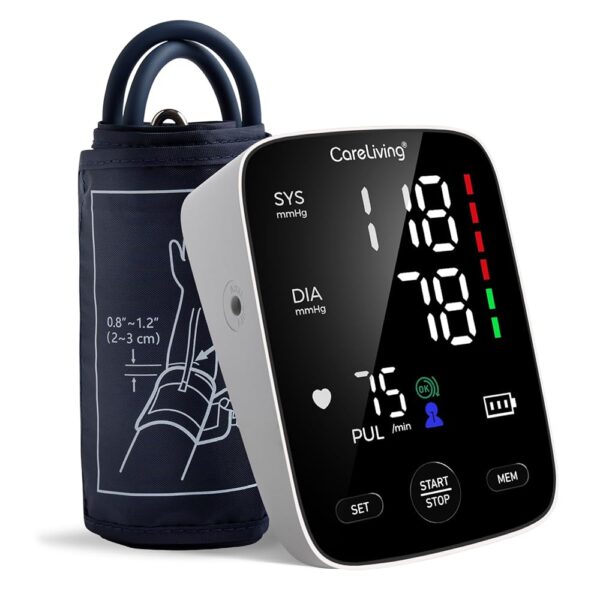
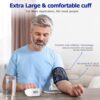
Around it sits a straightforward package: a wide range cuff, a large LED backlit screen angled for viewing, one button operation, and a storage bag. There is no app, no Bluetooth and no export, so records live on the device and on paper.
The device measures and stores. It does not diagnose, it does not replace professional medical care, and the readings it produces are for the clinician who manages your health to interpret rather than for you to act on alone.
The specifications that matter
Cuff range
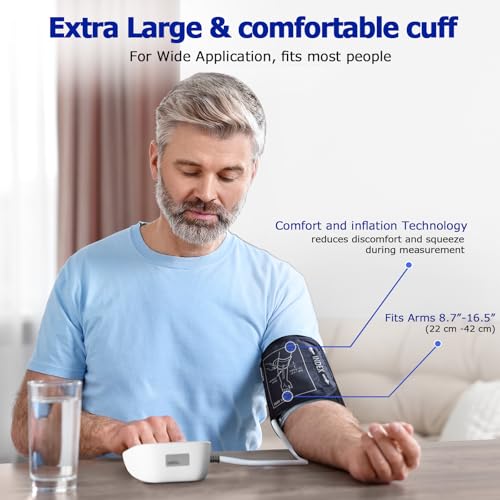
Published as 8.7 to 16.5 inches, given as 22 to 42 centimeters, in both the title and the feature bullets, with the conversions correct. That covers most adult upper arms.
Measure the midpoint of your upper arm with a soft tape, arm relaxed at your side, and buy on that number. A band that has run out of adjustment, or one so oversized it cannot lie flat, changes the numbers on a monitor that is working exactly as designed.
Worth knowing before you commit: CareLiving sells replacement bands, but neither of them matches this monitor’s own range at the lower end. Its small band, covered in our CareLiving small cuff review, stops at 24 centimeters, and its extra large band, in our CareLiving XL cuff review, starts at 32. If your arm measures between 24 and 32 centimeters and the supplied cuff eventually wears out, you will be buying from someone else. Our Luanerl medium cuff review covers that gap.
Memory and users
199 readings per user across two profiles, stored separately. Two figures in the listing agree on this, which is a lower bar than it should be but one many products here fail. At twice daily measurements, 199 is roughly three months per person before anything is overwritten.
Display and speed
A large LED backlit screen with bold type, described as angled for a comfortable viewing position, which is a small design decision that matters if the device sits on a table below eye level. CareLiving states a measurement takes 60 seconds, which is slower than the 30 second figure most competing machines quote. That is not a defect, and a slower inflation is often a gentler one, but it is worth knowing if you are used to a faster device.
Power, and a claim we have removed
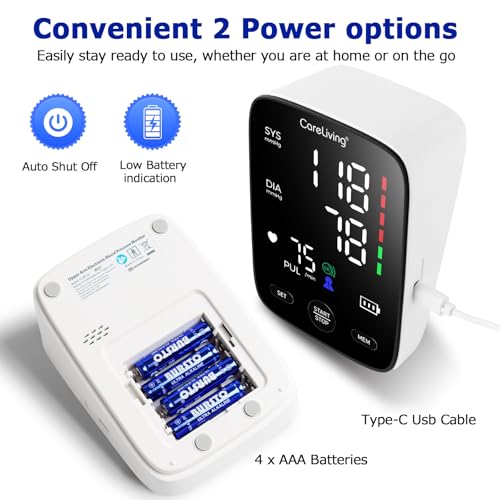
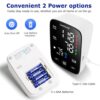
The power source field reads battery powered. No battery type is given, no count is given, and it is not stated whether cells are included. Our own previous description of this product claimed dual power from batteries or USB-C charging. Nothing in the listing supports that, so the claim has been removed rather than carried forward. If mains or USB power matters to you, confirm it with the seller before ordering.
What the listing leaves out or gets wrong
The included components field lists the blood pressure monitor and nothing else. Not the cuff, without which the machine is unusable, and not the storage bag that the product title advertises. That field is plainly incomplete rather than a description of what arrives, but ask for a packing list if the bag is part of why you are buying.
The listed dimensions are 2 by 2 by 2 inches, given twice, alongside a listed weight of 15.84 ounces. A pound of equipment does not fit in a two inch cube. That is a placeholder rather than a measurement, so if you are checking the machine against a shelf or a drawer, ask.
There is no model number anywhere in the listing. Not in the title, not in a specification field. For a device you may later need a replacement cuff or support for, that is a genuine inconvenience and the first thing to ask the seller for.
No irregular heartbeat flag is mentioned, no averaging mode is described and no positioning check is named. Several machines at this level publish all three, and their absence from a listing this detailed in other respects is worth weighing.
The accuracy claim
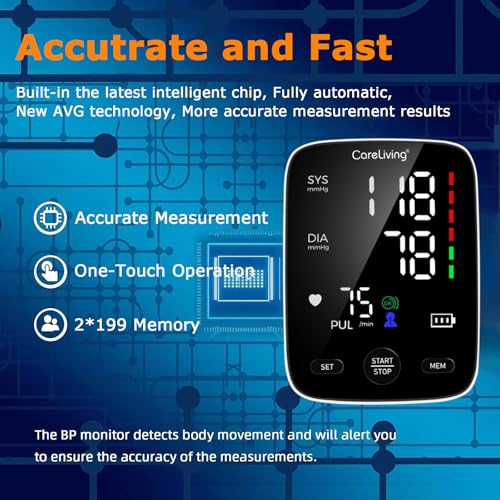
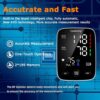
CareLiving states that each monitor is individually calibrated before delivery and that high precision chips and state of the art algorithms ensure the accuracy of each machine. Individual calibration is a more specific claim than most listings make, and if it is true it is meaningful, since batch calibration is the norm at this price.
It is still the manufacturer’s claim. No validation protocol is named, no clearance number is quoted, and no accuracy tolerance is published, so there is nothing here that can be checked and nothing we will assert in our own voice. Validation status for any home monitor can be looked up independently through the lists that medical societies publish, and that lookup is worth more than a sentence about algorithms.
Using it correctly
Rest for five minutes before measuring, sitting with your back supported, both feet flat on the floor, legs uncrossed. Bare the upper arm rather than pushing a sleeve up, since a rolled sleeve acts as a second cuff. Place the lower edge of the band about an inch above the elbow crease with the artery marker over the inside of the arm, tightened so two fingers slide underneath with mild resistance, and rest the arm on a table so the cuff sits level with your heart. Stay quiet and still until the result appears.
Confirm which user profile is selected before pressing start. With 199 slots each, a mixed log is a large mess and there is no way to separate it afterwards. Take readings at consistent times of day rather than at random, because a run of measurements taken at scattered times is much harder to read as a pattern.
Even with this much on device memory, keep a short written record with dates and times. A page of dated readings is what a clinician can scan in seconds, and 398 stored values on a small screen are not.
Alternatives worth comparing
For deeper storage still, and cuffs supplied in three sizes rather than one, read our AQESO U80B review, which holds 500 readings across three profiles. For a plainer machine with a published model number, our SDUNW upper arm monitor review is the comparison. The full home blood pressure monitor section lists them with cuff ranges attached.
Who should buy it, and who should not
Buy this monitor if two people need genuinely deep separate records, if both arms measure inside 22 to 42 centimeters, and if a large angled screen is what will make it usable. Skip it if you need a model number for future parts, if you want an irregular heartbeat flag or an averaging mode, or if you need the power arrangement settled before you order. And whatever 398 readings eventually show, that pattern is a clinician’s to interpret.