



Description
Who the Cosmama monitor is for, and what it settles
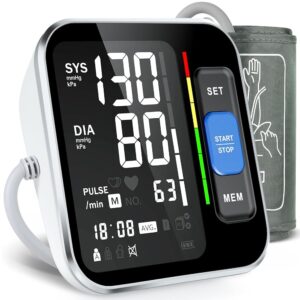
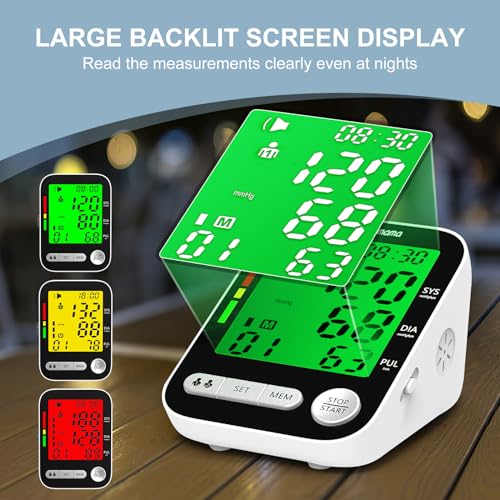
Cosmama has built this upper arm monitor around one idea: make the screen big enough that nobody has to lean in. The listing gives a 4.2 inch LCD with oversized numerals, large buttons and a spoken result, on a rechargeable machine that runs about 30 days per charge. If the person who will actually use the device has poor near vision, that combination is worth more than any feature list of extras.
It is a self contained machine. There is no app, no Bluetooth and no export in the published data, so records live on the device and on paper. For a household that wants a monitor and not a project, that is the right shape.
What follows describes hardware. This device does not diagnose anything, it does not replace professional medical care, and the numbers it produces are for the clinician who manages your health to interpret.
The specifications that matter
Cuff range
Cosmama publishes 8.6 to 16.5 inches, given as 22 to 42 centimeters, and the same figures appear in both the feature bullets and the structured band size field. The conversions check out. The listing also does something unusually sensible for this category and tells you outright to confirm the size fits you before buying.
Do exactly that. Measure the midpoint of your upper arm with a soft tape, arm relaxed at your side, and buy on that number rather than on a clothing size. A cuff that has run out of adjustment, or one so large it cannot be seated flat against the arm, changes the numbers on a monitor that is functioning correctly. No alternative band is offered here, so an arm outside 22 to 42 centimeters means a different machine.
Display and voice
A 4.2 inch LCD with large font, big buttons and a live voice broadcast of the result. The listing also describes a three color backlight. That last feature needs care: a colored backdrop sorts a number into a band, and Cosmama’s copy says it helps you know your health condition directly. It does not. A color is a classification of a single reading, not an assessment of your health, and what a reading means for you is a question for a clinician who knows your history.
Battery
A built in lithium cell stated to run about 30 days per charge. The listing does not publish a capacity, a charge time, or the number of measurements that 30 days assumes, and no charging cable appears in the structured contents field, which lists only a cuff and a kit. For a device sold on being rechargeable, the missing cable is worth confirming with the seller before ordering.
Size and weight
Listed dimensions are 4.33 by 3.74 by 6.3 inches, and the listed weight of 1.01 pounds agrees with the 458 gram figure given elsewhere in the same listing. Two fields agreeing is a small mercy here.
What the listing leaves out
The most important gap is memory. The title advertises dual user modes and the first bullet says two users can track and store readings separately. Nowhere does the listing say how many readings each user gets. Not in the bullets, not in the specifications, nowhere. A dual user monitor whose storage depth is unknown is hard to compare against machines that publish 90, 99, 120 or 500 per person, and if you intend to keep a log over months rather than weeks that number is the one that decides whether the device is fit for the job. Ask before ordering.
There is also no model number anywhere in the listing. Not in the title, not in a specification field. If you later need a replacement cuff or a service query, you will be starting from a photograph, which is worth knowing now rather than in two years. Buyers who want a machine with a named model and published memory should compare against the Abesee upper arm monitor or the SDUNW upper arm monitor.
Cosmama describes an advanced chip for minimal error and a reading delivered in 30 seconds. Those are manufacturer statements. No validation protocol is named, no clearance number is quoted, and no accuracy tolerance is published anywhere in the data, so there is nothing here for us to attribute beyond the claim itself, and we make no accuracy claim about this device in our own voice. Validation status can be checked independently through the lists that medical societies publish, and doing so is worth more than reading marketing copy, including ours.
One field in the listing reads Material Feature: recycle. That is not a specification of anything, and it is the sort of import artifact this catalog is full of. We are naming it rather than pretending it means the product is made from recycled material, because nothing in the listing says that.
Using it correctly
Rest for five minutes before you measure, sitting with your back supported, both feet flat, legs uncrossed. Bare the upper arm rather than pushing a sleeve up, since a rolled sleeve acts as a second cuff. Put the lower edge of the band about an inch above the elbow crease with the artery marker over the inside of the arm, tightened so two fingers slide under with mild resistance, and rest the arm so the cuff sits level with your heart. Stay quiet and still until the result appears.
Because the memory depth is unknown, write every reading down with the date and time from day one rather than trusting the device to hold a long history. If it turns out to store 30 readings per user, a paper log will be the only complete record you have, and it is the format a clinician can scan in seconds anyway.
Confirm which user profile is active before pressing start. Charge on a routine rather than waiting for a warning, since a flat monitor on the morning of an appointment is a gap in the record you cannot fill later.
Alternatives worth comparing
For a rechargeable machine with a much longer claimed charge interval and a published cuff range, read our Greetmed AES-U522 review. The ZIQING rechargeable monitor is the other close comparison, with a longer battery claim but far weaker cuff data. If a compact one piece design appeals more than a big screen, the Glucoracy all in one monitor takes a different approach entirely. Our home blood pressure monitor section lists them together with cuff ranges attached.
Who should buy it, and who should not
Buy the Cosmama if a large clear screen and a spoken result are the reasons a monitor will get used in your household, if your arm measures inside 22 to 42 centimeters, and if you are willing to keep a paper log rather than rely on unspecified memory. Skip it if you need a stated storage depth, if you want a model number for future parts, or if you were reading the color backlight as a health assessment. It is a color, and the assessment belongs to your clinician.