


Description
Who This Monitor Is For and What It Settles
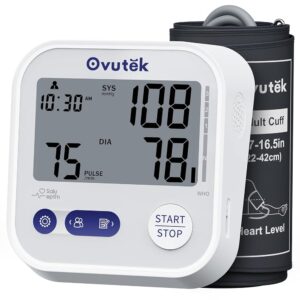
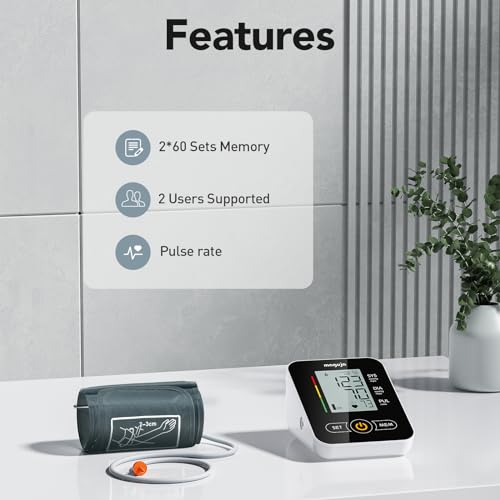
This is the 2024 maguja RN-032A listing, an upper arm blood pressure monitor with a single measurement button, a wrap cuff, and no phone connection of any kind. It is built for a household that wants one straightforward device on the shelf, operable by someone who will never open an app, and it settles one question only: whether a plain automatic monitor with two-user memory does the job for you, or whether you need a device that keeps a shareable record.
Say the important part before the specifications. This review describes a device, not a condition. A home blood pressure monitor does not replace professional medical care, it does not diagnose anything, and nothing written here interprets a reading or tells anyone what their numbers mean. Take the readings, keep the log, and let a clinician do the assessment.
The Specifications That Matter
Cuff circumference decides whether this monitor can work for you, because a cuff that is too small or too large produces wrong readings on hardware that is behaving perfectly. On this listing the number appears in exactly one place: a packing list bullet stating the included cuff measures 8.66 to 16.54 inches. There is no band size entry in the structured specification block for this ASIN at all, and no cuff range in the stored product attributes. One mention in one marketing bullet is thin documentation for the single most consequential figure on the page.
Measure the bare upper arm at the midpoint between shoulder and elbow before ordering. If the measurement is close to either end of that span, or above roughly 16 inches, do not buy on the strength of a bullet point. A separately documented cuff such as the Omron wide range replacement cuff publishes its range properly, and starting from a cuff that fits and working back to a compatible monitor is the sounder order of operations.
Power, display and what arrives in the box
The specification block says the unit is battery powered and the display is an LCD. The packing list then includes a USB cable, and no battery count, type or life appears anywhere. Battery powered plus a USB cable in the box is not a contradiction on its own, but the listing never says whether the USB port charges an internal cell, runs the device directly, or does something else, and it never says how many cells of what type the unit takes. Buyers should assume nothing here until the seller confirms it.
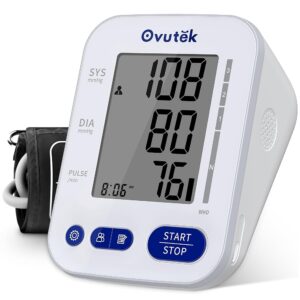
The included components are a cuff, the monitor, a bag and an instruction manual. Package dimensions are 6.1 by 4.69 by 3.82 inches at 14.39 ounces, and no separate figure for the monitor alone is published. No digit height is given, so anyone shopping for a large legible screen has only the product photographs to judge from, which is a weak basis for that particular decision.
Memory, Averaging and the Classification Bar
Memory holds 120 measurements as two banks of 60, kept separately per user. The device also computes an average of the three most recent readings automatically. Averaging is the more useful of the two features: single readings scatter, and a stable three-reading average makes a home log far more meaningful as a record.
The listing also advertises a blood pressure classification function, and states it follows World Health Organization and International Society of Hypertension guidance dated 1999. The listing frames that feature as a convenient way for the buyer to judge whether their own blood pressure is normal. That framing is the seller’s and it is not one we adopt. An indicator on a home monitor compares a number to a threshold stored in the firmware. It does not diagnose, it does not screen, and it is not a clinician. The cited guideline is also more than twenty-five years old and has been revised many times since it was issued, so the thresholds in the device may not correspond to anything a clinician currently uses. Record the numbers and disregard the bar.
Using It Correctly
Fit the cuff to the bare upper arm rather than over a sleeve, with the tube running down the inside of the arm toward the palm and the lower edge roughly an inch above the elbow crease. Snug, not tight. Sit with the back supported and both feet flat on the floor, rest the arm so the cuff is level with the heart, and stay still and silent through inflation and release. Take readings at the same times of day, use the same arm each time, and give yourself several quiet minutes before starting rather than measuring straight after activity.
Set the user slot before your first reading so the two memory banks stay clean. If more than two people in the household will use it, the memory design breaks down and a monitor with more banks, or a connected model such as the Etekcity TMB-1583-BS, is a better fit.
Limits and Gaps in the Published Data
The description field is empty, so five bullets and a short specification table carry the entire technical case. Absent from the data: any measurement range for pressure or pulse, any tolerance, any accuracy figure, any validation protocol, any regulatory clearance claim, any irregular heartbeat detection, any battery specification, and any digit height. The manufacturer of record is Ningbo Ranor Medical Science and Technology.
There is also a catalog level oddity worth knowing. The same RN-032A model designation appears on more than one product page here, including an earlier maguja RN-032A listing from 2022 and a third maguja RN032A listing. Their specification blocks do not agree with each other. The 2022 listing publishes a band size of 8.7 to 17 inches and calls the unit corded electric; this one publishes no band size at all and calls it battery powered. Same model number, different published facts, which is a reason to confirm the exact configuration with the seller rather than assume the pages are interchangeable.
The safety statement is not a footnote. This device produces numbers and stores them. It does not replace professional medical care, it does not diagnose, and no part of this review is advice about anyone’s health or treatment.
Alternatives Worth Comparing
If you want the same one-button simplicity with a fuller published specification, the Greater Goods 0663 documents more of what this listing leaves out. If the priority is a cuff you can trust rather than a brand, pair a documented cuff with any compatible monitor and take the guesswork out. The broader selection, from single-button units to app-connected models, sits in our blood pressure monitor category.
Who Should Buy It, Who Should Not
Buy it if your upper arm falls comfortably inside 8.66 to 16.54 inches, two users and 120 stored readings covers your household, and you want the least complicated device on the shelf. Skip it if you need the cuff range confirmed somewhere more solid than a single bullet, if the power arrangement needs answering first, if you want a published accuracy or validation figure, or if more than two people will share the device.