


Description
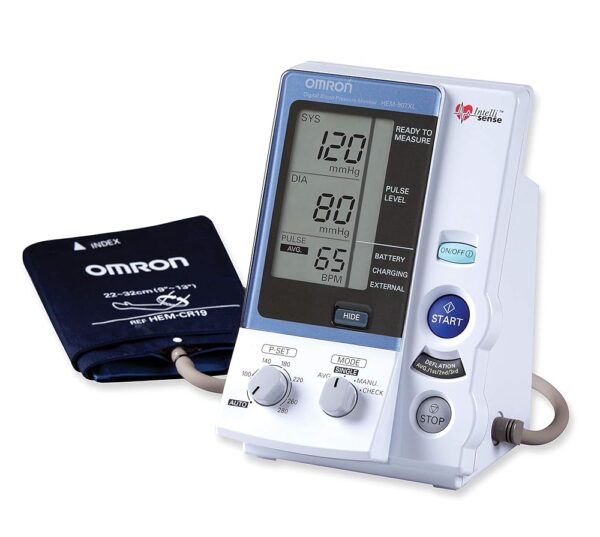
The OMRON HEM-907XL is not a home blood pressure monitor. It is a professional instrument built for clinics and research settings, with three measurement modes including an auscultation mode intended for use with a stethoscope, mains power, a rechargeable battery pack and multiple cuff sizes. This review describes it from its published listing data. It is not medical advice, it does not tell you what any reading means, and no monitor of any kind replaces professional medical care. Readings belong in a conversation with a clinician who knows your history.
Who this device is for
The HEM-907XL settles a different question from every other device in the blood pressure monitor section. Those devices are designed so that an untrained person can get a usable number at a kitchen table. This one is designed for a clinical setting where the operator has been trained, the patient is one of many, and the measurement protocol is fixed by the institution rather than the manufacturer.
Three things mark it out. It weighs three pounds and runs from an AC adapter or a rechargeable battery pack rather than disposable cells. It offers an average mode that takes two or three readings automatically and calculates the result, which is what standardized measurement protocols call for. And it offers an auscultation mode, which switches off the automatic algorithm and lets an operator take the reading by ear with a stethoscope while the device controls the cuff.
That third mode is the clearest signal of intended audience. Auscultation is a clinical skill that takes training to do reliably, and no stethoscope is included. If you are buying this for home use because it looks more serious than a consumer monitor, the automatic modes are what you will actually use, and a consumer device such as the OMRON Platinum gives you those with an app, a smaller footprint and a lower price.
The cuff information on this listing is contradictory
Cuff fit determines whether a reading is worth recording, because a cuff outside its intended range produces wrong numbers on a device that is functioning perfectly. On a device intended to measure many different people, having the right range of cuffs is the whole point.
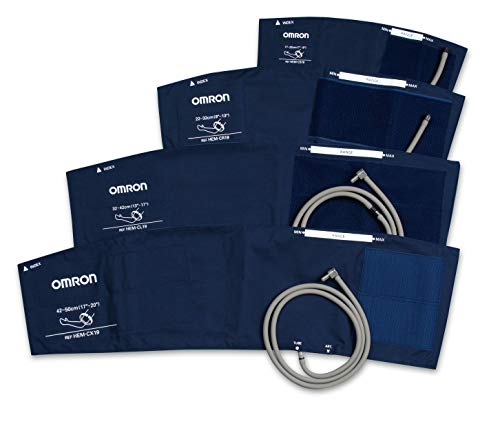
This listing publishes two incompatible answers. The structured band size field reads 22 to 32 centimeters, which is roughly 8.7 to 12.6 inches, an adult small to medium range. A feature bullet states that four cuffs are included for optimal sizing, accommodating adult arms from 7 to 20 inches in circumference. Those ranges do not overlap at either end.
The same bullet then names three sizes, medium, large and extra large, after saying four cuffs are supplied. So the listing gives four cuffs and three names, and two arm ranges that disagree with each other by a wide margin.
This is the specification you cannot afford to guess on. Before ordering, ask the seller exactly which cuffs are in the box and what circumference each covers, and measure the arms you intend to use it on. If you need a specific size that is not supplied, replacement cuffs in small and extra large are listed separately in this catalog.
Using it correctly
The measurement fundamentals do not change with the price of the device. The person being measured should sit with their back supported and feet flat on the floor, rest quietly for several minutes beforehand, have the arm supported at roughly heart level, wear the cuff on bare skin rather than over a sleeve, and stay still and silent while the measurement runs. Measurements should be taken at consistent times so they can be compared with one another.
The average mode is the feature to use rather than single mode. Taking two or three readings and averaging them is what most measurement protocols are built around, and the device doing it removes both the arithmetic and the temptation to keep the reading you liked. OMRON also states that the device switches off automatically after five minutes of inactivity.
The irregular pulse indicator here does something the consumer models do not: it displays the number of irregular pulse waves detected rather than simply showing a symbol. That is more information, and it is still a flag rather than a finding. It does not identify a rhythm, it does not say whether anything is significant, and it diagnoses nothing. On a device likely to be used by someone with clinical training, that distinction is presumably understood; on a device bought for a home, it needs saying.
What the listing does and does not claim
IntelliSense is described as technology that automatically determines the correct amount of pressure to apply, producing a faster and more comfortable measurement. That is a claim about inflation behavior rather than about measurement accuracy, and it is a reasonable one to make.
What is notably absent is everything OMRON puts on its consumer listings. There is no statement about FDA clearance or registration. There is no Validated Device Listing claim. There is no reference to any validation protocol, and no warranty term is published. A professional instrument would ordinarily carry more regulatory documentation than a consumer one, not less, so read this as a gap in the product page rather than a gap in the product, and ask the seller for the documentation if it matters to you.
We do not test devices and we will not describe any monitor as accurate, clinically accurate or medical grade in our own voice. Feedback is recorded at 4.2 out of 5 across 139 ratings, which is a small sample for a device of this age and measures buyer satisfaction rather than measurement performance.
What is in the box
The included components are listed as a cuff and an adapter, while the bullets describe multiple cuffs, an AC adapter and a rechargeable battery pack. OMRON states explicitly that the stand is not included, which is worth knowing because the HEM-907XL is commonly seen on a rolling stand in clinical photographs and that stand is a separate purchase. No stethoscope is included either, despite the auscultation mode.
If you want a manual measurement setup rather than an automatic one, the aneroid sphygmomanometer and stethoscope kits in this catalog are the purpose built option and cost a fraction of this. For extended monitoring rather than spot readings, the Contec ABPM50 is a different class of device again.
Who should buy it and who should not
Buy it if you are equipping a clinical or research setting, need average mode and auscultation mode, and have confirmed which cuffs are supplied. Do not buy it as a household monitor: it is heavy, it needs mains power or a battery pack, its most distinctive mode needs a stethoscope and training, and a device such as the OMRON Gold BP5350 does the home job better. A few further devices sit in the mixed shortlist section beside unrelated pressure products.