
Description
Who this machine is for and what it settles
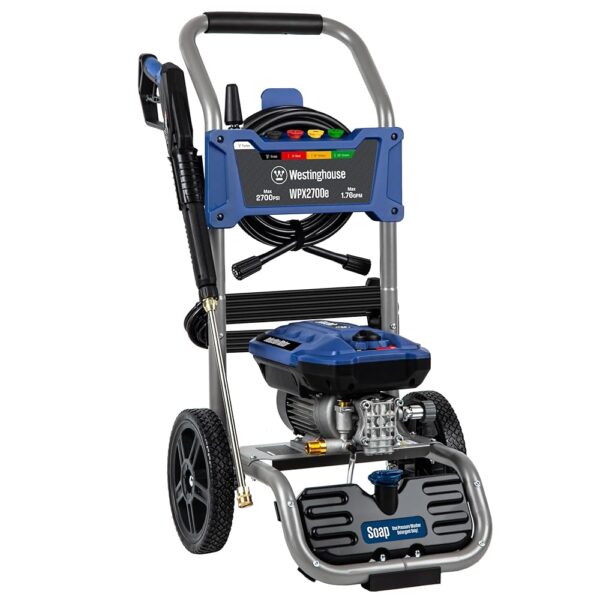
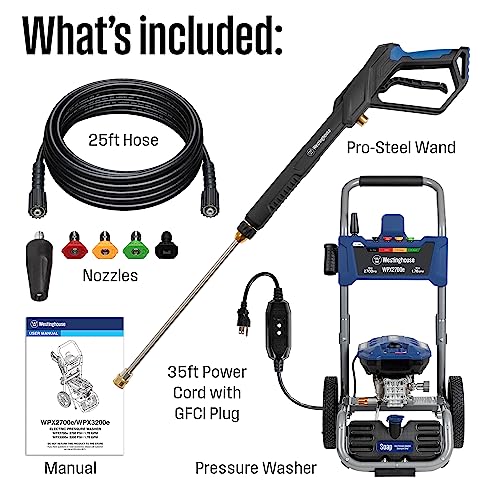
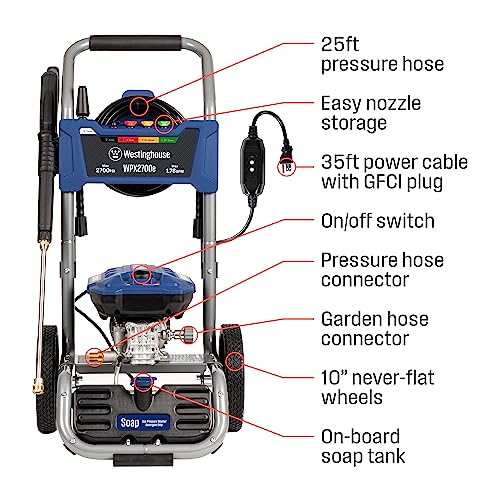
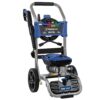
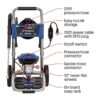
The Westinghouse WPX2700e is the full sized machine in the Westinghouse electric range, and it settles the question of whether an electric unit can be treated as a workhorse rather than a weekend tool. At 44.9 pounds on a steel frame with high profile never flat wheels, it is built to be rolled to a job and left there, and the specifications back that up: a 13 amp induction motor, an axial cam pump Westinghouse describes as maintenance free, a 35 foot power cord and a 25 foot abrasion resistant hose.
The induction motor is the meaningful difference against the lighter Westinghouse machines. Induction motors are heavier and quieter than the universal motors used in compact units, and they generally tolerate repeated long sessions better. That is why this machine weighs more than twice what the compact Westinghouse ePX3100 we review does while producing a similar flow rate.
The specifications that matter
Cleaning power comes from pressure and flow together. Westinghouse publishes 2700 PSI and 1.76 GPM, and unlike the compact ePX models in the same brand, the description and the first feature bullet state both figures without the at initial discharge and without a nozzle at minimum pressure qualifiers. The product title still ends with the phrase 2700 Max PSI, so the pressure figure should be read as a maximum, but this listing is noticeably less hedged than its stablemates.
The electrical detail is genuinely published here, which is rare in this catalog. Westinghouse states a 13 amp induction motor and a 35 foot power cord. A 13 amp continuous draw leaves limited headroom on a 15 amp household circuit, so the outlet should be identified in advance and nothing else should share the circuit while the machine runs. What is still not published is whether a GFCI protected outlet is required and what the extension cord policy is, and both belong in the manual rather than being assumed.
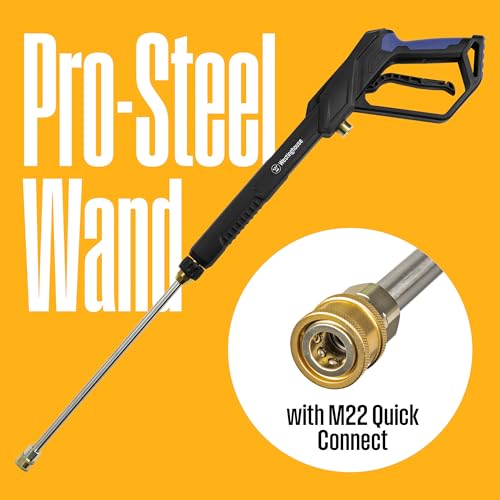
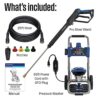
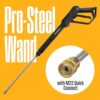
The accessory set is five quick connect nozzles covering 0, 15, 25, turbo and soap, a lightweight spray gun, and a 25 foot hose Westinghouse calls Super-Flex. Tools and a quick start guide are included. Westinghouse states three year limited coverage for service, labor and parts with a nationwide support network.
Two figures that do not agree
The soap tank is described twice with different capacities. A feature bullet calls it a half gallon onboard soap tank. The description calls it a handy 1.6 litre soap tank on the side of the machine. Half a US gallon is about 1.89 litres, so the two do not match. The difference is small in absolute terms but it is a straightforward internal contradiction in the same listing.
The maximum flow rate field in the specification block reads 176 gallons per minute. No consumer pressure washer moves 176 gallons per minute and no household supply could feed one. The intended figure is 1.76 GPM, which appears correctly in the title, the description and the bullets, and the decimal point has been lost during import. The identical error appears on the Westinghouse ePX3100 listing, so this is a systematic import fault rather than a one off.
Using it correctly
The five tips are the control surface. The turbo tip rotates a narrow jet in a cone for hard surfaces. The 25 degree tip is the general purpose choice, 15 degrees handles bonded dirt, and the soap tip drops pressure so detergent can be laid down before rinsing. The zero degree tip concentrates the entire flow into a point and at 2700 PSI it will gouge wood, strip paint and etch concrete quickly, so treat it as a specialist item rather than a default.
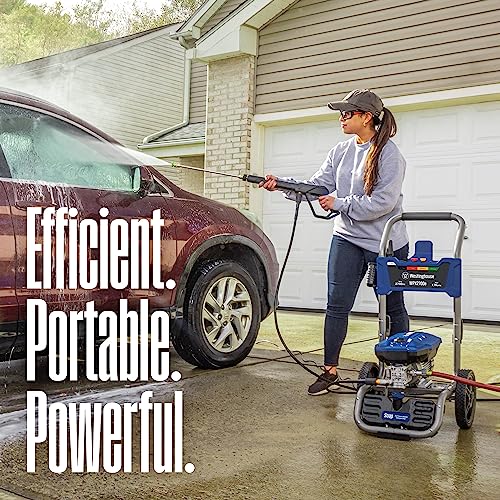
Westinghouse states in its description that the machine is safe to use on brick, stone, concrete, wood, aluminum and iron. That is the manufacturer’s statement, and it deserves a qualification we can give in our own voice: what a surface tolerates depends on the tip, the distance and how long the jet dwells, not only on the material. Wood in particular varies enormously between a hardwood deck and softwood fencing. Test on an inconspicuous area with the widest tip first, and move in only if nothing is happening.
A pressure washer jet can force water and surface contaminants through skin, and an injection injury requires immediate medical attention even when the entry wound looks small. Never aim the wand at a person or an animal, never test the spray against your hand, and wear eye protection because grit blasted off a surface returns toward the operator. Angle the spray downward on exterior walls so water is not driven up behind siding, and squeeze the trigger after shutdown to release the pressure still held in the hose.
Limits and gaps in the published data
Beyond the soap tank discrepancy and the flow rate import error, the listing does not publish the maximum inlet water temperature, the required supply pressure and flow, the pump service interval, or the noise level. Nothing is said about whether the pump can be repaired, which is worth knowing on a machine marketed as maintenance free, since maintenance free and repairable are not the same thing.
Dimensions are 17.5 by 16 by 22 inches at 44.9 pounds. Country of origin is Vietnam, the model number is WPX2700e and the UPC is 850032657587. Amazon showed a rating of 4.6 out of 5 across 1,956 ratings at capture, ranked 2,382nd in Patio, Lawn and Garden and 18th in pressure washers. Rank is a measure of sales volume rather than of build quality.
One practical note on flow. At 1.76 GPM this machine sits above the compact units but below the 2.0 GPM class, and that figure is what decides whether a surface cleaner attachment will spin properly. The Westinghouse PWSC12 surface cleaner review covers the brand matched attachment, and its 2500 PSI ceiling sits below this machine’s 2700 PSI rating, which is a mismatch worth checking with Westinghouse before pairing them.
Alternatives worth comparing
Within the brand, the Westinghouse WPX2300e review covers the smaller machine on the same frame design, and the Westinghouse ePX3500 review covers the compact alternative for anyone whose constraint is storage rather than output. Note that the ePX3500 is named for a pressure figure that does not appear in its own specifications, which this listing does not do.
Outside the brand, the Greenworks GPW3001 review is the direct competitor at 3000 PSI, and it is the only machine in this part of the electric pressure washer category that publishes both a maximum and a rated flow figure separately.
Who should buy it and who should not
Buy it if you have driveways, siding, fencing and vehicles to clean regularly, an outlet that can carry 13 amps without sharing the circuit, and space for a 45 pound wheeled machine. Do not buy it if storage is the binding constraint. Do not read the 176 GPM specification field as anything but a lost decimal point, and confirm the soap tank capacity and the GFCI and extension cord requirements against the manual before the first use.