Description
Who the AQESO U80B is for, and what it settles
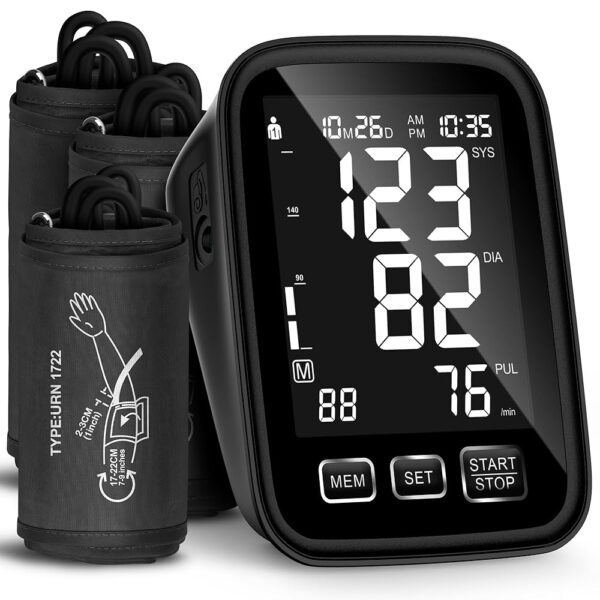
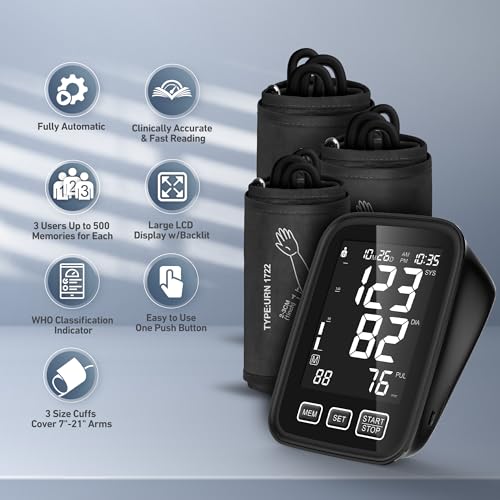
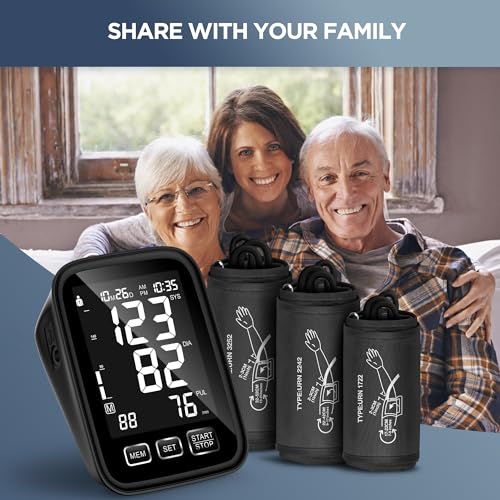
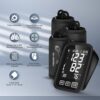
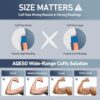
Most home monitors ship with one cuff and hope it fits. This one ships with three, and that is the entire reason to consider it. AQESO lists a small band for arms of 7 to 9 inches, a medium and large band for 9 to 17 inches, and an extra large band for 13 to 21 inches, covering 7 to 21 inches of upper arm circumference in one box. Add three user profiles and it becomes a plausible single machine for a household whose members are built very differently.
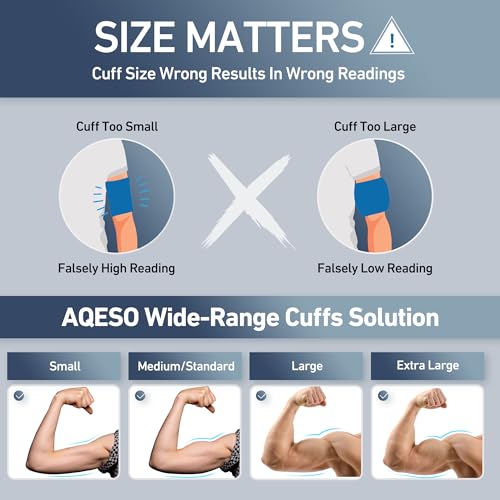
Cuff fit is the largest thing a home user controls, and it is the reason most home readings go wrong. A band too small for the arm, or one so large it cannot be seated evenly, changes the numbers on a monitor that is working exactly as designed. A device that removes the guesswork by supplying the sizes rather than selling them separately is solving the right problem.
None of which makes it a source of medical advice. This is a measuring instrument. It does not diagnose, it does not replace professional medical care, and its readings belong in a conversation with the clinician who manages your health.
The specifications that matter
Three cuffs, and how to choose between them
The ranges overlap deliberately, which is helpful. An arm measuring 9 inches falls at the top of the small band and the bottom of the medium and large, and an arm measuring 14 inches falls inside both the medium and large and the extra large. Where two bands overlap, the smaller one that still closes comfortably with room left is usually the better fit, because a band with a great deal of excess is harder to lay flat.
Measure the midpoint of your upper arm, halfway between shoulder and elbow, with the arm relaxed at your side and a soft tape held snug but not tight. Do that before you assume which cuff you need. AQESO invites buyers unsure about sizing to contact them, which is a reasonable offer to take up.
Note that the structured band size field in the listing just reads small, medium and large, and extra large, with no figures at all. The usable numbers are in the title and the feature bullets. That is the reverse of how most listings in this catalog fail, and worth knowing if you are comparing specification fields side by side.
Memory and users
Three user profiles with 500 readings each, timestamped by date and 12 hour clock. That is by a wide margin the deepest storage of any monitor in this part of our catalog. AQESO’s own copy describes it as the highest available anywhere, a claim we are not repeating, but the raw figure of 1,500 stored readings is real and it is unusual.
Power
Four AAA alkaline cells are supplied, and the device can alternatively run from a 5 volt, 1 amp USB Type-C source. The listing states clearly that the Type-C cable is included but the power adapter is not, which is a level of honesty worth acknowledging. If you plan to run it from the wall, you will need your own plug.
Display and handling
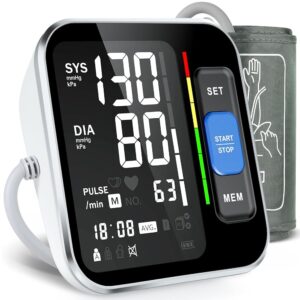
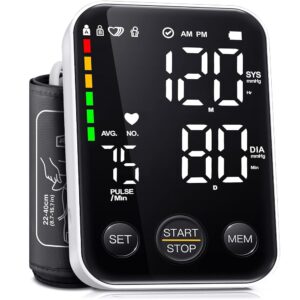
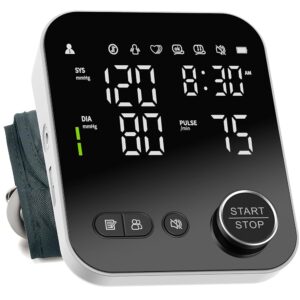
A 4 inch backlit LCD with oversized numerals, and an integrated D-ring with a hook and loop fastener, which makes a cuff easier to put on one handed. That matters more than it sounds if you are measuring your own arm without help. Listed dimensions are 4.65 by 3.55 by 2 inches and listed weight is 1.68 pounds, which is heavier than it looks and is presumably the three cuffs.
Claims that need attributing, and data that needs flagging
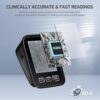
AQESO states that its machine uses ASP signal processing and has been tested against more than 100,000 items of clinical data, and describes the result as accurate and fast. Those are the manufacturer’s statements. No validation protocol is named, no clearance number is quoted, and no accuracy tolerance is published, so a figure like 100,000 tells you about the size of a dataset rather than about the performance of the device in front of you. We make no accuracy claim about this monitor in our own voice, and validation status is checkable independently through the lists that medical societies publish.
The listing’s contents field is corrupted. Instead of a packing list it contains a block of raw page script left behind by whatever imported the data, with the real contents appended after it. We have read the real list out of that mess, and it names the machine, a USB Type-C cable, four AAA batteries, the three cuffs with their ranges, and a carrying bag. If you want that confirmed, ask the seller rather than trusting a field that is visibly broken.
The manufacturer field names Shenzhen Urion Technology. The U80 model prefix runs across a long list of unrelated brands in this catalog, and our reviews of the Urion U81RH and the Elera U80B cover two of them. AQESO itself has several listings under the same model code, including our second AQESO U80B review and our third one, which do not all ship the same cuffs. Check which package a seller is actually offering before you order, because the three cuff bundle is the whole point of this particular listing.
Using it correctly
The listing carries a placement note that is worth repeating because it is correct and specific: put the cuff on the upper arm about an inch above the bend of the elbow, with the air tube running over the front center of the arm so the sensor sits in the right place, and pull the end of the band so it is evenly snug with no wrinkles.
Add the usual conditions. Rest for five minutes first, sit with your back supported and both feet flat, bare the arm rather than rolling a sleeve, and rest the arm on a table so the cuff is level with your heart. Stay quiet and stay still through the measurement.
With three users and three cuffs in one house, label them. Confirm the correct profile before pressing start, and keep each person’s band with their own log, because a mixed record across 500 stored readings is impossible to untangle afterwards. Write readings down with dates and times regardless, since that is the format a clinician can actually read.
Who should buy it, and who should not
Buy the U80B bundle if more than one person will use the machine and their arms are genuinely different sizes, or if your own measurement sits at an extreme where a standard cuff is a gamble. It is one of the few listings in our home blood pressure monitor section that treats sizing as a solved problem rather than a footnote. Skip it if you are a single user with an average arm, since you would be paying for two cuffs you will never fit, and skip it if you need a wall adapter in the box. And whichever cuff you end up using, the reading it produces is one input for a clinician rather than an answer on its own.