


Description
Who the ELERA U80B is for, and who it will not fit
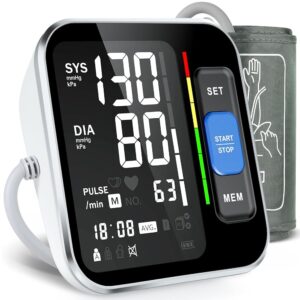
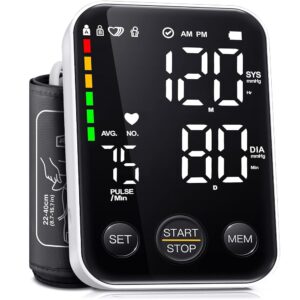
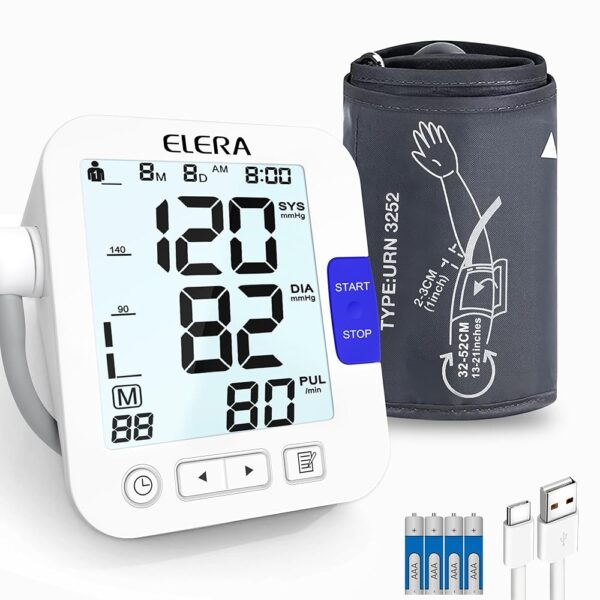
This is an upper arm automatic blood pressure monitor supplied with an extra large cuff, aimed squarely at people whose arms are too big for a standard machine. It records numbers for a clinician to review. It is not a diagnostic device and it does not replace professional medical care.
The most important thing on this page is the bottom of the cuff range rather than the top. The listing states that the cuff suits adult arms of 13 to 21 inches in circumference. Thirteen inches is the lower limit, not a starting point, which means this monitor is the wrong purchase for anyone with an average sized arm. A cuff that is too large for the arm produces readings just as unrepresentative as one that is too small, and the display will not warn you. If your arm measures under 13 inches, buy a different monitor, and if two people in a household sit either side of that figure, this one device will not serve both.
Measure the circumference of your bare upper arm with a cloth tape, midway between elbow and shoulder, before ordering. Note that our stored band size attribute records only 21 inches, dropping the lower bound, so use the full range as stated here.
The rest of the specification
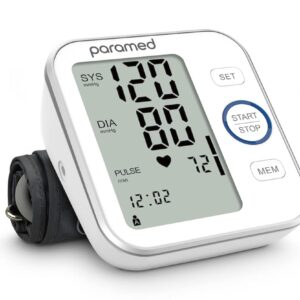
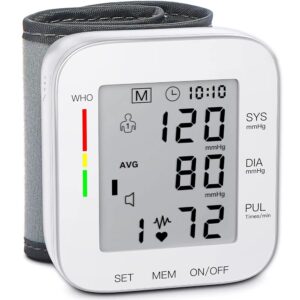
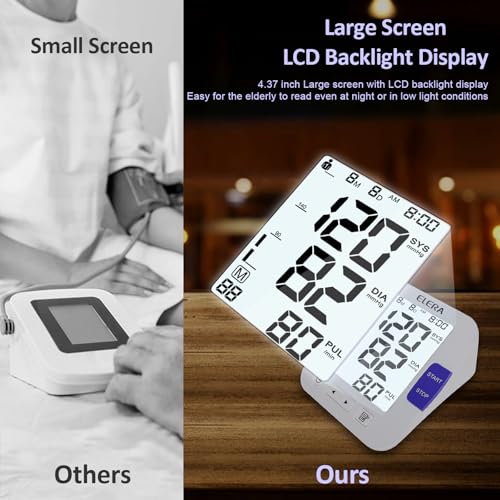
The device supports two users, each storing 99 measurement records, and it displays the average of the last three measurements. The listing states that a measurement takes about 50 seconds. The screen is a backlit LCD, described as large, though no dimension is published. The unit weighs 494 grams.
Power is offered two ways: AAA batteries or a USB Type C cable, and the listing states that both are included. Note that our stored power source attribute records corded electric only, which understates it. Dual power is genuinely useful on a device of this kind, because a large cuff takes more air to inflate and therefore more current, and battery powered monitors with big cuffs go through cells quickly.
The classification display and the irregular heartbeat reminder
The listing states that results are classified according to WHO and ISH blood pressure categories. That is a category indicator: a band or symbol that appears according to where a reading falls against thresholds programmed into the device. We are not reproducing those thresholds here as targets. What a number means for a particular person depends on their history, their treatment and their clinician’s judgment, and a colored band on a consumer display is a prompt to ask rather than an answer.
The listing also describes irregular heartbeat reminders. That is a flag. It reports that the device noticed an irregularity during a measurement. It does not identify a rhythm, it does not diagnose any condition, and the appropriate response is to mention it at an appointment.
Using it correctly, and what the readings are for
Sit with your back supported and your feet flat on the floor rather than crossed, and rest quietly for several minutes before measuring. Fit the cuff on a bare upper arm rather than over a sleeve, working a large cuff up the arm rather than sliding it down from the shoulder, with the tube running down the inside of the arm toward the hand and the lower edge clear of the elbow crease. Support the arm so the cuff sits at about the height of your heart. Do not talk during the measurement, and use the same arm at about the same time each day.
What you produce is a record for someone else to read. What a reading means, whether a pattern across readings is significant, and whether anything about your care should change are questions for a healthcare professional who knows your history and your medication. This device does not replace professional medical care, and no reading from it should be used to start, stop or adjust treatment on your own.
The claims, and one that goes too far
ELERA describes the monitor as using the most stable chip and the most advanced technology, and states that the WHO and ISH classification makes the readings more accurate. A classification display categorizes a reading after the fact. It has no effect on the measurement itself, so that particular sentence does not hold together. We do not test products and we will not describe any monitor as accurate in our own voice.
One further claim is worth correcting rather than repeating. The listing states that because the device averages the last three measurements, the reading will not be affected by breathing or movement during the measurement. Averaging reduces the influence of ordinary variation between readings. It does not immunize a measurement against movement, and moving or talking during a cuff inflation will still spoil that reading. Stay still.
No independent validation protocol and no assessing body is named anywhere in this listing. Where a home monitor has been assessed against a published protocol, the protocol is usually identified. Check an independent validation listing for this model number if that matters to you. The manufacturer is recorded as Shenzhen Urion Technology, a name that appears behind several differently branded monitors in this catalog, so compare listings on what is in the box rather than assuming the hardware differs.
Limits and gaps
There is no app and no wireless connection, so 99 readings per user is the full history unless you write them down. No display dimension, no battery life and no warranty term appears in the record we hold. The included components attribute lists only a cuff, which understates a package the feature text says also contains a USB cable and batteries.
The structural limit is the cuff range. A monitor that only fits arms from 13 inches upward is a specialist purchase, and buying one for a household that includes smaller arms is a mistake that will not announce itself.
Alternatives worth comparing
If you need wide coverage rather than large only coverage, the AlphaMed U80A, which ships with both a 9 to 17 inch and a 13 to 21 inch cuff solves the household problem this device does not, and the KIKEANG two cuff monitor reaches further still. Within the same brand, the ELERA XXL replacement cuff and the ELERA pediatric cuff cover the ends of the range, and the Livaroci U80B is another device on what appears to be the same platform. Our index of home monitors and cuffs publishes the cuff range for each listing.
Who should buy it and who should not
Buy it if your upper arm measures between 13 and 21 inches, you want dual power and a large backlit screen, and one or two people will use it. Do not buy it if any intended user measures under 13 inches, do not expect app syncing, and do not read the classification display as an interpretation of your health. Take your readings to a clinician.