


Description
Who the AQESO U80AH is for
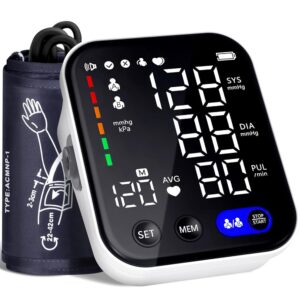
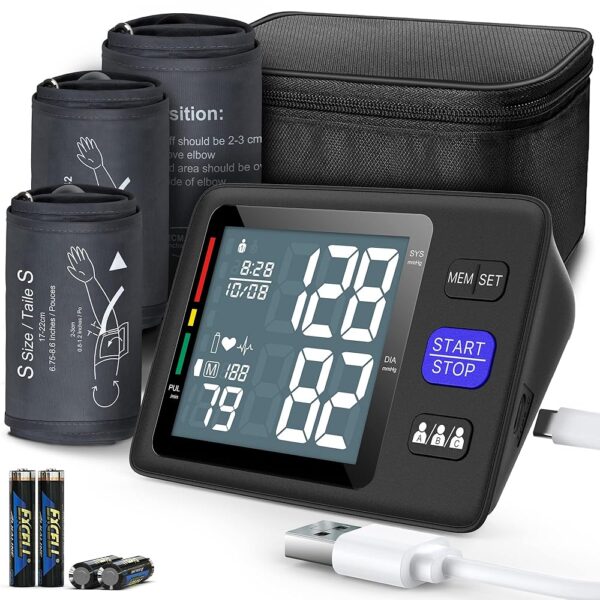
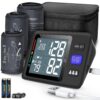
This is an upper arm automatic blood pressure monitor supplied with three cuffs, three user memories and a very deep storage capacity. It records numbers for a clinician to review. It is not a diagnostic device and it does not replace professional medical care.
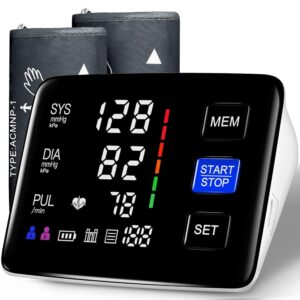
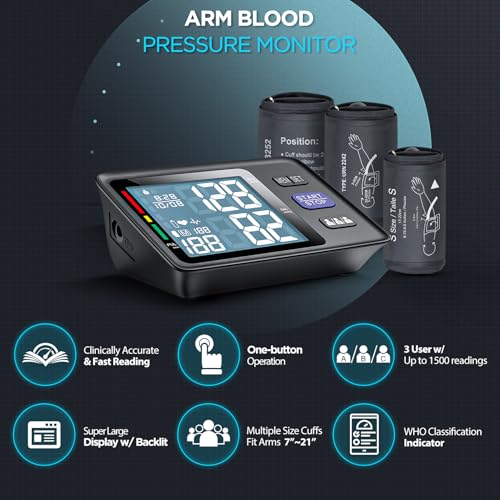
The proposition is coverage. Most monitors ship with one cuff and exclude anyone outside its range. This one ships with three, covering 7 to 21 inches of upper arm between them, and it gives three people their own records rather than the usual two. For a household with several adults of noticeably different builds, that is a genuinely different offer from the rest of this catalog.
The three cuff ranges
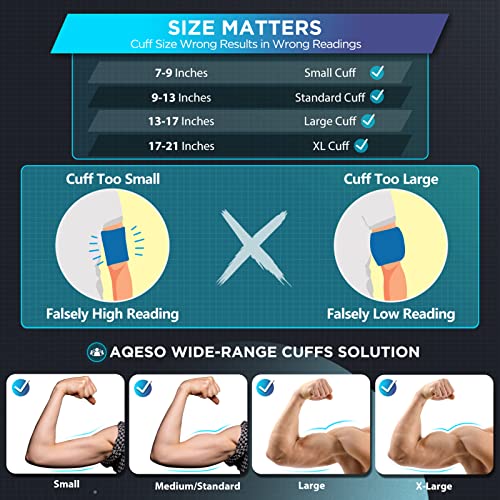
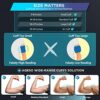
The listing states a small cuff of 7 to 9 inches, a medium to large cuff of 9 to 17 inches, and an extra large cuff of 13 to 21 inches. Our stored band size attribute records only 21 inches, dropping the rest, so use the figures from the listing.
Measure the circumference of your bare upper arm with a cloth tape, midway between elbow and shoulder, and choose the cuff that places your measurement inside a range rather than at its edge. Where two ranges overlap, the index markings printed on the cuff itself are the reference to follow. Cuff fit is what decides whether a reading represents anything: one too small or too large produces a number that does not match what the same device would record with the correct cuff, and nothing on the display warns you.
A caution about the smallest cuff. A 7 to 9 inch cuff is in the size range used for children and adolescents as well as very slim adults, and the listing does not restrict it. Measuring a child’s blood pressure is a clinical activity rather than a household one: cuff selection for a child is worked out against the child’s arm dimensions by someone trained to do it, and what a reading means in a child depends on factors that have no equivalent in adult home monitoring. Nothing here is instruction for measuring a child. If a clinician has asked you to take readings for a child at home, follow their instructions and their equipment.
Memory, power and the USB caveat
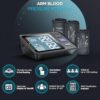
The device supports three users with 500 measurements each, 1500 in total, reached through a dedicated memory button. That is the deepest memory in this catalog by a wide margin. A measurement takes about 30 seconds and the display is a large backlit LCD.
Power works two ways and the listing is admirably clear about the limits. The device runs on four AAA batteries or a USB Type C cable, it is not rechargeable, and USB operation requires a continuous power connection throughout the measurement. A 5 volt 1 amp adapter is recommended and is not included, and the listing advises using the supplied cable for compatibility. The stored components field lists a case, batteries and a manual.
Using it correctly, and what the readings are for
Sit with your back supported and your feet flat on the floor rather than crossed, and rest quietly for several minutes before measuring. Fit the correct cuff on a bare upper arm rather than over a sleeve, with the tube running down the inside of the arm and the lower edge clear of the elbow crease. Support the arm so the cuff sits at about the height of your heart. Do not talk during the measurement.
With three cuffs and three users this device needs more discipline than most. Use the same arm and the same cuff every time, and check that the correct user slot is selected before the cuff goes on. A series of readings taken with different cuffs, or filed under someone else’s slot, is worse than no series at all, because it looks like data.
What you collect is a record for someone else to read. What a reading means, whether a pattern across your readings is significant, and whether anything about your care should change are questions for a healthcare professional who knows your history and your medication. This device does not replace professional medical care, and no reading from it should be used to start, stop or alter treatment on your own.
The claims, including one we will not repeat
The listing refers to accurate signal processing technology, states that more than a hundred thousand items of data were tested for reliability, and says the device is calibrated to best performance. Those are the seller’s own descriptions, naming no protocol, no assessing body and no study. We do not test products and we will not describe any monitor as accurate in our own voice. Check whether this model number appears on an independent validation listing if that matters to you.
One sentence we are not repeating. The listing tells the reader to rest assured about detecting a hypertension issue by means of the colored classification bar on the display. A category bar is driven by thresholds programmed into the device. It does not detect a condition, it does not know your history or your medication, and it is not a substitute for a diagnosis by someone who does. We are also not reprinting the thresholds, because interpreting a number for a particular person is clinical work. Treat the bar as a prompt to record the reading and raise it at an appointment.
The listing also claims the three cuffs fit all arms. Three cuffs covering 7 to 21 inches is broad coverage and it is a real advantage, but it is not all arms, and anyone above 21 inches will still need a separate extra large cuff.
Limits and gaps
No irregular heartbeat detection and no averaging function is described, so a short series has to be averaged by you. There is no app and no wireless connection, so 1500 readings is a memory you will be scrolling through on a screen rather than exporting. No display dimension is published, no accuracy figure in mmHg is given, and no warranty term appears in the record we hold. The USB adapter is not in the box.
Alternatives worth comparing
Within the same brand, the AQESO U80BH, which ships with two cuffs and 99 readings per user is the simpler sibling, and a second AQESO U80AH listing appears in our catalog under a different code. On the same platform, the ALPHAGOMED U80AH and the Urion U80AH both ship with two cuffs. If the small cuff is what you actually need, the ELERA small replacement cuff covering 5.9 to 9.5 inches is sold separately, with the same cautions. Our index of home monitors and cuffs publishes the cuff range each listing states.
Who should buy it and who should not
Buy it if a household needs three cuff sizes and three separate records, arms fall between 7 and 21 inches, and a very deep memory appeals. Do not buy it expecting a rechargeable device or an app, do not use the small cuff on a child without clinical direction, and do not read the classification bar as detecting anything. Take your readings to a clinician.