



Description
Who the Urion U80AH is for
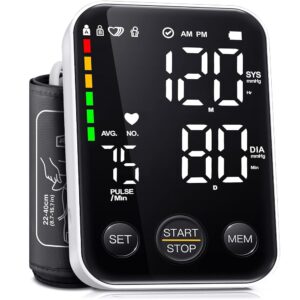
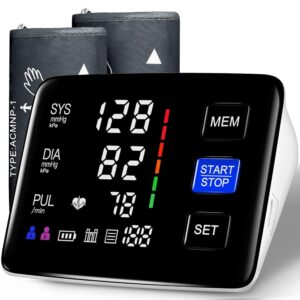
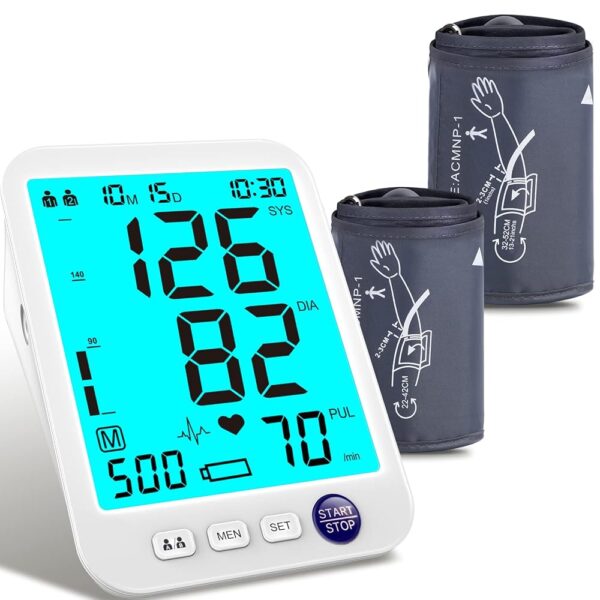
This is an upper arm automatic blood pressure monitor supplied with two cuffs and a 6 inch backlit screen, aimed at a household where arm sizes differ and where at least one person needs a large display. It records numbers for a clinician to review. It is not a diagnostic device and it does not replace professional medical care.
The proposition is straightforward: rather than buying one monitor for a standard arm and another for a large one, you get both cuffs in the box. The manufacturer is recorded as Shenzhen Urion Technology, a name that appears behind several differently branded monitors in this catalog, so if you are comparing this against other U80 series devices you are often comparing packaging rather than hardware.
The cuff ranges, and a stored figure that disagrees with both
The listing title and feature text give two cuffs: a medium to large cuff covering 9 to 17 inches, and an extra large cuff covering 13 to 21 inches. Together that spans most adult arms and a good way beyond.
Our stored band size attribute, however, records 32 to 52 cm, which converts to roughly 12.6 to 20.5 inches. That matches neither published range: it starts well above the standard cuff and ends below the extra large one. We are not going to reconcile it, and the figures to work from are the ones in the listing text. If your measurement is near a boundary, confirm the actual cuff sizes with the seller before ordering.
Measure the circumference of your bare upper arm with a cloth tape, midway between elbow and shoulder, and choose the cuff that puts your measurement inside a range rather than at its edge. This matters more than anything else on the page. A cuff that is too small or too large produces a reading that does not match what the same device would record with the right cuff, and nothing on the display warns you.
Memory, screen and power
The listing states storage of 1000 results across two users, with date and time stamps, which is deep for a device with no app. The screen is described as a customized 6 inch backlit LCD with large fonts, and legibility is clearly the design priority here. Power comes from batteries or a USB cable, with four AAA batteries and a Type C cable both stated as included, along with a nylon carry bag. The unit shuts off automatically after three minutes of inactivity.
One inconsistency worth noting: the stored product dimensions record the device as 5 by 3 by 4 inches, which cannot contain a 6 inch screen. Treat the dimensions field as unreliable and the screen size as the manufacturer’s claim.
Using it correctly, and what the readings are for
Sit with your back supported and your feet flat on the floor rather than crossed, and rest quietly for several minutes before measuring. Fit the correct cuff on a bare upper arm rather than over a sleeve, working a large cuff up the arm rather than sliding it down from the shoulder, with the tube running down the inside of the arm and the lower edge clear of the elbow crease. Support the arm so the cuff sits at about the height of your heart. Do not talk during the measurement. Use the same arm and the same cuff each time, since switching cuffs partway through a series makes the readings hard to compare with one another.
The listing itself carries a candid note that readings vary because of stress, timing and how the cuff is wrapped, and suggests taking more than one measurement. That is sound. What you produce is a record. What a reading means, whether a pattern across readings is significant, and whether anything about your care should change are questions for a healthcare professional who knows your history and your medication. This device does not replace professional medical care, and no reading from it should be used to start, stop or alter treatment on your own.
Claims, limits and gaps
The listing describes updated inflation technology for faster readings on large arms and adaptive pressure control for comfort. Those are design descriptions rather than measurement claims, and inflation comfort genuinely matters on a big cuff, which has to move a lot more air. No accuracy figure, no independent validation protocol and no assessing body is named anywhere in this listing. If validation matters to you, check whether this model number appears on an independent validation listing before ordering.
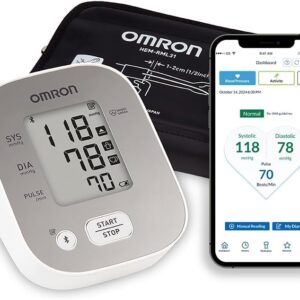
On gaps: no irregular heartbeat detection is described, there is no averaging function, and there is no app or wireless connection, so 1000 readings is the whole history and you will be reading it off the device. No warranty term appears in the record we hold and no display measurement is given other than the 6 inch claim. The stored power source attribute records corded electric only, which understates a device the listing says runs on batteries too.
A word about that 1000 reading memory, because deep storage on a device with no export is less useful than it sounds. A thousand readings across two users is several years of daily measurement, and there is no way to get any of it off the device other than scrolling through it on the screen and writing numbers down. In practice a clinician wants a short recent series, typically a week or two of readings taken morning and evening, not a scroll through three years of history. If you are measuring because someone asked you to, keep a paper log alongside the device from the first day. The memory is then a backup rather than the record itself, which is the right way round.
The second point concerns switching between the two cuffs. If more than one person uses this monitor, make sure each person is also using their own user slot, not just their own cuff. Readings from two people in one memory bank are worse than no readings, because they average out into something that describes nobody.
Alternatives worth comparing
Within what appears to be the same hardware family, the Urion U81RH, the AlphaMed U80A, which also ships with two cuffs and the ALPHAGOMED U80AH are the closest comparisons, and they differ mainly in what is in the box. The ELERA U80B covers large arms only, with a 13 inch floor. If you need coverage beyond 21 inches, the KIKEANG two cuff monitor reaches to about 21.7 inches. Our index of home monitors and cuffs publishes the cuff range each listing states.
Who should buy it and who should not
Buy it if a household needs both a standard and an extra large cuff, a very large display is a priority, and you are content to keep readings on the device. Do not buy it if you want irregular heartbeat flagging, automatic averaging or app syncing, and confirm the cuff sizes with the seller if your measurement sits near a boundary, because our stored data disagrees with the listing. Take your readings to a clinician.