


Description
Who this gauge is for and what it settles
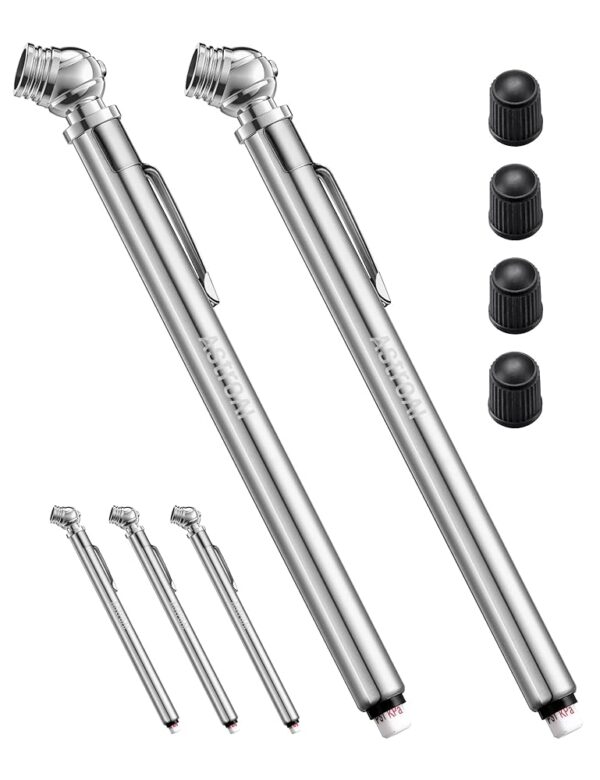
The AstroAI pencil tire pressure gauge ships as a two pack under the part number ASITIREGAP-2PACK, and the decision it settles is whether a mechanical gauge is enough for your vehicles. It has no battery, no screen and no memory. A stainless steel barrel, a metal nozzle and a four sided plastic indicator bar are the whole instrument. That is the appeal for a glove box tool that may sit unused for six months and still has to work on a cold morning, and it is the limitation for anyone who wants a backlit reading in a dark driveway.
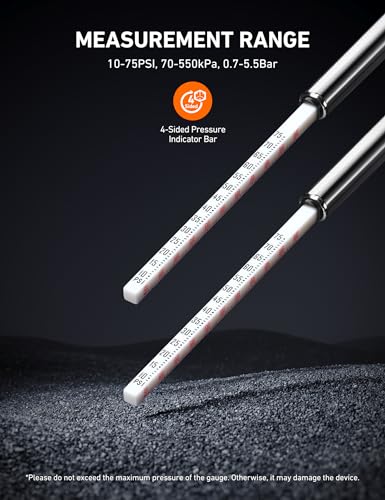
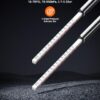
The range decides most of the rest. AstroAI publishes 10 to 75 PSI, which is also expressed as 70 to 550 kPa and 0.7 to 5.5 bar, and the title advertises three measurement units on the one indicator bar. That range covers passenger cars, most SUVs, bicycles at the lower end and motorcycles. It does not cover light truck tires, trailer tires or recreational vehicle tires that call for pressures above 75 PSI, and AstroAI states plainly in its own bullets that exceeding the maximum pressure permanently damages the gauge. Readers with those vehicles should be looking at the AstroAI ATG180 digital gauge review instead, which is the same brand with a far wider range.
The specifications that matter
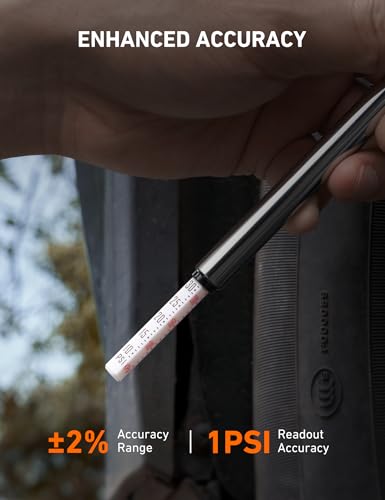
AstroAI states an accuracy figure of plus or minus 2 percent of span. That is the manufacturer’s own claim and we report it as such. No third party certification, calibration standard or test protocol is named anywhere in the listing, so a reader who needs a documented tolerance for professional use has nothing here to point at. For checking household tires against a door placard, a claimed 2 percent of span is a usable figure. For anything where a documented calibration matters, it is not.
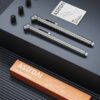
Construction is described as stainless steel components that resist rust and corrosion, with a precision crafted nozzle intended to seal on the valve stem, and an indicator bar made of ABS. Four spare valve stem caps are included, which is a small but genuinely useful inclusion given how often caps disappear. A deflator valve is built in so pressure can be let down without a separate tool, and the pocket clip is designed for a glove box, tool belt or workbench. Because there is no battery, there is nothing to maintain and nothing to fail in cold weather.
The figures that do not say what they cover
The listing gives product dimensions of 6.89 by 1.18 by 0.71 inches and an item weight of 1.76 ounces, and never states whether those figures describe one gauge or the pair. A pencil gauge that is nearly seven inches long and weighs under two ounces is plausible as a single unit, but the record is ambiguous and the packaged shipping weight would be higher. We are naming that rather than guessing which reading is correct.
Using a tire gauge correctly
The number you are checking against is on the vehicle placard, usually inside the driver door jamb or in the owner manual, and it is not the number molded into the tire sidewall. The sidewall figure is the maximum the tire is rated for, not the pressure the vehicle is designed to run. Setting tires to the sidewall number instead of the placard number is the single most common mistake this tool is involved in, and it changes braking, wear and handling.
Check pressures cold, meaning before driving or at least several hours after, because rolling heats the air and raises the reading. Press the nozzle squarely onto the valve stem in one motion until the hiss stops, then read the highest graduation still visible on the indicator bar. Do not exceed the printed range of the gauge under any circumstance, since AstroAI states that doing so causes permanent damage. Keep the spare caps in the vehicle rather than in a drawer, because an uncapped valve stem collects grit that then prevents a good seal.
Limits, gaps and the honest picture
The main limit is the ceiling. At 75 PSI this gauge stops well below what many trailer and light truck tires require, and there is no partial workaround. The second limit is legibility. A mechanical indicator bar with three unit scales printed on four faces is harder to read quickly than a lit digital display, particularly in poor light, and there is no illumination of any kind.
The listing also publishes no resolution figure, meaning it never states the size of the smallest graduation, which is a meaningful omission on an analog scale. There is no stated warranty term in the imported data, no country of manufacture beyond China, and no service or recalibration guidance. Amazon showed a rating of 4.6 out of 5 across 13,294 ratings when the listing was captured, with a sales rank of 193rd in Automotive and 3rd in analog tire pressure gauges. Those ranks measure sales, not measurement quality.
Fitting and range mismatches are the most common source of disappointment across small pressure hardware, and the Twinkle Star adapter set review covers the same lesson in a different aisle, where a 14 mm fitting will leak on a 15 mm machine. Check the number before ordering rather than after.
Alternatives worth comparing
Within the same brand, the digital ATG180 linked above trades battery dependence for a much wider range and a lit display. If the underlying problem is a dashboard warning light rather than a pressure check, a gauge is the wrong purchase entirely and the VXDAS EL-50448 TPMS relearn tool review covers the tool that resets a monitoring system after a rotation.
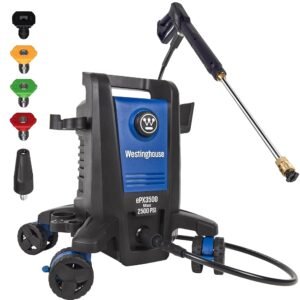
Readers browsing pressure measurement often arrive from the cleaning side of this site, where headline numbers deserve the same skepticism. The Westinghouse ePX3500 review is a good example, since its model name and its published maximum PSI do not agree. The rest of that equipment sits in the electric pressure washer category, while this gauge is filed with the mixed shelf of pressure rated gear we cover.
Who should buy it and who should not
Buy it if your vehicles run below 75 PSI, you want a battery free tool in each of two cars, and you are comfortable reading an analog scale. Do not buy it for a trailer, a dually or a recreational vehicle, do not buy it if you need a documented calibration, and do not buy it expecting a lit display. Set pressures to the vehicle placard, check them cold, and replace any gauge that has been dropped hard enough to bend the barrel.