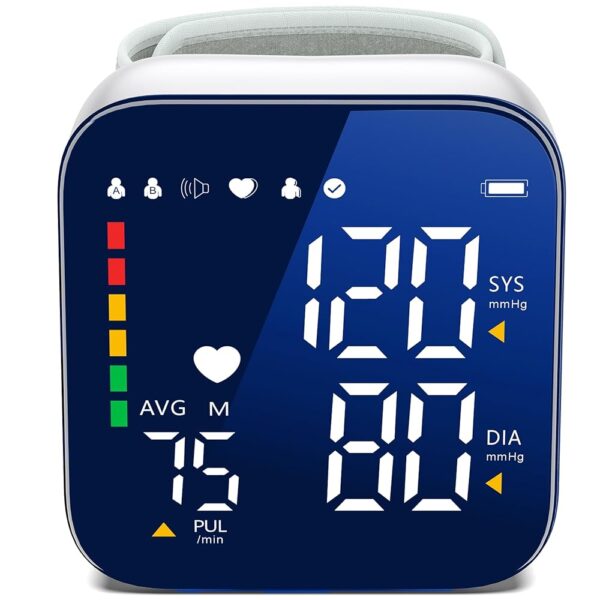
Description
What this listing actually publishes
Most reviews on this site start with who a product is for. This one has to start somewhere else, because the Coverich listing publishes almost nothing. The product title is Blood Pressure Monitor Sphygmomanometer with Manual. The single feature bullet reads, in full, Sphygmomanometer. There is no product description. There is no model number.
Here is the complete set of facts the listing provides. The brand is Coverich. The manufacturer is Shenzhen Changkun Technology. The package measures 3.82 by 3.74 by 3.7 inches and weighs 8.78 ounces. The band size is given as 7.6 inches. The product became available in October 2024, and it carries a barcode. That is everything.
We are not going to invent the rest. Our own previous description of this product claimed a memory capacity of 180 readings and made a claim about its price. Neither is supported by anything in the listing, so both have been removed rather than carried forward. This review covers what is published, what is missing, and what you would need to establish before buying. And as with any home monitor, whatever this device turns out to be, it does not diagnose anything and it does not replace professional medical care.
The most important thing the listing does not say
It does not say whether this is an arm device or a wrist device.
That is not a small omission, it is the first question anyone should answer about a blood pressure monitor. The two formats are not interchangeable. A wrist device sits further from the heart, measures at smaller arteries, and produces results that shift noticeably with how the hand is held. Upper arm monitors remain the usual recommendation for home monitoring, and a wrist unit is normally chosen when an arm cuff is impractical or will not fit. Buying without knowing which you are getting means you cannot judge whether the device suits you at all.
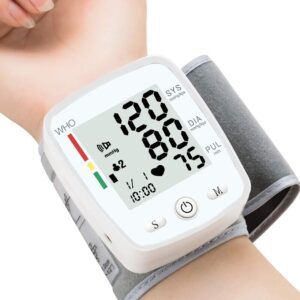
The single clue is the band size of 7.6 inches. That figure is far too small to wrap an adult upper arm, where cuffs typically start around 8.6 inches and run to 16.5 or beyond. It sits squarely in the range wrist bands occupy, which usually run from about 5.3 to 7.7 inches. The manufacturer named on the listing, Shenzhen Changkun Technology, also makes several wrist monitors that appear elsewhere in this catalog, including the devices covered in our NOUYAN CK-W355 review and our maguja CK-W118 review. Coverich itself has a wrist monitor on this site, reviewed as the Coverich wrist blood pressure monitor.
All of that points one way, but pointing is not stating, and we are not going to publish an inference as a specification. Ask the seller directly whether this is a wrist or an upper arm device before you spend anything.
The band figure, and why one number is not a range
Even taking 7.6 inches at face value, it is a single number rather than a range. A band specification needs two ends. Almost certainly 7.6 is the maximum the band reaches, but the listing never says so and never gives a minimum.
The minimum matters as much as the maximum. A band too large for the limb inside it cannot be seated evenly, the bladder does not sit correctly over the artery, and the numbers change on a device that is otherwise working properly. Whether you are measuring a wrist or an arm, buy on your own measurement and require both ends of the range from the seller in writing.
Measure a wrist just below the bone, where a watch strap would sit. Measure an upper arm at the midpoint between shoulder and elbow, with the arm relaxed at your side. Use a soft tape, held snug rather than tight, and write the number down before you shop.
Everything else that is absent
There is no power source listed, so you do not know whether it takes batteries, which kind, how many, whether they are included, or whether it charges. There is no display type, no screen size and no indication whether it is backlit. There is no memory figure and no statement of whether it supports one user or two. There is nothing about a voice readout, an averaging mode, an irregular heartbeat flag or a positioning check. There is no packing list beyond the word manual in the title. There is no model number, which means that in two years there will be no part to order and nothing to quote to a seller.
And there is no validation claim of any kind. No protocol is named, no clearance number is quoted, no accuracy tolerance is published. We are not treating that as evidence against the device, because a listing this sparse does not assert anything either way. But it does mean there is nothing whatever to check, and validation status is exactly the thing worth checking independently through the lists that medical societies publish before you rely on a home monitor.
What to do if you are still interested
Ask the seller, in writing, for five things: whether the device measures at the arm or the wrist, the full band circumference range with both ends given, what powers it and whether cells or a cable are supplied, how many readings it stores and for how many users, and the model number printed on the unit. If those five answers arrive and they suit you, you are making an informed purchase. If they do not arrive, that is your answer.
None of this is a judgment about the hardware. A thin listing can sit in front of a sound and serviceable device, and a lavish listing can sit in front of a poor one. What a thin listing does is transfer all the risk to you, because there is nothing to hold anyone to.
Better documented alternatives
If you want a device where the specifications are published and checkable, the Omron BP5100 states its cuff range, memory and power plainly and comes from a manufacturer whose validation record is straightforward to look up. For a machine that treats sizing as a solved problem, the AQESO U80B ships three cuffs with published ranges. Our full home blood pressure monitor section lists every device we cover with its cuff range attached, which is the specification to compare before any other.
Who should buy it, and who should not
Nobody should buy this on the strength of the listing as it stands, because the listing does not describe a product in enough detail to know what would arrive. If the seller answers the five questions above and the answers fit your measurements and your needs, then it becomes a normal purchase decision. Until then, it is a box with a barcode. And whichever monitor you end up with, the reading it produces is a number for your clinician to interpret, not a conclusion you can draw at home.