
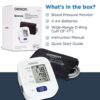
Description
Who the Omron Bronze BP5100 is for
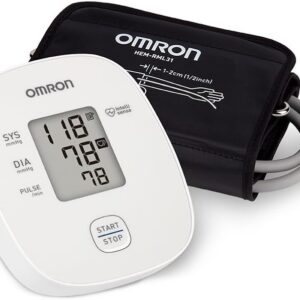
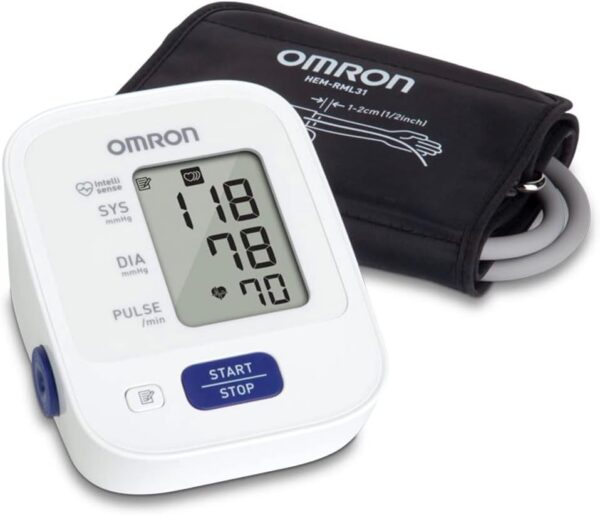
This is the entry point of Omron’s home range: an upper arm automatic blood pressure monitor with a wide range cuff, one touch operation, no app and a very small memory. It records numbers for a clinician to review. It is not a diagnostic device and it does not replace professional medical care.
The decision it settles is whether you want the cuff and the measurement without paying for the memory and the connectivity. If your habit is to take a reading and write it in a notebook or a booklet from your clinic, that is exactly what this device supports. If you expect the machine to hold your history, read the memory section below before ordering, because it is the smallest in this catalog.
Cuff range and the specifications that matter
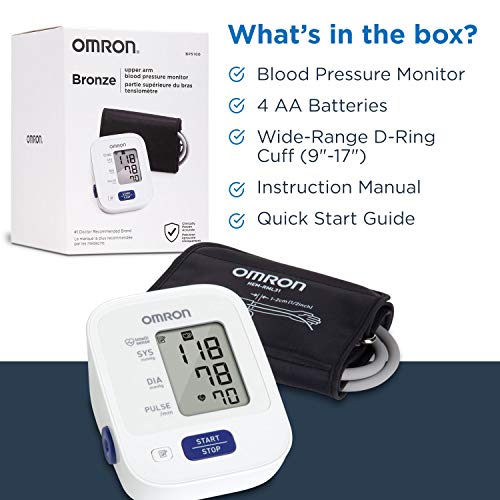
The supplied cuff is a soft, wide range D ring cuff fitting standard and large adult upper arms of 9 to 17 inches in circumference, recorded in the stored attributes as 22 to 42 cm. That is the same cuff size range as Omron’s more expensive models, which is the strongest argument for this device: the part that determines whether a reading represents anything is not where the cost has been cut.
Measure the circumference of your bare upper arm with a cloth tape, midway between elbow and shoulder, before ordering. A cuff that is too small or too large for the arm produces readings that do not match what the same monitor records with a correctly fitted cuff, and the display gives no warning. The D ring lets you thread and tighten the cuff one handed, which matters when you are measuring your own non dominant arm.
Fourteen readings, for one user
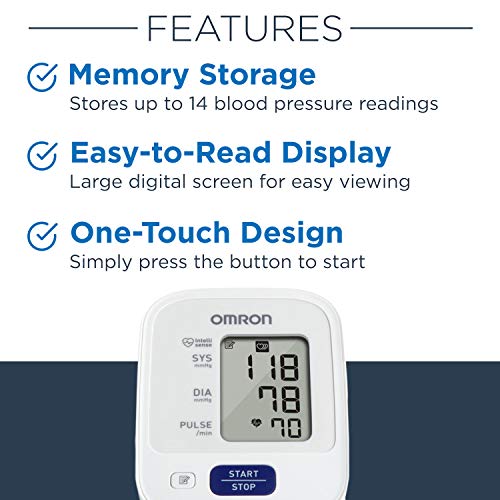
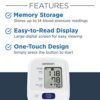
The memory holds 14 readings for one user. That is not a typographical error and it is the defining limitation of this model. Fourteen readings is a week of measuring twice a day. There is no second user slot, no app, no Bluetooth and no export, so anything beyond that fortnight has to be written down as you go.
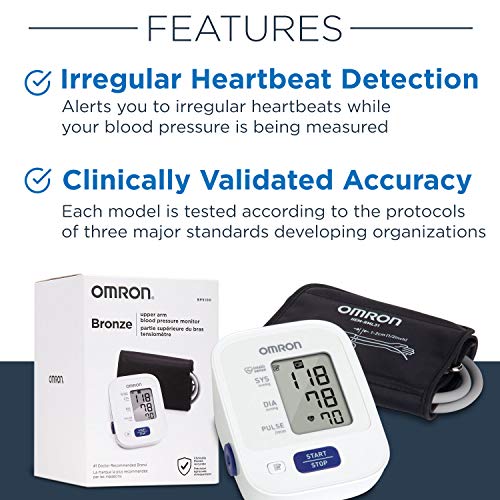
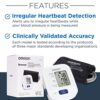
For some people that is fine, and for anyone asked by a clinician to keep a two week record it is arguably sufficient. For anyone who wants to look at a trend over months, it is not, and the models above this one in the range exist for that reason. The monitor detects irregular heartbeats and body movement during a measurement, four AA batteries are included, the unit weighs 0.55 pounds and Omron states a two year warranty.
Using it correctly, and what the readings are for
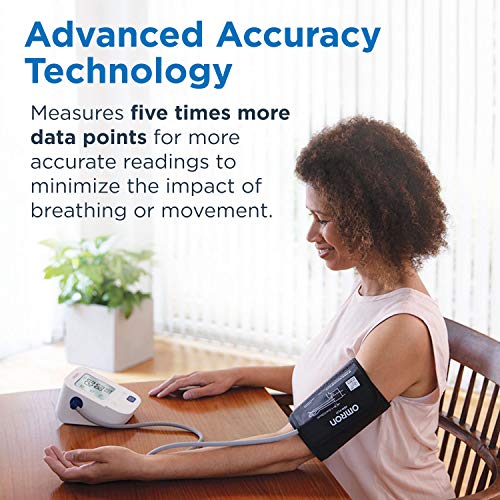
Sit with your back supported and your feet flat on the floor rather than crossed, and rest quietly for several minutes before measuring. Fit the cuff on a bare upper arm rather than over a sleeve, and support the arm so the cuff sits at about the height of your heart. Do not talk during the measurement, and stay still, since this model flags body movement and will tell you when a measurement was disturbed.
The listing carries one instruction that is easy to overlook and worth following: keep portable radio frequency equipment, including phones, antenna cables and external antennas, at least 12 inches away from the monitor and its cables during a measurement, because Omron states that closer proximity could degrade performance. Putting your phone down on the far side of the table costs nothing.
What you collect is a record. What a reading means, whether a pattern across readings is significant, and whether anything about your treatment should change are questions for a healthcare professional who knows your history and your medication. This device does not replace professional medical care, and no reading from it should be used to start, stop or alter treatment on your own. The irregular heartbeat symbol is a flag that the device noticed something during that measurement. It does not identify a rhythm and it does not diagnose anything.
The regulatory and validation claims, attributed
This listing makes two claims that are more specific than the usual marketing language, and both are worth reporting precisely because they are checkable.
The first is that the monitor is registered with the FDA as a medical device. Registration and listing are administrative steps that a manufacturer completes, and they are not the same thing as an independent assessment of how well a device measures. Do not read registration as a performance finding.
The second is more substantial. The listing states that the monitor meets the Validated Device Listing for clinical accuracy as determined through an independent review process. That refers to a published listing of home blood pressure monitors that have been assessed independently, and it is one of the few claims in this catalog that points at something a reader can go and look up. It is Omron’s statement rather than a test we have performed, and validation listings are updated over time and attach to a specific model and cuff combination. Look up this model number on the current listing rather than taking the sentence on trust, and remember that the finding attaches to the device used with its own cuff.
Omron also states that it stands behind the accuracy and quality of its products. We do not test devices and we will not describe any monitor as accurate in our own voice.
Limits and gaps
The 14 reading single user memory is the limit and everything else follows from it. There is no averaging function, so if you want a short series averaged you will be doing the arithmetic. No AC adapter is listed, so this runs on the supplied AA batteries unless you source one, and battery life is not published. The stored manufacturer field reads as a marketplace vendor code rather than a company name, which is import junk rather than a product issue.
Alternatives worth comparing
A second Omron Bronze listing appears in our catalog as the Omron Bronze upper arm monitor under a different listing code, so compare the two on memory and included items before ordering. A step up, the Omron 5 Series BP742N adds two user memory and 100 readings, and the Omron 10 Series BP7450 adds automatic three reading averaging and an app. The Omron BP4350 sits between them. If the cuff is what you need rather than the machine, the Omron Wide Range D Ring cuff covers the same 9 to 17 inch range. Our index of home monitors and cuffs lists memory and cuff range for each.
Who should buy it and who should not
Buy it if one person will use it, the arm measures between 9 and 17 inches, and you are content to keep your own written record. Do not buy it if two people need separate memories, if you want a history longer than 14 readings on the device, or if you want an app. Take whatever you record to a clinician rather than interpreting it yourself.