
Description
Who This Monitor Is For and What It Settles
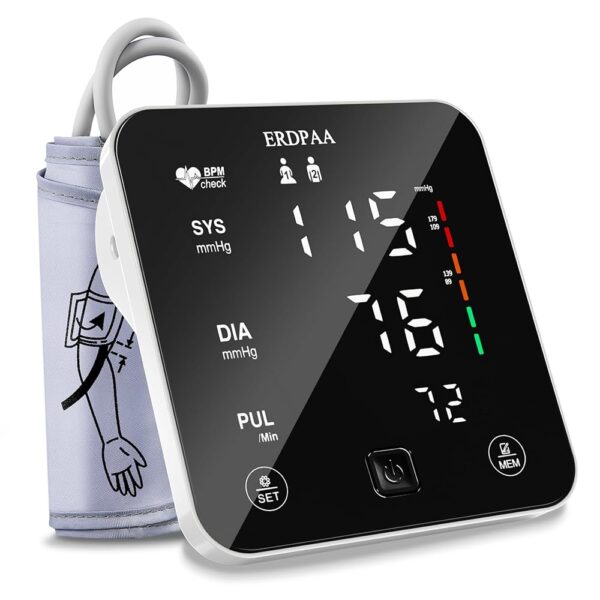
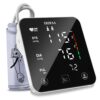
The ERDPAA AES-U231 is an upper arm blood pressure monitor with a large backlit display, 180 stored readings across two users, an automatic three reading average and automatic arm detection. It is marketed throughout as an XL cuff device for larger arms, and that framing is the first thing that needs examining, because the published range does not support it.
Before the specifications, the standing point. This review describes a device and the data published for it. It does not interpret readings, it does not tell anyone what their numbers mean, and a home blood pressure monitor does not replace professional medical care.
The XL Label Does Not Match the Cuff Range
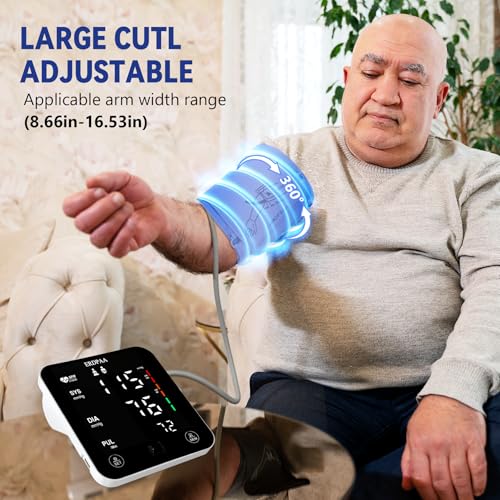
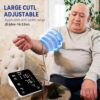
The product title calls this a monitor with an XL pressure cuff and a large cuff. A bullet heading calls it an XL cuff design. The body of that same bullet then gives the actual figure: the adjustable cuff ranges from 8.7 to 15.7 inches. The structured band size field agrees, recording 15.7 inches.
That is not an extra large cuff. A standard wide range adult cuff on most monitors in this catalog reaches 16.5 inches, and a genuine extra large cuff reaches 21 inches or beyond. A cuff topping out at 15.7 inches stops nearly an inch short of the ordinary adult ceiling, which means a buyer who came here specifically because standard cuffs have not fitted them would be buying a cuff smaller than the one that already failed.
This matters more than a labeling quibble. A cuff that is too small for an arm has to squeeze harder than it should, and the result is a wrong reading on a device that is working perfectly, with no error shown on the screen. Measure the bare upper arm at the midpoint between shoulder and elbow before ordering. If your measurement exceeds 15.7 inches, this device is out of range whatever the title says, and a genuinely oversized option such as the iHealth extra large cuff on a compatible monitor is the correct purchase.
What Is Actually Documented
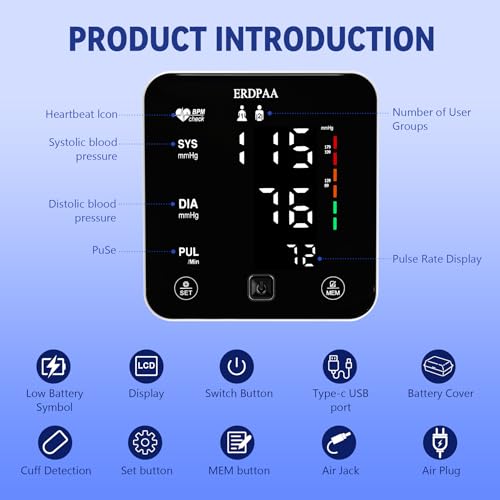
Memory holds 90 readings for each of two users, 180 in total, and the device takes three consecutive readings to calculate an average. Averaging is the most useful feature on the page, because single readings scatter and a short series is a steadier record than any one of them.
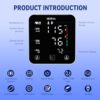
The display is described as a large backlit panel with specially enlarged fonts, readable day or night. No digit height is published, so the character size has to be judged from photographs. A measurement takes about 30 seconds from a single button press.
Automatic arm detection is included, flagging an on-screen alert if the cuff is used incorrectly. Treat that as a convenience rather than a guarantee: it can catch an obvious application error, but it cannot confirm the cuff is the right size, at the right height, or aligned over the inside of the arm, and those are the errors that distort readings.
The rechargeable question
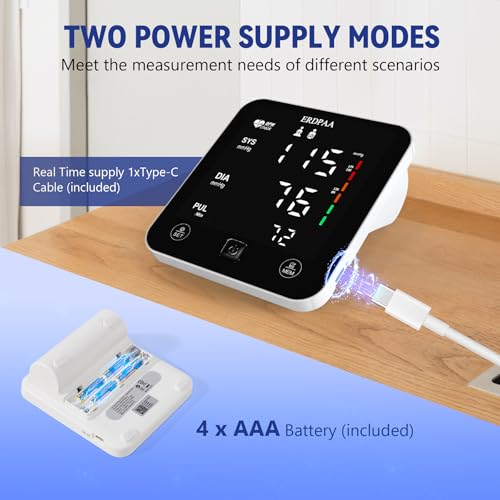
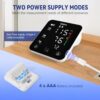
The product title describes this as a rechargeable device. The bullets say something different: the monitor runs on four AAA batteries or from a Type-C interface, with no mention of an internal cell, no charge time and no charge cycle count. The power source field simply says battery powered, and the included components field lists only a cuff.
Disposable AAA cells plus a USB port is not the same arrangement as a rechargeable device, and the previous copy on this page compounded the confusion by describing a rechargeable function that removes the need to buy batteries. Nothing in the listing supports that, so it has been removed. If you want a device that holds a charge, confirm it with the seller before ordering rather than buying on the title.
The Cardiovascular Health Claim
One bullet needs naming directly. It states that the monitor uses the latest chip and advanced algorithms trained on data from more than 3,000 testers, that it ensures exceptionally accurate readings, that it detects and alerts the user to irregular heartbeats, and that it offers a comprehensive overview of your cardiovascular health for peace of mind and effective management.
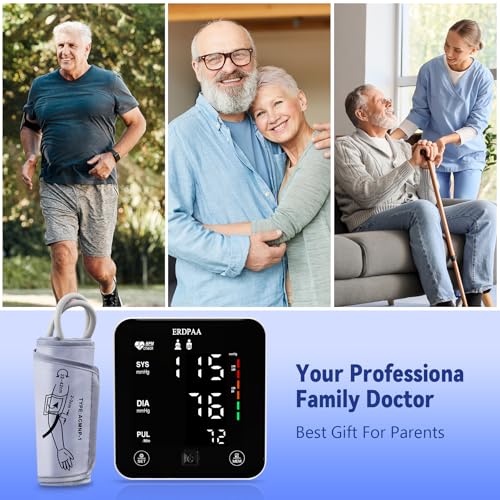
The last part is the problem. A home blood pressure monitor measures pressure and pulse. It does not provide an overview of anyone’s cardiovascular health, comprehensive or otherwise, and it does not manage anything. That is the seller’s framing and we do not adopt it.
The rest is attribution. We do not test devices and we do not verify manufacturer claims. No accuracy figure, no tolerance, no validation protocol and no regulatory clearance appears anywhere in the data, and a tester count is not a protocol. Validation status can be checked independently through the registries medical bodies maintain. The irregular heartbeat alert is a flag rather than a diagnosis: it indicates the device saw an irregularity during that measurement, without identifying what it is or separating a genuine finding from an artifact caused by movement or a poorly placed cuff. Note it and raise it with a clinician.
Using It Correctly
Fit the cuff to the bare upper arm rather than over a sleeve, with the tubing running down the inside of the arm toward the palm and the lower edge roughly an inch above the elbow crease, closed so one finger slides underneath with mild resistance. Sit with the back supported and both feet flat on the floor, rest the arm so the cuff sits level with the heart, and stay silent and still through inflation and release.
Rest for several quiet minutes before the first reading rather than measuring straight after activity, and use the same arm at the same times each day. Because the device averages three consecutive readings, take the full sequence rather than stopping after one figure, and set the user slot before you start so the two banks stay separate.
Limits and the Wider Model Family
The description field is empty, so five bullets and a specification table carry everything. Nothing is published about the pressure or pulse measurement range, tolerance, digit height or battery life. There is no item model number field, only a model name reading AES-U231, and the unit measures 5 by 4 by 5 inches at a listed 1.1 pounds.
The manufacturer of record is Alicn Medical in Shenzhen, which supplies several brands in this catalog under the AES model prefix. Related pages include the GUAEVER AES-U131, the Greetmed AES-U522 and the Longevousioo AES-U382. One factory, several brand names, and specification blocks that do not always agree.
The point that outranks the rest: this device produces numbers and averages them. It does not diagnose, it does not assess anyone’s cardiovascular health, it does not replace professional medical care, and nothing in this review is guidance about a condition or a treatment. The full selection sits in our blood pressure monitor category.
Who Should Buy It, Who Should Not
Buy it if your arm measures inside 8.7 to 15.7 inches, an automatic three reading average and 90 readings per user suits you, and you are ignoring the XL branding entirely. Skip it if your arm is above 15.7 inches, because the cuff will not fit whatever the title says, and skip it too if you need a device that genuinely holds a charge, if you need documented accuracy or validation, or if the promise of a comprehensive cardiovascular overview is what drew you here.