



Description
What This Page Can and Cannot Tell You
This review has to open with an unusual admission. The listing data stored for this FOTOSY blood pressure monitor is almost entirely empty. There is no product title in the source record, no description, no feature bullets and no specification table at all. Three fields survive: the brand, FOTOSY; the manufacturer of record, Shenzhen Yuezhongxing Technology; and a UPC, 755560839644. That is the complete set of verifiable facts available for this product.
We are not going to fill that gap with invention. On a regulated medical device, writing a specification that no source supports would be worse than writing nothing, so what follows is an honest account of what is missing, why each missing item matters, and exactly what to confirm before you would be in a position to buy this device sensibly. If you need a monitor you can evaluate on paper today, the better move is to start from a product whose listing publishes its numbers, and our blood pressure monitor category has plenty that do.
The standing statement applies here as it does everywhere on this site: a home blood pressure monitor is a measuring device. It does not replace professional medical care, it does not diagnose anything, and nothing on this page interprets a reading or tells anyone what their numbers mean.
The Cuff Range Is Missing, and That Is the Serious One
No cuff circumference range is published for this product. None. This is the specification that matters more than any other on a blood pressure monitor, because a cuff that is too small or too large produces wrong readings on a device that is functioning perfectly, and nothing on the display warns you that it is happening. A monitor with an undersized cuff does not throw an error; it simply returns numbers that do not reflect what is actually happening in the artery.
Before ordering any monitor, measure the circumference of your bare upper arm at the midpoint between the shoulder and the elbow, and write the number down. Then check it against the range the manufacturer publishes. For this product there is no range to check against, so the measurement has to be the first thing you send the seller. If the seller cannot answer with a specific range in centimeters or inches, that answer is itself the decision.
Form Factor Is Not Documented Either
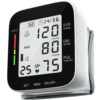
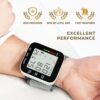
The record does not state whether this is an upper arm device or a wrist device, and that distinction is not cosmetic. Upper arm monitors are the usual form factor for home monitoring. Wrist monitors are far more sensitive to how the joint is held and how high the device sits relative to the heart, so a wrist device used casually can produce a very different number from the same device used carefully. The two are not interchangeable, and a buyer who assumes they are receiving one and receives the other has bought the wrong product.
If you are weighing the two, compare a documented upper arm unit such as the Omron BP5100 Bronze against a documented wrist unit such as the Care Touch digital wrist monitor, and make the decision on published specifications rather than on a listing that names neither.
What Else Is Absent
The list of unpublished items is long enough to be worth stating in full, because each entry is something a careful buyer would normally use to choose.
There is no model number, which means the device cannot be looked up in a manufacturer’s documentation, matched to a manual, or checked against any independent registry. There is no power source, so whether it runs on AA cells, AAA cells, an internal rechargeable battery, a mains adapter or a USB port is unknown, and so is battery life. There is no display specification and no digit height, so legibility, which is the reason many households buy a home monitor in the first place, cannot be assessed at all. There is no memory capacity and no statement of how many users the device supports. There is no averaging function documented. There is no mention of irregular heartbeat detection, and no accuracy figure, tolerance, validation protocol or regulatory clearance claim of any kind.
It is worth being clear about what the absence of a validation claim does and does not mean. It does not establish that the device performs badly. It establishes that nothing has been published from which anyone could judge, which for a device people may use to inform decisions about their health is a meaningful gap rather than a paperwork detail.
Unsupported Claims in the Previous Copy
The short description that ran on this page before this rewrite described accurate readings, a voice feature for users who struggle to read the screen, a convenient carrying case, fast results and an easy interface. None of those claims is supported by anything in the source record. There is no voice feature documented, no case documented, no speed figure and no accuracy figure. Those statements have been removed rather than repeated.
Anyone who specifically wants a talking monitor should buy one that documents the feature in its own specifications. A voice output is either present in the hardware or it is not, and it is not a feature to take on trust from secondhand copy. The same applies to a carrying case, which some monitors include and many do not.
What to Confirm Before Buying
If you still want to pursue this particular unit, there is a short list to put to the seller in writing, and it is the same list worth using on any thinly documented monitor. Ask for the cuff circumference range in centimeters. Ask whether it is an upper arm or wrist device. Ask for the model number. Ask what powers it and how many batteries of what type it takes. Ask how many readings it stores and for how many users. Ask whether the device has been validated and, if so, under which protocol, and ask for the regulatory clearance number if one is claimed.
Those seven answers turn an unbuyable listing into a comparable one. If they do not arrive, compare against products that publish them up front, such as the A&D Medical UA-651 or the Greater Goods 0663, both of which give a buyer something concrete to weigh. FOTOSY also appears elsewhere in this catalog with a better documented W1101L listing, which is a more sensible place to look at the brand.
Using Any Monitor Correctly
Whatever you end up buying, the technique is the same and it matters as much as the hardware. Fit the cuff to the bare upper arm rather than over clothing, with the tubing down the inside of the arm toward the palm and the lower edge about an inch above the elbow crease, snug enough that a finger slides underneath with mild resistance. Sit with the back supported and both feet flat, rest the arm so the cuff is level with the heart, and stay silent and still while the cuff inflates and releases. Rest for a few quiet minutes first. Use the same arm at the same times of day so the record compares with itself, and take the record to a clinician rather than drawing conclusions from it.
Who Should Buy It, Who Should Not
Buy it only if you have obtained the cuff range, the form factor and the model number directly from the seller and they suit you. Skip it if you are choosing on published specifications, because there are none here to choose on, and a blood pressure monitor is not the category in which to buy blind.