Description
Who the Greetmed CK-W118 is for, and the wrist question first
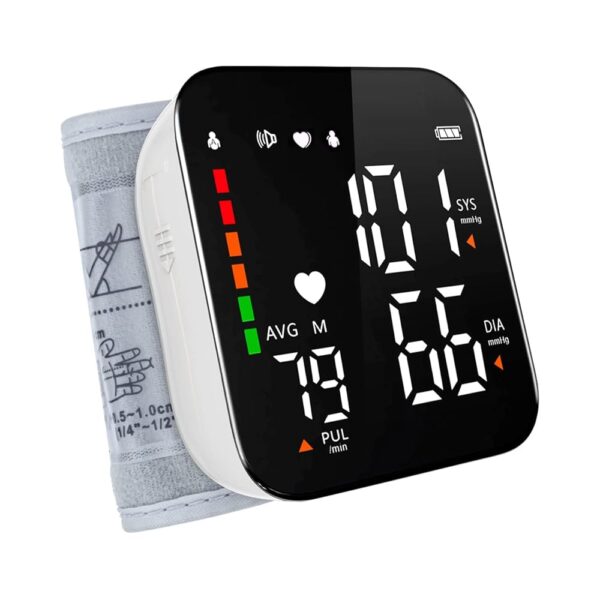
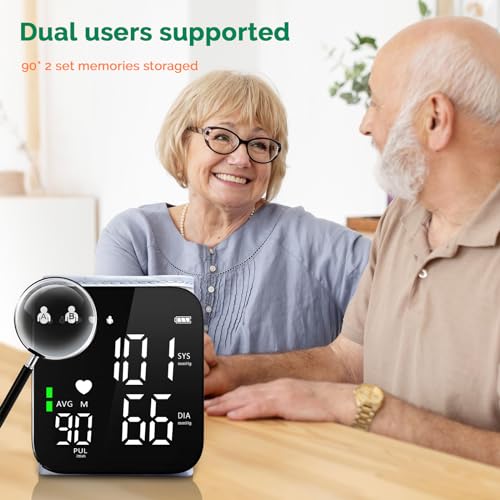
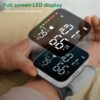
This is a talking wrist blood pressure monitor with two user memories, a full screen LED display and a carrying case. The voice function can be switched off in the settings, which is a sensible piece of design in a shared household. It records numbers for a clinician to review. It is not a diagnostic device and it does not replace professional medical care.
Before the features, the category. Wrist devices and upper arm devices are not interchangeable. On the wrist, how high you hold your arm relative to your heart changes the number, and the site is smaller and more variable than the upper arm. Upper arm devices are the usual recommendation for home monitoring, and a wrist device is normally chosen for a particular reason, most often portability or an arm cuff that cannot be fitted. Talking upper arm monitors exist as well, so the voice function alone does not push you into the wrist category.
Wrist size and the specifications that matter
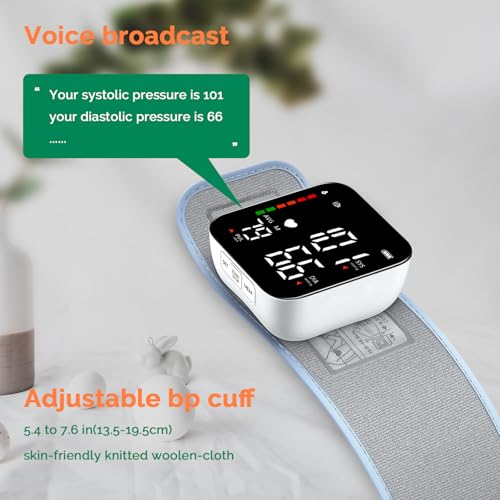
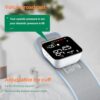
The listing states an adjustable wrist cuff covering 5.3 to 7.7 inches, and the stored attribute agrees. That upper limit is lower than several competing wrist monitors, which reach 8.5 inches, so measure the bare wrist you intend to use, just above the wrist bone, before ordering. Fit governs the result: a wrist cuff that cannot close snugly will not compress the artery as the device expects, and the display will report a number rather than an error.
The strap is described as a skin friendly knitted woolen cloth. That is a comfort choice rather than a measurement one, and it is worth knowing if anyone in the household reacts to wool against skin. It is also worth knowing when it comes to cleaning, since a knitted strap holds moisture more readily than a coated nylon one.
Memory, display and power
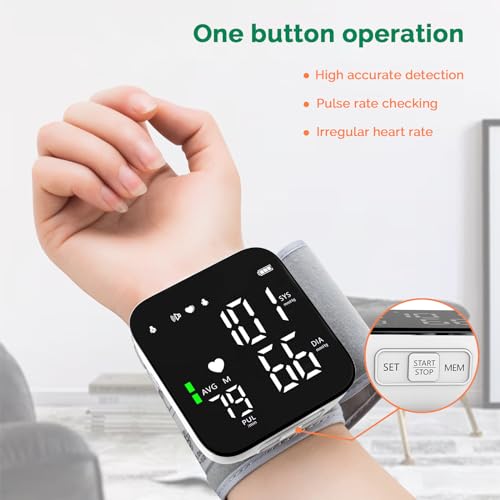
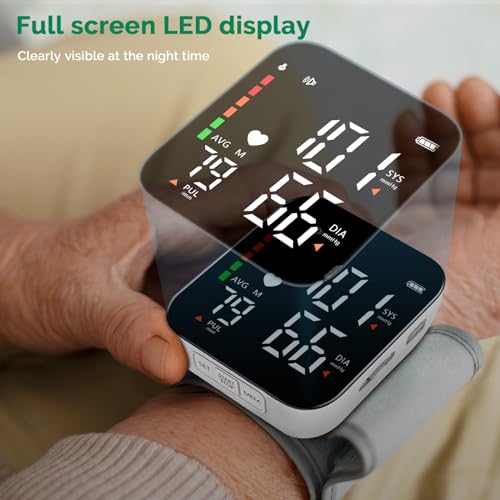
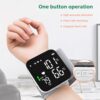
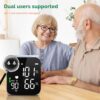
The device supports two users with 90 measurements each, 180 in total, stored with date and time so that historical readings can be compared. The display is described as a large full screen LED. Operation is a single button, and the device has automatic shut off and a low battery reminder. The box contains the monitor, a carrying case and two AAA batteries, and the unit weighs 8 ounces packed.
The voice function reads out both the measurement results and any alerts. Where a spoken alert appears, treat it as a prompt rather than a verdict. It is driven by thresholds the manufacturer programmed into the device, and a machine cannot know your history, your age or your medication. We are not reprinting those thresholds here, because interpreting a number for a particular person is clinical work.
Using it correctly, and what the readings are for
Sit with your back supported and your feet flat on the floor, and rest quietly for several minutes before starting. Fit the cuff on a bare wrist, snug rather than tight, then support your forearm with the other hand or on a cushion so the device sits at about the height of your heart. Hold still and stay silent while it inflates. Holding the wrist in your lap or up near your chest is the classic error and it changes the number. Use the same wrist at about the same time each day, and if two people share the device, check the user slot is correct before you start.
What you produce is a record. What a reading means, whether a pattern across your readings is significant, and whether anything about your care should change are questions for a healthcare professional who knows your history and your medication. This device does not replace professional medical care, and no reading from it should be used to start, stop or alter treatment on your own.
Claims, limits and gaps
This listing is unusually restrained on accuracy language, which is worth noting in a category full of superlatives: it describes the device as easy to use and clear to read rather than making claims about precision. There is no accuracy figure in mmHg, no independent validation protocol and no assessing body named anywhere, so check an independent validation listing for this model number if that matters to you. We do not test products and we will not describe any monitor as accurate in our own voice.
On gaps: no irregular heartbeat detection is described, no averaging function is described, and there is no app or wireless connection, so 90 readings per user is the whole history unless you write them down. No heart level positioning aid and no cuff tightness indicator is described, which leaves positioning entirely to the user and is the recurring weakness of the wrist category. No warranty term appears in the record we hold, and no display dimension is given.
A note on our own earlier summary of this product, which described the clarity of the voice function in terms that implied someone here had listened to it. We do not test or use products, and the wording has been removed.
One habit is worth adopting with any device that lacks an averaging function, and this one lacks it. Take two or three measurements a minute apart rather than one, and write all of them down with the date, the time and which wrist you used. Single readings vary for ordinary reasons, and a short series taken the same way each day is far more useful to a clinician than a scattering of individual numbers pulled out of a memory bank. The device memory is then a backup rather than the record itself, which is the right way round, and it survives a flat battery or a reset that clears the stored readings without warning.
A platform note that helps when comparing
The CK-W118 model number appears in our catalog under several brand names, with the manufacturer recorded here as Shenzhen Changkun Technology. That is a shared hardware platform badged for a number of sellers. The measuring components are likely to be the same across those listings, and what varies is the package, the memory figure enabled in firmware, the warranty and who you deal with if something fails. Ratings are split across the listings rather than pooled, so a page with few ratings is not necessarily an unpopular product. Read across the family before choosing which badge to buy.
Alternatives worth comparing
The same model number appears as a second Greetmed CK-W118 listing and under other brands as the maguja CK-W118 and the BTYOLFUP CK-W118. The MBUPAI CK-W355 comes from the same manufacturer with USB charging. For a wrist device with a heart level aid, the yuwell YE8800CR is the comparison. Our index of home monitors and cuffs separates wrist listings from arm listings.
Who should buy it and who should not
Buy it if spoken readings help someone in the household, your wrist measures between 5.3 and 7.7 inches, two people will share it, and you want a case and batteries in the box. Do not buy it if your wrist is near the top of that range, do not choose it over an upper arm device without a reason, and do not expect a positioning aid, averaging or an app.