



Description
Who the yuwell YE8800CR is for, and the wrist question first
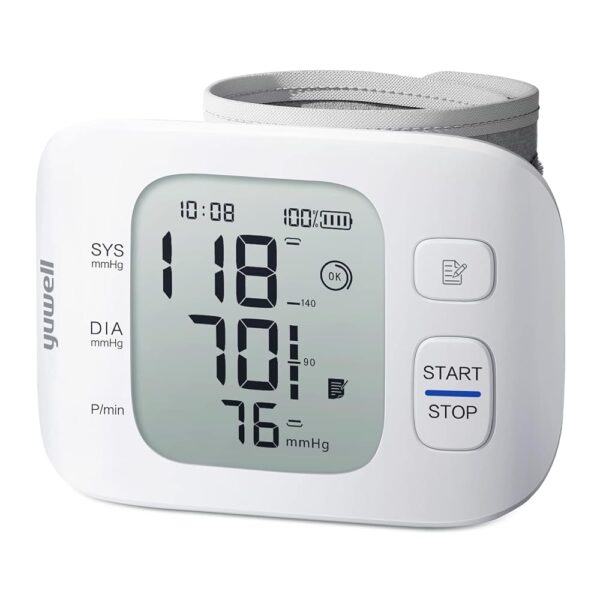
This is a rechargeable talking wrist blood pressure monitor with a heart level positioning aid, a travel case and a stated 90 day battery life. It records numbers for a clinician to review. It is not a diagnostic device and it does not replace professional medical care.
The category comes first. Wrist devices and upper arm devices are not interchangeable. On the wrist, how you hold your arm relative to your heart changes the number, and the site is smaller and more variable than the upper arm. Upper arm devices are the usual recommendation for home monitoring, and a wrist device is normally chosen for a particular reason. Where a wrist device is the right choice, this one at least addresses the central weakness of the category, which is the reason to consider it.
Wrist size and the specifications that matter
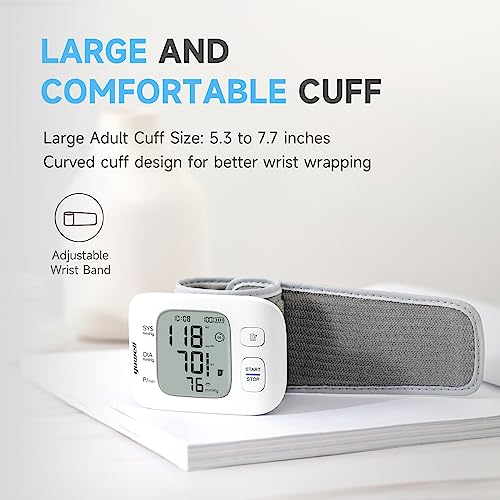
The listing states an adjustable wrist cuff fitting 5.32 to 7.68 inches. Our stored band size attribute records only 7.68 inches, dropping the lower bound, so use the full range. Measure the bare wrist you intend to use, just above the wrist bone, before ordering. That upper limit is lower than several competing wrist monitors, which reach 8.5 inches, so it is worth checking rather than assuming.
One wording point: the listing describes the cuff as fitting adult arm sizes. It is a wrist cuff and it fits wrists. That is careless phrasing rather than a misleading specification, but it is the kind of sentence that leads someone to buy the wrong category of device.
Heart Zone Guidance, which is the feature that matters
The listing describes Heart Zone Guidance, which guides your wrist into the proper position at heart level. On a wrist device that is the most valuable feature available, because arm height is the dominant source of error in wrist measurement and it is the thing a user cannot easily judge for themselves. Use it rather than working around it.
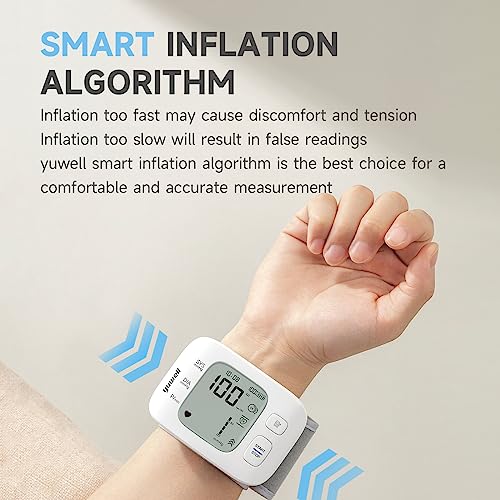
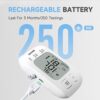
The device also describes intelligent pressurization intended to reduce the discomfort of over inflation, a 500 mAh built in battery stated to last 250 measurements or 90 days per charge, automatic power off after three minutes, and 74 stored measurements. Note that 74 is a small memory by the standards of this catalog and no number of user slots is stated, so treat it as a single user device unless the seller confirms otherwise. The unit weighs 110 grams and the box contains the monitor, the cuff, a USB charging cord, a travel case and a manual.
The spoken verdict, and why we are flagging it
This device does something most do not, and it needs saying clearly. The listing states that at the end of a measurement the monitor will announce aloud whether your blood pressure is normal or not, describing this as an intelligent diagnosis.
That is a category indicator delivered as speech. The device is comparing your reading against thresholds the manufacturer programmed in and reading out a verdict. It does not know your age, your history, your medication or anything else about you, and no device can. Hearing a machine say the word normal, or not normal, carries a weight that a colored bar on a screen does not, and that is precisely why it deserves flagging rather than listing as a feature.
Treat what it says as a prompt, not an answer. If the announcement concerns you, write the reading down with the date and time and take it to your next appointment. If the announcement reassures you, that is not a reason to skip an appointment or to stop a medication. We are not reprinting the thresholds involved, because interpreting a number for a particular person is clinical work rather than a device function. If the spoken verdict would worry a user in your household, check whether it can be disabled separately from the spoken reading before ordering, because the listing does not say.
Using it correctly, and what the readings are for
Sit with your back supported and your feet flat on the floor, and rest quietly for several minutes before starting. Fit the cuff on a bare wrist, snug rather than tight. Then support your forearm with the other hand or on a cushion, raise it until the position guidance confirms heart level, and hold still and silent while it inflates. Use the same wrist at about the same time each day, and write the numbers down, since 74 stored readings is not a long history.
What you produce is a record. What a reading means, whether a pattern across your readings is significant, and whether anything about your care should change are questions for a healthcare professional who knows your history and your medication. This device does not replace professional medical care, and no reading from it should be used to start, stop or alter treatment on your own.
Claims, limits and gaps
The listing states that advanced measuring techniques provide the most accurate reading. That is the seller’s description in superlative form, and we do not test products, so we will not describe any monitor as accurate in our own voice. No independent validation protocol and no assessing body is named anywhere in this listing. Check whether this model number appears on an independent validation listing if that matters to you.
On gaps: no user count is published against the 74 reading memory, no averaging function is described, and there is no app or export. Irregular heartbeat detection appears in the product title but not in the feature text, so its behavior is not described. The stored components field lists batteries alongside a device the listing says has a built in rechargeable cell, which does not fit together and is worth confirming. No warranty term appears in the record we hold.
Alternatives worth comparing
Within the same brand, the yuwell upper arm monitor and the yuwell YE680B are the siblings. Among wrist devices with positioning aids, the Omron BP6350, which combines heart level guidance with a cuff wrap guide is the closest comparison. For other talking wrist devices, the Greetmed CK-W118 and the AMZ VISION W1681 both offer a voice that can be switched off. Our index of home monitors and cuffs separates wrist listings from arm listings.
Who should buy it and who should not
Buy it if a wrist device suits your situation, your wrist measures between 5.32 and 7.68 inches, and a rechargeable battery with heart level guidance is what you want. Do not buy it as a first monitor if an upper arm cuff would fit you, do not rely on a 74 reading memory as a record, and do not treat a spoken verdict about your blood pressure as a clinical opinion. It is not one.