

Description
Who This Monitor Is For and What It Settles
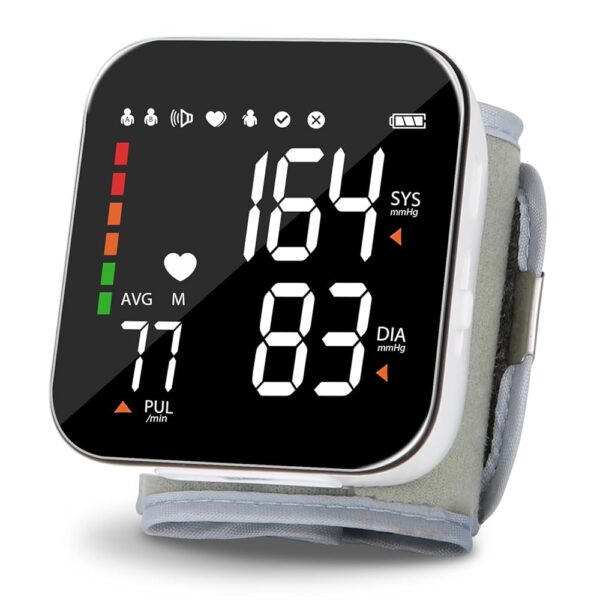
The BTYOLFUP CK-W118 is a rechargeable wrist blood pressure monitor with a backlit display, a voice broadcast that can be muted, 180 stored readings across two users, and a hard case. It is built for people who want something pocket sized, and specifically for people who would rather hear a reading than squint at one.
The form factor is the real decision here, and it should not be glossed over. Wrist monitors are not equivalent to upper arm monitors. On the wrist, the angle of the joint and the height of the device relative to the heart both change the result, so positioning matters far more than it does on the arm. Upper arm devices remain the usual recommendation for home monitoring, and a documented arm unit such as the Omron BP5100 Bronze is the comparison worth making before choosing a wrist device purely for convenience. This review describes a device; it does not interpret readings, and a home monitor does not replace professional medical care.
The Specifications That Matter
The wrist cuff range appears in exactly one place, the last bullet, which gives 5.3 to 7.6 inches. That is the number to work from, because the structured specification fields are worse than useless here: the band size field reads Long, which is not a measurement, and the size field reads Small, which contradicts it. Neither tells a buyer whether the strap will close on their wrist.
Measure around the bare wrist just above the wrist bone before ordering. A wrist strap that is too loose will not seal against the skin and one that will not close at all is simply the wrong purchase, and neither problem announces itself on the display.
Power, display and memory
Power is a built in rechargeable cell, listed in the specification block as one lithium ion battery, included, and described in a bullet as removing the cost of replacing disposables. That is one of the cleaner arrangements in this bracket, though no charge time, charge cycle count or battery life estimate is published anywhere.
The display is where the record gets muddled. The product title calls it an LED backlit display, a bullet calls it a large backlit screen with big numbers, and the structured display field simply says Digital. LED and LCD are different technologies and the listing never settles which one is fitted. No digit height is published either, so how large the numbers actually are has to be judged from photographs. Memory is 90 readings for each of two users, 180 in total, with the user switched by pressing the M button before measuring.
The unit measures 3.03 by 2.76 by 1.34 inches and weighs 5.22 ounces, matching the 148 gram figure elsewhere in the record, so the weight fields at least agree. The model number is CK-W118, though the model name field instead contains the generic phrase wrist electronic sphygmomanometer, which is a description rather than a designation.
The Claim That Needs Flagging
The first bullet states that after pressing the start button the device will detect blood pressure and pulse and give out alerts if your health is compromised. That sentence needs naming rather than repeating. A home blood pressure monitor measures pressure and pulse and compares the result against thresholds stored in its firmware. It does not assess whether anyone’s health is compromised, it does not screen for a condition, and it is not in a position to raise an alert about a person’s health. That is the seller’s framing and we do not adopt it.
Nothing in the listing supports the claim either. There is no accuracy figure, no tolerance, no validation protocol and no regulatory clearance cited anywhere in the data. Whatever indicator the device shows, treat it as a value flagged against a stored number and take the readings to a clinician, who is the only party able to interpret them. Validation status for home monitors can be checked independently through the registries medical bodies maintain, and on an unvalidated wrist device that check is worth more, not less, because the wrist adds a positioning variable on top of everything else.
Using It Correctly
Rest the forearm on a table, sit with the back supported and both feet flat, and raise the wrist so the device sits level with the heart, supporting the elbow as the manual directs. Keep the wrist straight rather than bent, keep the device against bare skin with the sleeve pushed clear, and stay silent and still through the measurement. Rest for several quiet minutes first rather than measuring immediately after moving around, and use the same wrist at the same times each day so the record compares with itself.
The voice broadcast reads results aloud and can be muted when privacy matters, which is a sensible pairing of features. Set the user bank with the M button before the first reading so the two logs stay separate, and charge the unit fully before starting a run of readings rather than partway through.
Limits and Gaps in the Published Data
The description field is empty, so five bullets and a specification table carry the whole technical case. Missing from the data: any pressure or pulse measurement range, any tolerance, any accuracy figure, any validation protocol, any clearance claim, any digit height, any charge time, any battery life, any averaging function, and any mention of irregular heartbeat detection. The included components field lists only a cuff, despite the title and bullets describing a protective case, so what actually arrives in the box is not clearly documented either.
The manufacturer of record is Shenzhen Changkun Technology, which supplies several brands in this catalog under the same CK model prefix. The CK-W118 designation in particular appears on other pages here, including a Greetmed CK-W118 and a second Greetmed CK-W118 listing. Identical model numbers under different brand names usually means one factory serving several sellers, and the specifications published on one page should not be assumed to hold for another.
The point that outranks everything above: this device collects numbers. It does not diagnose, it does not assess anyone’s health, it does not replace professional medical care, and nothing in this review is guidance about a condition or a treatment.
Alternatives Worth Comparing
If voice output is the requirement, the MBUPAI CK-W355 documents the same feature on a wrist device and publishes its wrist range in the specification block rather than only in a bullet. Buyers who want a wrist unit with a longer track record can weigh the SureLife WRS-35H. The full shelf, arm and wrist together, sits in our blood pressure monitor category.
Who Should Buy It, Who Should Not
Buy it if your wrist measures inside 5.3 to 7.6 inches, you want spoken results with a mute option, and a rechargeable cell suits you better than disposables. Skip it if you can use an upper arm cuff, if the specification fields saying Long and Small in place of a range bother you, if you need documented accuracy or validation, or if a listing telling you the device alerts when your health is compromised is the kind of overreach that should end a purchase.