



Description
Who This Monitor Is For and What It Settles
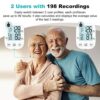
The HealthTree U80B is an upper arm blood pressure monitor with an LCD display and an adjustable cuff. That is very nearly the whole of what the listing documents, because this is one of the thinnest product records in the catalog: a single feature bullet, an empty description, and a specification table that contradicts itself on the one figure that matters most.
Before going further, the standing point. This review describes a device and its published data. It does not interpret readings, it does not tell anyone what their numbers mean, and a home blood pressure monitor does not replace professional medical care.
The Cuff Range, and Why the Label Is Wrong
Cuff circumference is the specification that decides whether a monitor can work for a given arm, because a cuff that is too small or too large produces wrong readings on hardware that is functioning perfectly, and nothing on the display warns you.
The only bullet on this listing states that the cuff is adjustable to fit arm sizes ranging from 22 to 36 cm. In inches that is roughly 8.7 to 14.2. The structured band size field, meanwhile, says 17 inches, which is about 43 cm. And the size field says extra large.
Those three do not describe the same accessory, and the direction of the error matters. A cuff topping out at 36 cm is not extra large; it is smaller than the ordinary wide range adult cuff supplied with most monitors on this shelf, which typically reaches 42 cm. A buyer with a large arm who chooses this device because the size field says extra large would be buying a cuff nearly two and a half inches shorter than the one that already did not fit.
Measure the bare upper arm at the midpoint between shoulder and elbow and treat 22 to 36 cm as the working figure, because it is the only number attached to an actual sentence about the cuff. If your measurement exceeds 36 cm, this device is out of range whatever the size field says, and a genuinely oversized option such as the iHealth extra large cuff paired with a compatible monitor is the correct purchase. If you cannot get the discrepancy resolved in writing by the seller, that answer is itself the decision.
What Else Is Not Published
The list of missing items on this listing is long enough to be worth stating in full, because each entry is something a careful buyer would normally use to choose.
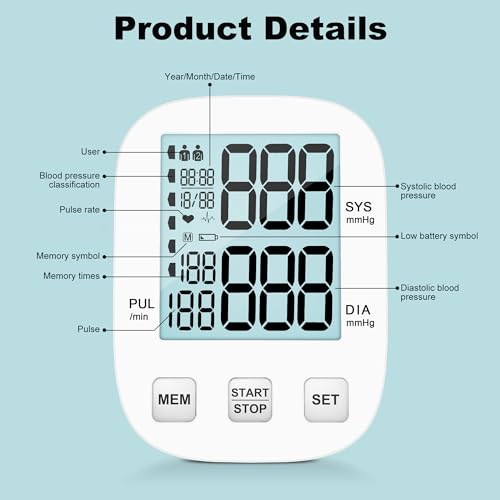
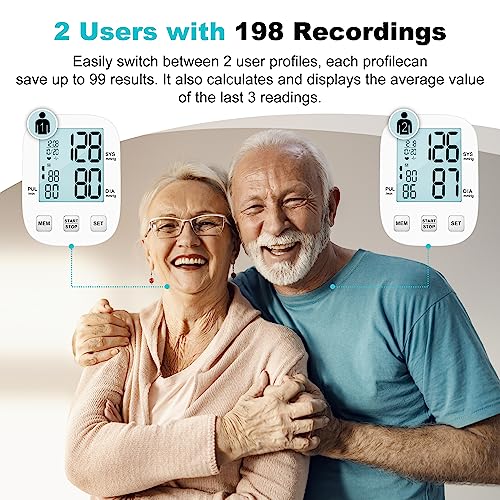
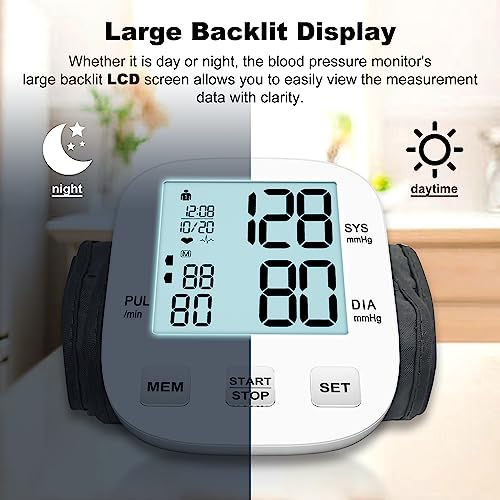
There is no memory capacity and no user count, so whether this device stores anything at all is unknown. There is no display size and no digit height, despite the product title advertising a large backlight display, and no bullet mentions the screen. There is no measurement time, no averaging function, no irregular heartbeat indicator, no measurement range for pressure or pulse, no tolerance, no accuracy figure, no validation protocol and no regulatory clearance. There is no use-for field stating whether this is an arm or wrist device, though the title says upper arm.
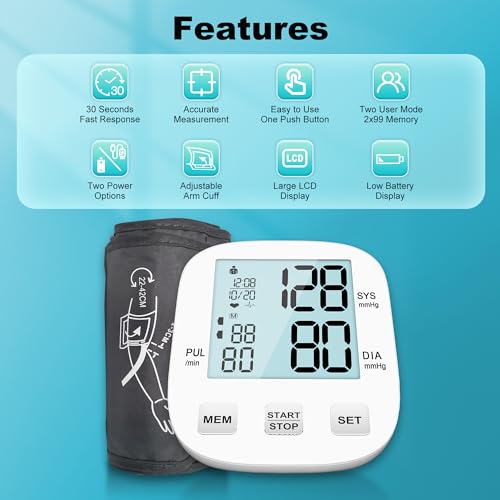
The previous copy on this page described dual power options with batteries or USB, a large backlit display and clear buttons. No USB appears anywhere in the source data, and no bullet describes the display or the buttons, so those claims are unsupported and have been removed rather than repeated.
Two fields that cannot be right
The battery field says four AAAA batteries are required and included. AAAA is a real but very unusual cell, used mostly in styluses and small penlights, and no home blood pressure monitor in this catalog uses them. This is almost certainly a typing error for AAA, but it is not our error to correct, and anyone buying spares should confirm the cell size with the seller rather than ordering from the listing.
The product dimensions read 0.5 by 0.2 by 0.3 inches at 11.64 ounces. Half an inch by two tenths by three tenths is smaller than a postage stamp, and it cannot describe a monitor, its packaging or its cuff. The weight figure of 330 grams elsewhere in the record is plausible for a monitor; the dimensions are not.
What the Listing Claims
The product title describes an accurate adjustable digital cuff. That is the seller’s word and not ours. We do not test devices and we do not verify manufacturer claims, and with no tolerance, protocol or clearance published anywhere there is nothing behind the word to check. Validation status for home monitors can be looked up through the independent registries medical bodies maintain, and on a listing this thin that check is the only meaningful thing a buyer can do before ordering.
The manufacturer of record is given as HealthTree itself. The U80B model designation belongs to a family of monitors made by Shenzhen Urion and sold in this catalog under many brand names, including the AQESO U80B, the Elera U80B and the Livaroci U80B. Those pages publish different cuff ranges and different memory arrangements from one another, so a shared model number tells you very little about what arrives.
Using It Correctly
Fit the cuff to the bare upper arm rather than over a sleeve, with the tubing running down the inside of the arm toward the palm and the lower edge roughly an inch above the elbow crease, closed so one finger slides underneath with mild resistance. Sit with the back supported and both feet flat on the floor, rest the arm so the cuff sits level with the heart, and stay silent and still through inflation and release.
Rest for several quiet minutes before the first reading rather than measuring straight after activity, and use the same arm at the same times each day so the record compares with itself. Since no memory capacity is documented, keep a written log rather than assuming the device will hold one for you.
The Statement That Matters
This device produces numbers. It does not diagnose, it does not replace professional medical care, and nothing in this review is guidance about anyone’s health or treatment. Take the log to a clinician and let the interpretation happen there. The full selection of monitors and cuffs sits in our blood pressure monitor category, which is the right place to start if a listing with one bullet and a contradictory cuff figure is not enough to buy on.
Who Should Buy It, Who Should Not
Buy it only if the seller confirms the cuff range in writing and it covers your arm, and you accept that memory, display size and battery type are all unknown until the box arrives. Skip it if your arm is above 36 cm, because the size field saying extra large does not make the cuff longer, and skip it too if you need documented memory, documented accuracy, or a specification block whose dimensions describe a real object.