

Description
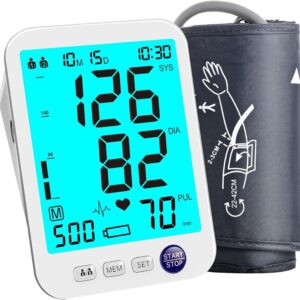
The Invaxe AOJ-30G is an upper arm blood pressure monitor with a 4.5 inch backlit screen and storage for 199 readings each across two users. Its listing carries a direct contradiction in the one specification that matters most, so that is where this review starts. Everything here comes from the published listing data. It is not medical advice, it does not tell you what any reading means, and a home monitor does not replace professional medical care. Readings belong in a conversation with a clinician who knows your history.
The cuff range is published twice, with two different answers
Cuff fit determines whether a reading is worth anything. A cuff that is too small or too large produces wrong numbers on a device that is functioning perfectly, and no amount of care with technique corrects for it. It is a measurement problem, not a comfort problem.
The product title on this listing states an adjustable large cuff fitting 9 to 17 inches. The structured band size field on the same listing reads “16.5 inch”. Those disagree in two ways: the field gives a single number where a cuff needs a minimum and a maximum, and the number it gives is half an inch below the upper bound in the title.
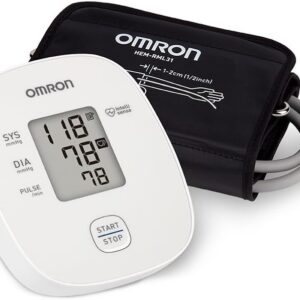
Half an inch sounds trivial and is not, because it falls exactly where the largest adult arms sit. If your upper arm measures between 16.5 and 17 inches, this listing does not tell you whether the supplied cuff fits you. Measure your arm at the midpoint between shoulder and elbow before ordering and, if you are anywhere near the top of the range, ask Invaxe to confirm the actual cuff dimensions in writing. Where a listing publishes an unambiguous range, such as the OMRON Gold BP5350 at 9 to 17 inches, that certainty is worth something in itself.
Who this monitor is for and what it settles
The AOJ-30G settles whether a large screen and a large memory can be had cheaply. It publishes a 4.5 inch backlit display, which is bigger than most devices in the blood pressure monitor section, and 199 stored readings for each of two users, which is among the largest on device memories here. For a household where two people measure daily and nobody wants a phone app involved, that combination is the whole argument.
Nothing in the listing describes Bluetooth, an app or any means of exporting readings, so what the device holds is the complete record you can bring to an appointment. Package dimensions are 6.22 by 4.65 by 3.74 inches at about 1.19 pounds, and the included components are the cuff, a battery and an instruction manual.
The features named in the title need careful reading
The product title describes the device as an arrhythmia and home hypertension detector. Both of those words are stronger than what a home monitor does.
An irregular heartbeat feature on a blood pressure monitor flags that the device saw an irregularity in the pulse while it was measuring. It does not identify a rhythm, it does not distinguish one kind of irregularity from another, and it diagnoses nothing. Arrhythmia is a clinical diagnosis made by a clinician using clinical tools. If this device flags something, the correct response is to record it and raise it at an appointment.
The hypertension feature works the same way: the device sorts a reading into a band the manufacturer has programmed. That is not an assessment of you, it takes no account of your history, your medication or the circumstances of the measurement, and this page will not tell you what any band or number means. Treat any alert as a prompt to seek professional input.
Using it correctly
Home readings become useful when the routine is identical every time. Sit with your back supported and your feet flat on the floor. Rest quietly for several minutes before starting. Support the arm at roughly heart level. Fit the cuff on bare skin rather than over a sleeve. Stay still and silent while the measurement runs, and take readings at the same times each day so the numbers can be compared with one another. Follow the instruction manual for the specific fitting the device expects, and follow any protocol your clinician has given you in preference to a general routine.
What the listing does and does not support
The feature bullets on this listing are unusually thin. There are three of them, headed “Large Cuff”, “Battery Powered” and “Automatic Operation”, and between them they say the cuff fits most adults, the device runs on batteries and it inflates at one touch. The words accurate, reliable and precise appear in that copy without a single supporting reference.
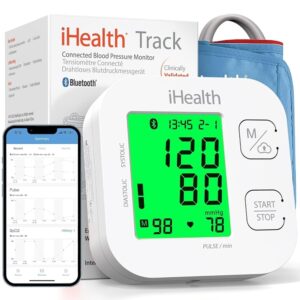
No validation protocol is named anywhere on this listing. No independent validation body is cited. There is no statement about FDA clearance or registration. Compare that with the iHealth Track, which names the ESH 2010 protocol, or with OMRON’s listings, which cite a Validated Device Listing process. Naming a protocol gives a reader something to check. Repeating the word accurate does not. We do not test devices and we will not describe any monitor as accurate, clinically accurate or medical grade in our own voice.
One further observation about the feedback record. The listing shows 4.9 out of 5 across 1,694 ratings. That is a notably higher average than almost every established brand in this catalog, where 4.3 to 4.5 is the normal band, including for devices from manufacturers with fifty year histories. A 4.9 average is not evidence of anything by itself, but it is an outlier and it is worth reading recent reviews rather than taking the headline figure at face value.
The manufacturer field reads Shenzhen AOJ Medical Technology Co Ltd rather than Invaxe. The same AOJ platform appears elsewhere in this catalog under other brand names, including the Abesee AOJ-30C, which is useful to know when a comparison looks broader than it is.
Who should buy it and who should not
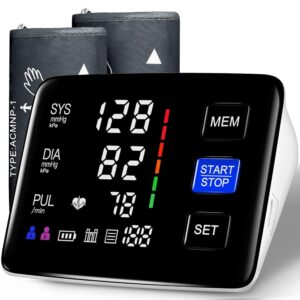
Buy it if you want a large screen and a very large on device memory without an app, and if your upper arm measures comfortably inside the range rather than at the top of it. Do not buy it if your arm is near 16.5 inches, because the listing cannot tell you whether the cuff fits, and do not buy it if a named validation protocol is part of your decision. If you want two cuff sizes supplied in the box rather than one disputed range, the Braun ExactFit 3 is the option to compare, and further monitors sit in the mixed shortlist section alongside unrelated pressure products.