

Description
Who the Abesee AOJ-30C is for
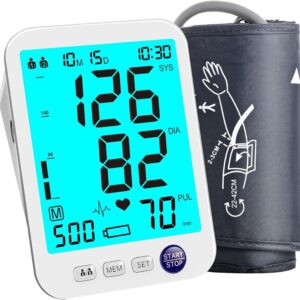
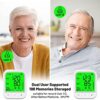
This is an upper arm automatic blood pressure monitor with a large backlit display, a spoken output, two user memories and a wide range cuff. The manufacturer is recorded as Shenzhen AOJ Medical Technology, and the listing states the device is intended for adults over 18. It records numbers for a clinician to review. It is not a diagnostic device and it does not replace professional medical care.
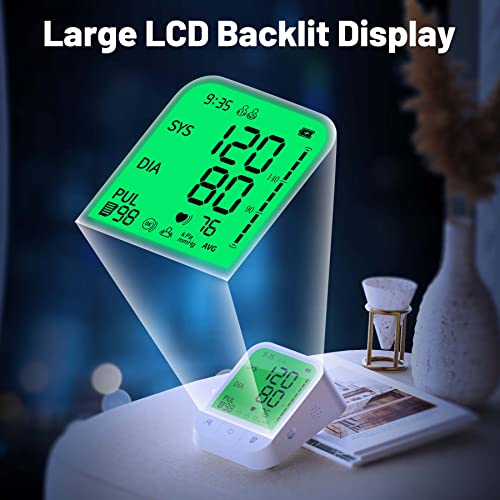
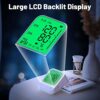
The buyer it suits is someone who wants legibility above everything else. The display is stated at 4.3 inches, which is large for this class and, unlike most listings that simply call a screen large, it is an actual measurement. Combined with a spoken announcement that can be switched off, that makes this one of the more accessible devices in this part of the catalog.
Cuff range and the specifications that matter
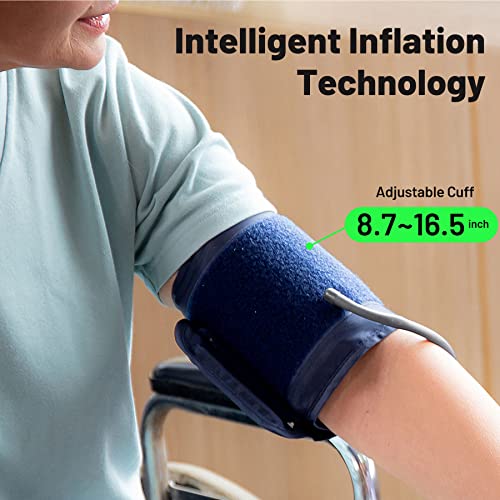
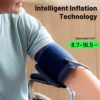
The listing states that the cuff fits most adult arms with a circumference of 8.7 to 16.5 inches. That is a proper wide range cuff and it covers most adults, though it stops short of the extra large cuffs that reach 21 inches. The cuff material is described as durable and easy to clean.
Measure the circumference of your bare upper arm with a cloth tape, midway between elbow and shoulder, before ordering. Cuff fit decides whether a reading represents anything: one that is too small or too large produces a number that does not match what the same device would record with the correct cuff, and there is no warning on the display. If you are above 16.5 inches, this is the wrong purchase and no other feature compensates.
Memory, display and power
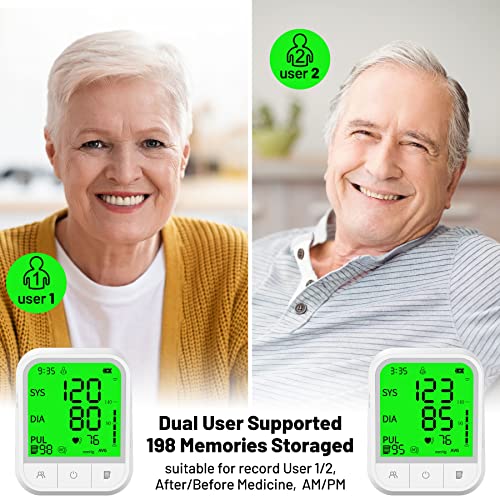
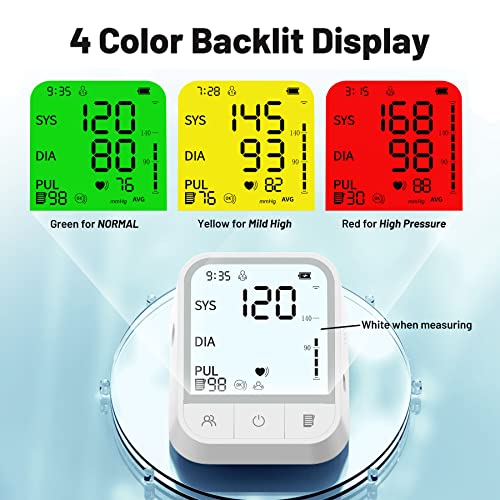
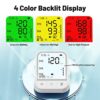
The device supports two independent users with 99 stored measurements each. A measurement completes in about 30 seconds from a single button press. The display is the stated 4.3 inch backlit screen, and the listing describes four color themes used to indicate blood pressure status.
Power needs attention before ordering. The listing states that the monitor runs on four AAA batteries, which are not included, or a Type C charging cable, which is. That means the device arrives with a cable and no cells, so budget for one or the other, and check with the seller whether the cable requires a separately purchased adapter, since the listing does not say. A storage bag is included.
The spoken status and the color themes
Two features on this device deliver a category judgment rather than a number, and both need reading carefully.
The first is the voice. The listing states that the monitor announces your status aloud at the end of a measurement, and that this can be turned on or off. The second is the set of color themes indicating blood pressure status on the display. Both are driven by thresholds the manufacturer has programmed into the device.
Treat both as prompts rather than verdicts. A monitor does not know your age, your history, your medication or anything else about you, and a spoken word or a colored screen carries a certainty that the underlying calculation does not support. We are not reprinting the thresholds involved here, because interpreting a number for a particular person is clinical work and not a device function. If a status appears that concerns you, write the reading down with the date and the time and raise it at your next appointment. If it reassures you, that is not a reason to skip an appointment or to change a medication.
The ability to switch the voice off is worth knowing about for a shared household, where an announcement aloud may not be wanted.
Using it correctly, and what the readings are for
Sit with your back supported and your feet flat on the floor rather than crossed, and rest quietly for several minutes before measuring. Fit the cuff on a bare upper arm rather than over a sleeve, with the tube running down the inside of the arm and the lower edge clear of the elbow crease. Support the arm so the cuff sits at about the height of your heart. Do not talk during the measurement, and use the same arm at about the same time each day.
No averaging function is described, so take two or three measurements a minute apart and record all of them rather than relying on one. Single readings vary for ordinary reasons and a short series is far more informative. If two people share the device, check the user slot before the cuff goes on, because readings from two people in one memory bank describe nobody.
What you collect is a record for someone else to read. What a reading means, whether a pattern across your readings is significant, and whether anything about your care should change are questions for a healthcare professional who knows your history and your medication. This device does not replace professional medical care, and no reading from it should be used to start, stop or alter treatment on your own.
Claims, limits and gaps
The listing states that advanced measurement techniques provide fast and more accurate results. That is the seller’s description and it names no protocol, no assessing body and no tolerance figure. We do not test products and we will not describe any monitor as accurate in our own voice. No independent validation protocol is named anywhere in this listing, and where a home monitor has been assessed against a published protocol the protocol is normally identified. Check an independent validation listing for this model number if that matters to you.
On gaps: no irregular heartbeat detection is described, no averaging function, no app and no wireless connection, so 99 readings per user is the whole history unless you write them down. No warranty term appears in the record we hold and battery life is not published, which is a more pointed omission on a device that does not ship with batteries.
A catalog note. The AOJ designation and the barcode block on this listing both appear against other brand names in our catalog, which normally indicates hardware built by one company and sold under several labels. Compare those listings on package contents and support rather than assuming the devices differ, and remember that ratings are split across them rather than pooled.
Alternatives worth comparing
A second Abesee device appears in our catalog as the Abesee blood pressure monitor under a different listing code, and the INVAXE AOJ-30G carries a closely related model designation under another brand. Among comparable inexpensive two user monitors, the DOUHAO C02 with a 240 reading memory and the PLAYOUNG BSX525 with a color coded display are the direct competitors. The Coverich monitor is an example of the same market segment with almost nothing published, which is worth seeing for contrast. Our index of home monitors and cuffs lists the cuff range and memory each publishes.
Who should buy it and who should not
Buy it if legibility is your priority, your arm measures between 8.7 and 16.5 inches, two people need separate records, and a spoken output would help someone in the household. Do not buy it expecting batteries in the box, do not expect averaging, irregular heartbeat flagging or an app, and do not treat a spoken status or a colored screen as an assessment of your health. Take your readings to a clinician.