Description
Who This Cuff Is For and What It Settles
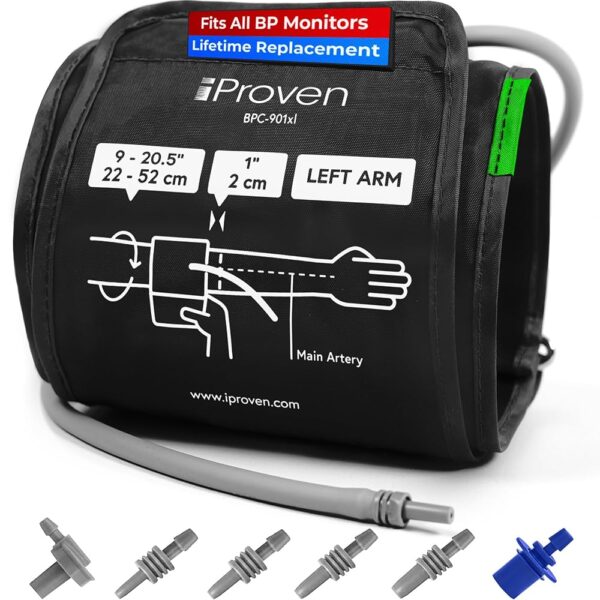
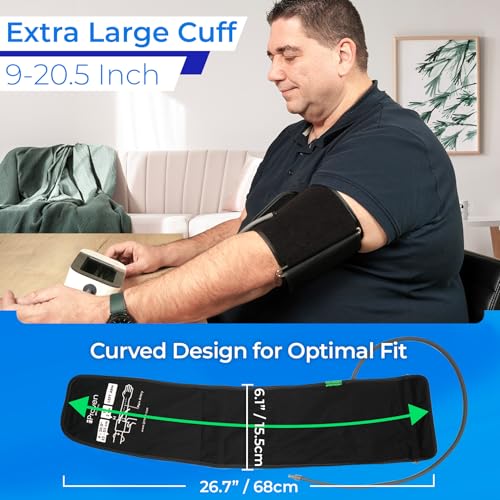
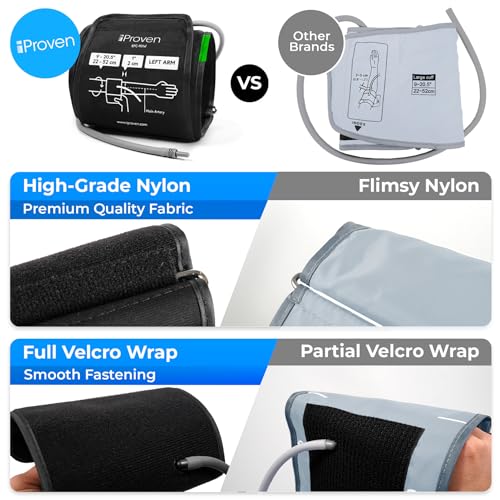
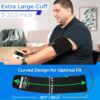
This is a replacement cuff, not a monitor. The iProven BPC-901-XL is a curved oversized cuff with a hose and six connectors, intended for arms that a standard wide range cuff will not close around. The curve is the design point: a cuff shaped to follow the taper of a large upper arm sits flatter against the skin than a straight rectangle forced around the same limb.
That matters because a cuff that does not sit flat does not apply even pressure, and a cuff that is simply too small squeezes harder than it should. Neither failure shows up as an error on the display, which is why cuff size and cuff fit outrank every other variable a home user controls. This review describes an accessory and its published data; it does not interpret readings, and neither a monitor nor a cuff replaces professional medical care.
The Cuff Range, Published Two Ways
The upper bound is consistent everywhere: 20.5 inches, given as 52 cm, and repeated in the band size field. That is genuine oversized reach, and it is the reason to consider this cuff.
The lower bound is not consistent. The product title says 9 inches. A bullet says 8.7 inches. The metric figure of 22 cm converts to about 8.66 inches, which supports the bullet rather than the title. The band size field gives only the 20.5 inch maximum and no lower figure at all.
The gap is about a third of an inch, which sounds trivial until you are the person whose arm measures 8.8 inches and is trying to work out whether an oversized cuff will tighten far enough. Work from the metric range of 22 to 52 cm, and measure the bare upper arm at the midpoint between shoulder and elbow before ordering. If you are near the bottom of that span you are probably better served by a standard or small cuff anyway, since an oversized cuff used on a slim arm is the opposite error and just as silent.
Connectors and the compatibility figure
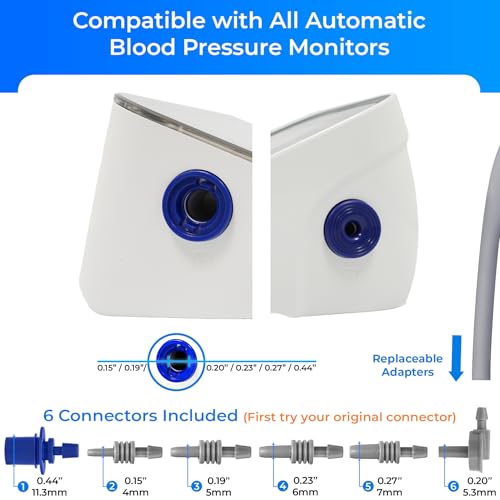
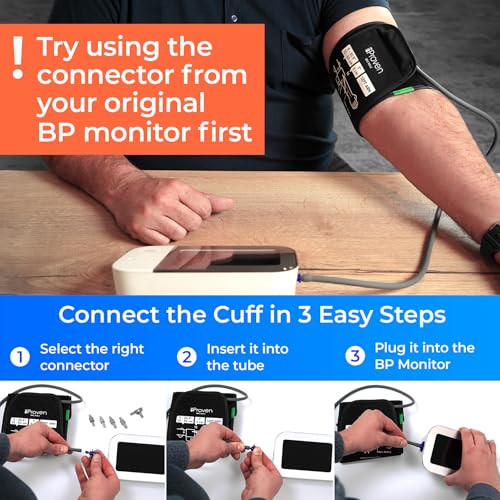
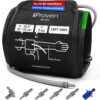
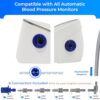
Six connectors ship with the cuff, along with the hose and a user guide, and that spread covers most consumer monitor fittings. The listing states that the cuff is compatible with 99 percent of blood pressure devices on the market, and repeats the figure in its description.
That number needs naming rather than repeating. Ninety-nine percent is a precise-sounding statistic with no source, no method and no device list behind it anywhere in the source data. It is the seller’s claim. What is verifiable is the connector count, so check the hose fitting on your own monitor against the six supplied sizes, and remember that a connector that physically fits is not the same as a cuff a monitor manufacturer has validated with its own hardware. A bladder with different dimensions can shift results even when the fitting is mechanically correct.
The Description Needs Reading Carefully
The description on this listing is written almost entirely in superlatives. It promises accuracy the seller calls unparalleled, describes the cuff as the ideal choice and the ultimate solution, and says it delivers precision in every reading. A bullet adds that the setup delivers accurate readings every time.
None of that is ours and none of it is supportable from the page. A cuff does not deliver readings at all; the monitor takes the measurement. A cuff is one variable among several, alongside posture, arm height, rest before measuring and the device itself, and getting the size right removes a major source of error rather than guaranteeing a result. We do not test devices, we do not verify manufacturer claims, and no accuracy figure, tolerance, validation protocol or clearance reference appears anywhere in the source data.
What the listing does document properly is the physical product: a curved form intended to prevent air leakage through an uneven seal, a stated circumference range, six connectors, a hose, a global trade identifier and a weight of 6.74 ounces on a 9.06 by 7.87 by 1.26 inch item. Those are the facts worth buying on.
Using It Correctly
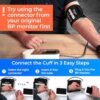
Fit the cuff to the bare upper arm, not over a sleeve, with the hose running down the inside of the arm toward the palm and the lower edge roughly an inch above the elbow crease. Align the artery marker over the inside of the arm rather than wrapping by eye, and close it so one finger slides underneath with mild resistance. On a curved cuff, take an extra moment to check the whole sleeve is in contact with the skin rather than tenting at one edge, because an uneven seal is the failure this design exists to prevent.
Sit with the back supported and both feet flat, rest the arm so the cuff is level with the heart, and stay silent and still through the measurement. After changing cuffs, treat the log as starting fresh: a different cuff is a different measurement setup, so readings before and after are not directly comparable. Note the date and mention the change to a clinician rather than merging the two series.
Limits and Data Quality
Nothing is published about bladder dimensions, which is the figure that actually determines whether a cuff suits a given arm circumference, and nothing about pressure rating or expected service life. There is no compatibility list naming specific monitor models, only the 99 percent figure. The brand name is stored with a mangled accented character in both the manufacturer and brand fields, which is an import defect rather than a product fault.
One claim from the previous copy on this page has been removed rather than repeated. It described a green positioning tab that ensures proper placement. Nothing in the title, the description, the bullets, the specification block or the stored attributes mentions a green tab or any positioning marker, so that detail is unsupported by the source data. Most cuffs do carry an artery marker of some kind, but this listing does not say so, and we are not going to say it for them.
To restate the part that carries the most weight: a cuff is a measuring accessory. It does not diagnose, it does not replace professional medical care, and no reading taken with it should be interpreted at home. If readings shift noticeably after fitting a new cuff, that is information for a clinician rather than a conclusion to draw yourself.
Alternatives Worth Comparing
Among oversized cuffs here, the AuQty extra large cuff publishes the same 22 to 52 cm span with five connectors and a flat design, while the Qutryven extra large cuff covers the same range with four. Buyers needing more than 52 cm should look at the Alcarefam BD66 XXXL. If you would rather buy a monitor and cuff from the same maker, iProven also sells the BPM-35 upper arm monitor. The full selection sits in our blood pressure monitor category.
Who Should Buy It, Who Should Not
Buy it if your upper arm measures between 22 and 52 cm, your monitor’s fitting matches one of the six connectors, and a curved cuff that sits flat on a large arm is what you have been missing. Skip it if your arm is near the disputed lower bound and you cannot get it confirmed, if your monitor’s manufacturer sells a sized cuff of its own, if you need published bladder dimensions, or if the 99 percent compatibility figure is doing more persuading than the connector list.