

Description
Who This Cuff Is For and What It Settles
This is a replacement cuff, not a monitor. The listing states in its final bullet that no blood pressure monitor is included, and the product itself is a nylon sleeve over a TPU bladder with a hose and a set of connectors, meant to be fitted to a machine you already own.
It exists for one problem, and it is the most common problem in home blood pressure measurement: the cuff supplied with a monitor does not fit the arm using it. A cuff that is too small squeezes harder than it should and one that is too large does not squeeze enough, and neither failure shows on the display as an error. That silence is what makes cuff size the most consequential specification in the category, and it is why an oversized replacement is often the right purchase rather than a new machine.
The standing point applies here as everywhere: this review describes a product and its published data, it does not interpret readings, and neither a monitor nor a cuff replaces professional medical care.
The Specifications That Matter
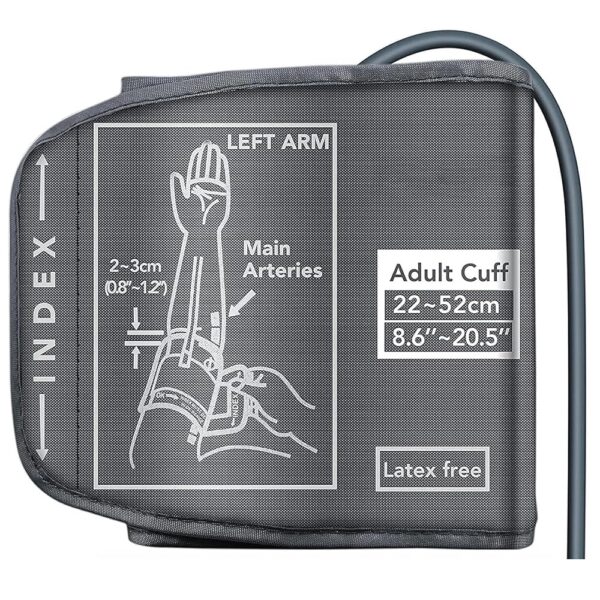
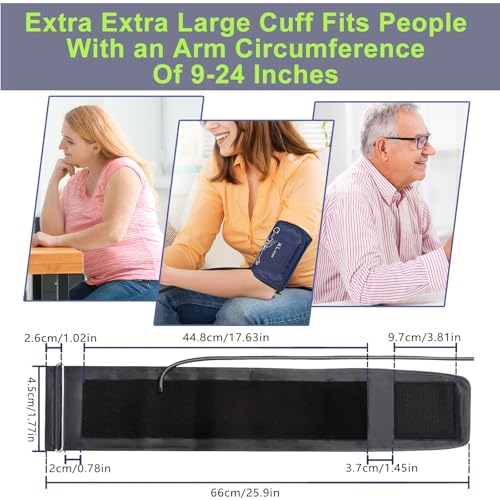
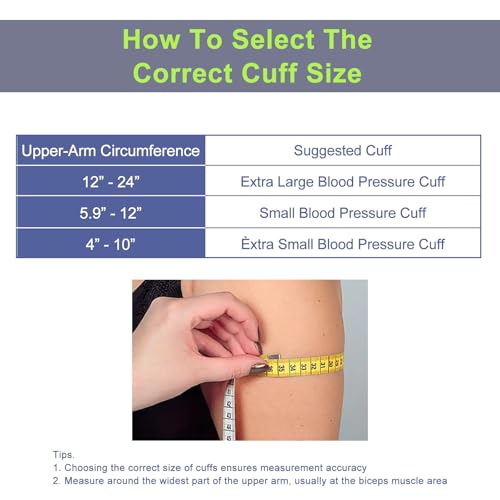
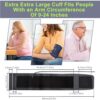
The circumference range is published in the product title and in the first bullet as 22 to 52 cm. That reaches well past a standard adult cuff at the top end and it is the reason to consider this accessory.
There is a practical problem with how it is published, though. The figure appears only in centimeters. Nowhere on the page is an inch equivalent given, on a listing sold to a market that measures arms in inches. For reference, 22 to 52 cm works out to roughly 8.7 to 20.5 inches, but that conversion is ours rather than the seller’s, and a buyer should not have to do arithmetic to find out whether a medical accessory fits.
Measure the bare upper arm at the midpoint between shoulder and elbow before ordering, in centimeters if that is how the listing speaks. If your measurement sits above 52 cm this is not the right cuff, and options such as the Alcarefam BD66 XXXL or the Rihaory XL cuff are the class to compare.
Connectors and the compatibility wording
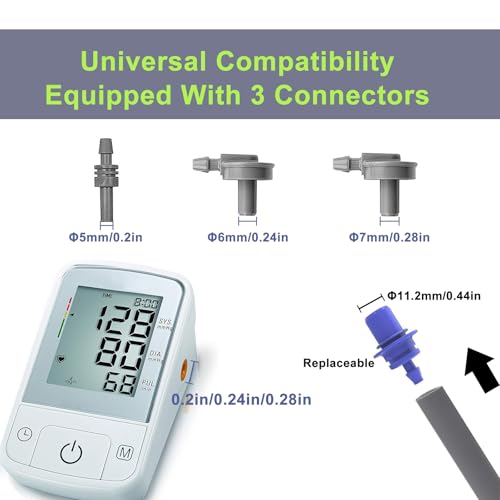
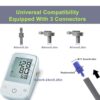
Four connectors ship with this cuff, listed at 7 mm, 6 mm, 5 mm and 4.6 mm, given in the bullet as 0.27, 0.23, 0.19 and 0.18 inches. That is a narrower spread than the five and seven connector sets sold by some competitors, and it omits the larger fittings some monitors use, so check the hose fitting on your own machine against those four sizes before ordering.
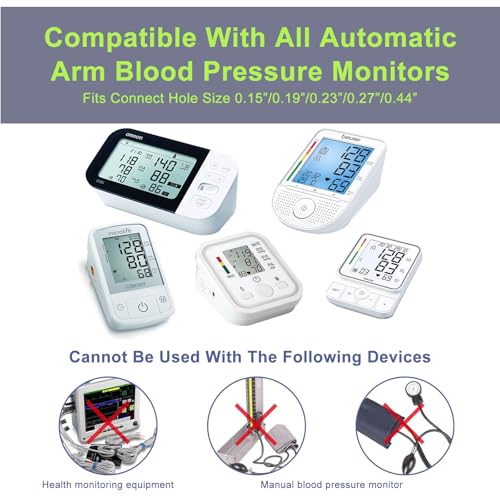
The compatibility wording is where the listing overreaches. One sentence says the cuff is suitable for all blood pressure monitors whose connection hole matches those four sizes. The very next sentence says it is universally compatible with most brands. All and most are different claims, and the product title narrows it again by naming Omron specifically. A connector that physically fits is also not the same as a cuff the monitor’s manufacturer has validated with its own hardware, and a bladder with different dimensions can shift results even when the fitting is mechanically correct. If your monitor’s maker sells a sized cuff of its own, such as the Omron wide range cuff, that is the lower risk route.
Materials and Build
The sleeve is nylon cuff fabric over a non-toxic TPU airbag, with a soft hook and loop closure. Weight is 90 grams, or 3.17 ounces, and a quick user guide is included alongside the connectors.
One claim in the first bullet needs naming. It says the cuff ensures accurate readings every time. A cuff does not produce a reading and cannot ensure anything about one; the monitor takes the measurement and the cuff is one variable among several, alongside posture, arm height, rest before measuring and the device itself. Getting the size right removes a major source of error, which is a real benefit, but it is not a guarantee and it should not be sold as one.
The Specification Block Is Not Trustworthy
Several fields on this listing describe something other than a cuff, and one is physically impossible.
The product dimensions field reads 0.5 by 0.4 by 0.3 inches. That is smaller than a postage stamp, and it cannot describe a cuff sized for a 52 cm arm, its packaging, or anything else in the box. The power source field says corded electric and the display type field says LED, on an item that has no power source and no display of any kind. Those entries are almost certainly template leftovers from a listing built for complete monitors, but they undermine the rest of the block, and on a page whose closing bullet exists specifically to clarify that no monitor is included, they pull in exactly the wrong direction.
Nothing is published about bladder dimensions, which is the figure that actually determines whether a cuff suits a given arm, and nothing about pressure rating or expected service life. The model name field contains the words extra large cuff rather than a designation. The manufacturer of record is the brand itself, Qutryven, with country of origin given as China and the listing dated December 2024.
Using It Correctly
Fit the cuff to the bare upper arm, not over a sleeve, with the hose running down the inside of the arm toward the palm and the lower edge roughly an inch above the elbow crease. Align the artery marker over the inside of the arm rather than wrapping by eye, and close it so one finger slides underneath with mild resistance. Sit with the back supported and both feet flat, rest the arm so the cuff is level with the heart, and stay silent and still through the measurement.
After changing cuffs, treat the log as starting fresh. A different cuff is a different measurement setup, so readings before and after are not directly comparable. Note the date of the change and mention it to a clinician rather than merging the two series into one.
Limits and the Statement That Matters
To restate the part that carries the most weight: a cuff is a measuring accessory. It does not diagnose, it does not replace professional medical care, and no reading taken with it should be interpreted at home. If readings shift noticeably after fitting a new cuff, that is information for a clinician rather than a conclusion to draw yourself.
Buyers weighing other oversized options should compare published ranges directly rather than size labels, since extra large means different things on different listings. The AuQty extra large cuff publishes the same 22 to 52 cm span with five connectors instead of four. The full selection of cuffs and the monitors they attach to sits in our blood pressure monitor category.
Who Should Buy It, Who Should Not
Buy it if your upper arm measures between 22 and 52 cm, your monitor’s hose fitting matches one of the four supplied connectors, and you have checked that your monitor’s maker does not object to a third party cuff. Skip it if your fitting is larger than 7 mm, if your monitor manufacturer sells a sized cuff of its own, if you want the range published in inches rather than converting it yourself, or if a specification block claiming a half inch product with an LED display is not a basis on which you want to buy.