




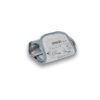
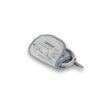
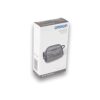
Description
Who This Cuff Is For and What It Settles
This is a cuff and nothing else. The listing says so three separate times, in three separate bullets, with an emphasis that borders on exasperation: only the small cuff, not the machine; this packet does not contain a machine; no gauge on it. Somebody has clearly been asked too many times.
What it settles is the small arm problem. The Omron 9515373-3, also identified in the listing as the CS 24 Type B, fits arm circumferences of 17 to 22 cm, which is 7 to 9 inches. That is well below the lower bound of the standard cuffs shipped with most home monitors, which typically start around 22 cm. If the cuff that came with your monitor will not tighten enough on a slim arm, this is the class of accessory that fixes it.
That matters more than it sounds. A cuff that is too large for an arm does not squeeze enough, a cuff that is too small squeezes too hard, and neither failure shows up as an error on the display. Silent failure is what makes cuff size the most consequential specification in home blood pressure measurement. This review describes an accessory and its published data; it does not interpret readings, and neither a monitor nor its cuff replaces professional medical care.
The Specifications That Matter
The circumference range is published with unusual consistency: 17 to 22 cm appears in the product title, in the description, in the band size field, in the model name field and in a bullet. Five separate places, all agreeing. That is not something most listings in this catalog manage even twice.
Measure the bare upper arm at the midpoint between shoulder and elbow before ordering. If the measurement lands above 22 cm this is the wrong size and a standard or wide range cuff such as the Omron wide range cuff is the right class. The stored age range field on this listing reads as a child size, and it is worth being clear about that: choosing a cuff for a child, and deciding whether to measure at all, is a matter for the child’s clinician rather than something to settle from a product page. A purpose-made option such as the Elera pediatric cuff is the comparison to raise with them.
The compatibility list, and its catch
The best feature of this listing is that it names compatible and incompatible monitors explicitly rather than claiming to fit most brands. It lists compatibility with a long run of Omron models, and then lists specific exclusions: the Omron Comfort Cuff devices M6 Comfort, M7 and M10-IT, and the MIT Elite and MIT Elite Plus. An accessory listing that tells you what it does not fit is doing something almost nothing else on this shelf does.
There is a catch, and it is worth knowing before ordering. The model designations in that list, including HEM-7120, M5 and MX3, are the naming scheme Omron uses outside the United States. Buyers holding an American Omron with a BP-series number will not find their model on either list, and cannot resolve compatibility from this page alone. Check the hose connector on your own monitor and, if in doubt, ask Omron rather than guessing, because a physically fitting connector is not the same as a cuff the manufacturer has validated with that hardware.
Fields That Do Not Belong
Several entries in the specification block describe a monitor rather than a cuff, and they should be disregarded rather than believed. The batteries field says four AA batteries are required. The power source field says battery powered. The display type field says digital. A cuff is a sleeve, a bladder and a hose; it has no batteries, no power source and no display of any kind. These are almost certainly leftovers from a template built for complete monitors, but on a page whose entire purpose is to clarify that no machine is included, they work against the listing’s own message.
The manufacturer field is a different kind of problem. It records the manufacturer of record as OfficeMarket, which is a seller name rather than Omron, while the brand field says Omron. The listing does not establish the supply chain, and anyone who specifically wants manufacturer-original stock should confirm that with the seller before ordering. The item dates from 2012 and the size field reads 1 count, pack of 1, which is packaging metadata rather than a specification.
Packed dimensions are given as 4.84 by 5.55 by 3.35 inches at 3.53 ounces, with the two dimension fields listing the same numbers in a different order.
Using It Correctly
Fit the cuff to the bare upper arm, not over a sleeve, with the hose running down the inside of the arm toward the palm and the lower edge roughly an inch above the elbow crease. Align the artery marker over the inside of the arm rather than wrapping by eye, and close it so one finger slides underneath with mild resistance. Sit with the back supported and both feet flat, rest the arm so the cuff is level with the heart, and stay silent and still through the measurement.
After changing to a smaller cuff, treat the log as starting fresh rather than continuing. A different cuff is a different measurement setup, so readings taken before and after the change are not directly comparable. Note the date of the change and mention it to a clinician rather than merging both sets of numbers into one series.
Limits and the Statement That Matters
Nothing is published about bladder dimensions, which is the figure that actually governs whether a cuff suits a given arm circumference, and nothing about pressure rating or expected service life. There is no accuracy claim on this page, which is appropriate, since a cuff does not produce a reading; the monitor does.
To restate the part that carries the most weight: fitting the right cuff is the single most useful thing most people can do to make a home log meaningful, but the log is still only a log. It does not diagnose, it does not replace professional medical care, and nothing on this page tells anyone what a reading means. Buyers weighing other Omron accessories can compare the Omron HEM-FL31 easy wrap cuff and the Omron 9513256-6 cuff, and the wider shelf sits in our blood pressure monitor category.
Who Should Buy It, Who Should Not
Buy it if the arm measures 17 to 22 cm, your Omron model appears on the compatible list, and you understand you are buying a cuff alone. Skip it if the arm is above 22 cm, if your monitor is one of the excluded Comfort Cuff or MIT Elite models, if you hold a United States Omron whose model number does not appear on either list and you cannot confirm the fitting, or if the cuff is for a child and you have not yet raised sizing with their clinician.