Description
Who the AlphaMed U80A is for
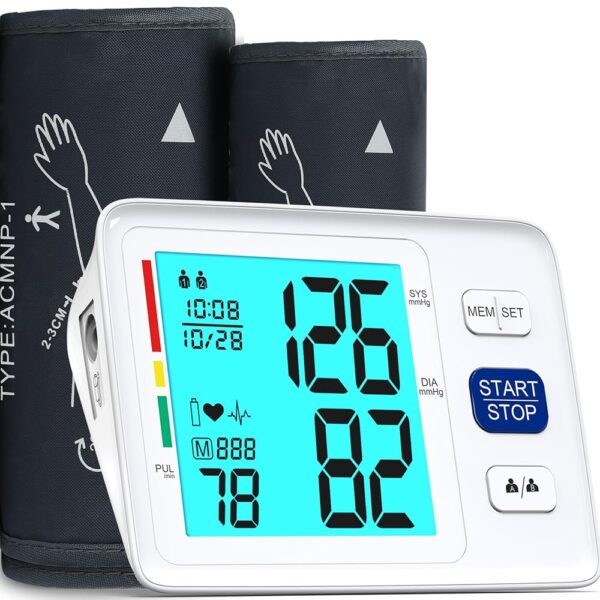
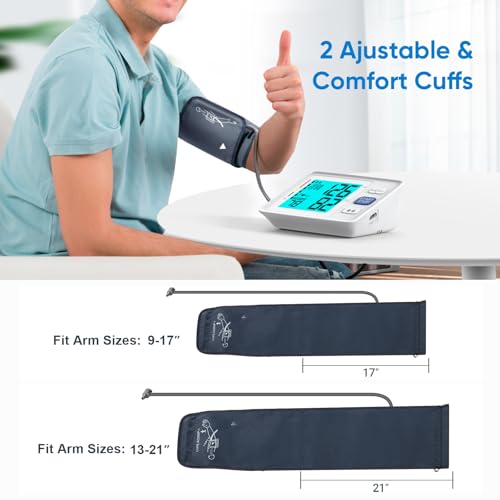
This is an upper arm automatic blood pressure monitor sold with two cuffs rather than one, which is the whole point of the product. Most monitors ship with a single cuff and leave anyone outside that range buying a second one separately. This listing puts a standard cuff and an extra large cuff in the same box. It records numbers for a clinician to review. It is not a diagnostic device and it does not replace professional medical care.
The buyer it suits is a household where arm sizes differ widely, or an individual whose arm sits near or above the upper limit of a normal cuff. The manufacturer is recorded in the stored attributes as Shenzhen Urion Technology, and the U80 designation appears across a number of brands in this catalog, which points to a shared hardware platform sold under several names. That is worth knowing when you compare listings, because two products with different brand names may be the same device with different packaging.
The cuff ranges, which are the reason to consider this at all
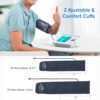
The listing states two upper arm circumference ranges: 9 to 17 inches for the standard cuff and 13 to 21 inches for the extra large. Together that covers a wider span than almost anything else at this level. Note that our own stored band size attribute records only 21 inches, dropping the rest, so use the figures from the listing as set out here rather than the attribute table.
Measure the bare upper arm at the midpoint between shoulder and elbow with a tape measure before you order, and pick the cuff that puts your measurement comfortably inside a range rather than at its edge. This matters more than any other specification on the page. A cuff that is too small or too large produces readings that do not reflect what the same device would record with a correctly fitted cuff, and nothing on the display warns you that it has happened. Where two cuffs overlap, as they do here between 13 and 17 inches, the general principle is that the arm should sit within the marked range on the cuff itself, which is printed on it.
Memory, display and power
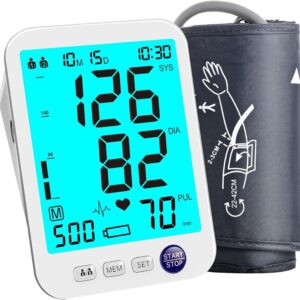
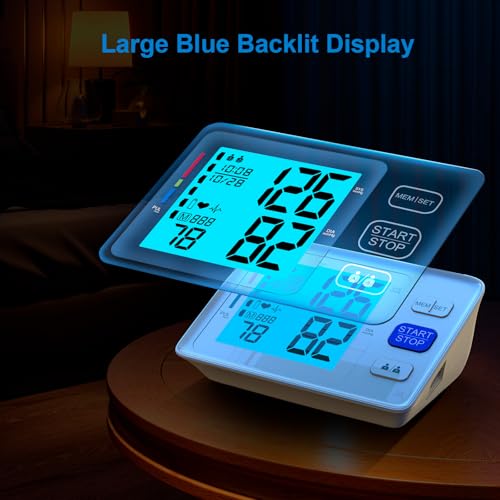
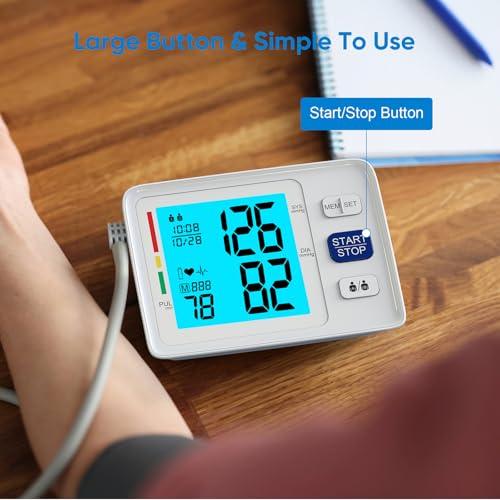
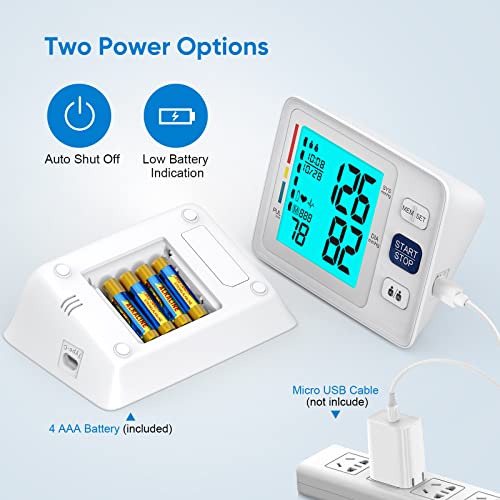
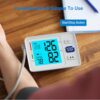
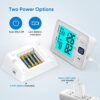
The listing states storage of 500 readings for each of two users, described in the title as 2×500 memories and in the bullets as up to 1000 readings across two users. Those agree. The display is a backlit LCD with oversized numbers and large buttons, which is the part of this listing most likely to matter to a reader with limited vision. Four AAA batteries are included. A USB port is provided as a second power option, and the listing states plainly that the adapter is not included. Our stored components attribute lists an adapter as included, which contradicts the listing text. Assume you will need to supply your own USB power source, and confirm with the seller if that decides the purchase. A nylon carry bag, a quick user guide and a manual are also listed.
Using it correctly, and what the readings are for
How you take the reading changes the reading. Sit with your back supported and your feet flat on the floor rather than crossed, and rest quietly for several minutes before you start. Fit the cuff on a bare upper arm, not over a sleeve, and support the arm so that the cuff sits at roughly the height of your heart. Do not talk during the measurement. Use the same arm and roughly the same time of day on each occasion, because a series taken consistently is worth far more than a set of one off numbers.
The record is the product here. What any reading means, whether a pattern across readings is significant, and whether anything about your care should change are questions for a healthcare professional who knows your history and your medication. This device does not replace professional medical care, and readings from it should be discussed with a clinician rather than acted on alone.
The accuracy claim, and what is missing behind it
The listing states that a smart chip provides faster and more accurate measuring results based on a large scale clinical data collection, and describes adaptive pressure control technology. That is the manufacturer’s wording and it needs handling carefully, because it is the kind of sentence that sounds like validation without being it. No protocol is named. No independent body is named. No study is identified. A reference to clinical data collection is not the same as a monitor having been tested against a published validation protocol by an independent assessor.
We do not test devices and we will not tell you in our own voice that this or any monitor is accurate. What we can tell you is what to check: whether this specific model appears on an independent validation listing. If it does not, that is not proof of anything, but it does mean the claim in the listing is unsupported by anything a reader can inspect.
Limits and gaps
No irregular heartbeat detection is described anywhere in this listing, so if you want a device that flags an irregular rhythm for a clinician to consider, this one does not claim to. There is no Bluetooth and no app, so the 500 reading memory per user is the whole history unless you write the numbers down. Battery life is not published, and neither is the display size in inches.
The stored product dimensions record the unit as one inch by one inch by one inch, which is obviously junk data from the import and should be disregarded when planning where it will sit. As a general matter with rebadged platforms, service support and long term cuff availability are harder to predict than with an established brand, and a replacement cuff bought later needs to match the connector as well as the size.
Alternatives worth comparing
Other devices on what appears to be the same platform sit across this catalog under different names, including the ALPHAGOMED U80AH, the ELERA U80B, the Livaroci U80B and the Urion U81RH. Comparing them is mostly a matter of which cuffs are in the box and what each seller supports. For a different platform with a comparable large display, the AILE X5 is worth a look. Our index of home monitors and cuffs lists the cuff range published for each.
Who should buy it and who should not
Buy it if arm size is your problem, if someone in the household measures between 17 and 21 inches, and if a large backlit display and a deep memory matter more than connectivity. Do not buy it expecting a USB adapter in the box, do not buy it if you want irregular heartbeat flagging or app syncing, and do not read the accuracy wording in the listing as independent validation. Take the readings to a clinician.