Description
Who the KIKEANG two cuff monitor is for
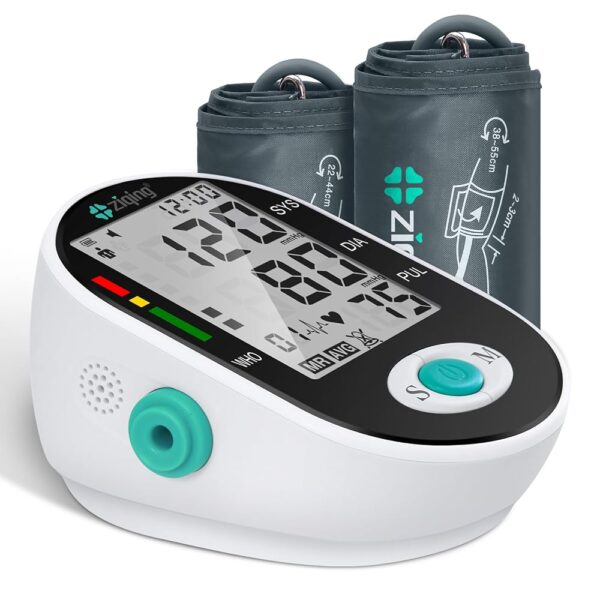
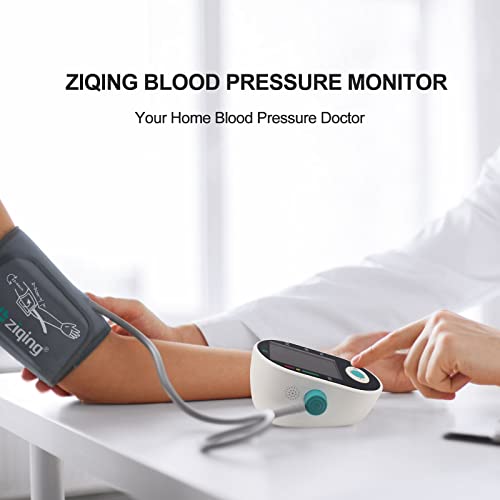
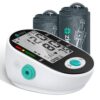
This is an upper arm automatic blood pressure monitor supplied with two cuffs, and the second cuff is the whole reason to consider it. The extra large cuff reaches further up the size range than almost anything else in this catalog. It records numbers for a clinician to review. It is not a diagnostic device and it does not replace professional medical care.
It suits a household where arm sizes differ substantially, or an individual whose upper arm is too large for a standard wide range cuff and who has found that most monitors simply do not fit. That is a real and under served problem, and it is worth reading the cuff section carefully before anything else.
The two cuff ranges
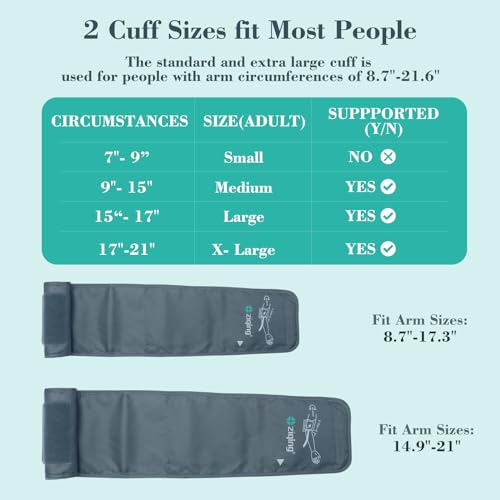
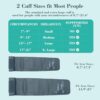
The listing states a medium cuff covering 22 to 44 cm and an extra large cuff covering 38 to 55 cm. Converted, that is roughly 8.7 to 17.3 inches for the medium and roughly 15 to 21.7 inches for the extra large. Our stored band size attribute records only 55 centimeters, dropping everything else, so use the figures from the listing.
Measure your bare upper arm at the midpoint between shoulder and elbow with a tape measure and choose the cuff that places your measurement inside a range rather than at its edge. Where the two overlap, between roughly 15 and 17.3 inches, either will physically fit, and the marking printed on the cuff itself is the reference to follow. Cuff fit governs whether a reading represents anything at all. A cuff too small or too large produces a number that does not match what the same device would record on a correctly fitted arm, and nothing on the display warns you it has happened.
Power, which works differently here
Read this before ordering, because it is unusual. The listing states plainly that the monitor is powered by a plug in connection rather than being rechargeable, and that you can power it from a laptop, a power bank or any device with a USB interface. A Type C cable is included. Our stored power source attribute lists both corded electric and battery powered, which contradicts the listing text, and no batteries appear in the components list.
Taken at face value, this device has no internal battery and no battery compartment, so it needs a live USB power source every time you use it. That is workable at a desk and awkward at a bedside or when traveling without a power bank. If you were expecting to drop in four AA batteries, this is not that kind of device. Confirm the arrangement with the seller if it decides your purchase.
The rest of the specification
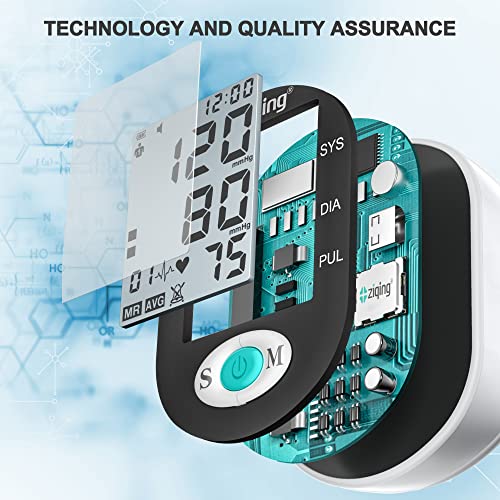
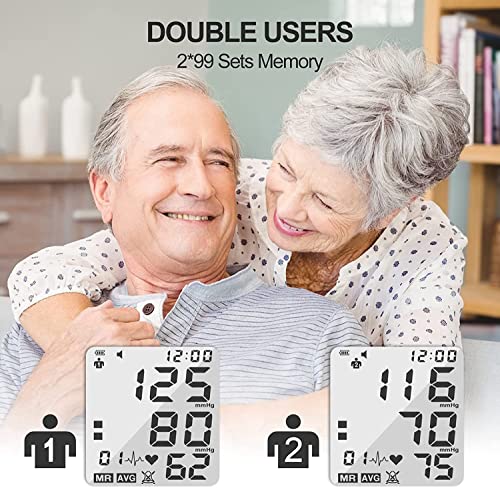
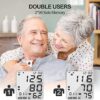
The monitor stores 99 sets of readings for each of two users. Operation is a single start and stop button, and the listing states that a full measurement takes about half a minute. The box contains the monitor, two arm cuffs, a manual and the Type C cable, with a stated twelve month warranty. The unit measures about 5.59 by 4.44 by 2.75 inches.
Using it correctly, and what the readings are for
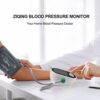
Sit with your back supported and your feet flat on the floor rather than crossed, and rest quietly for several minutes before measuring. Fit the correct cuff on a bare upper arm rather than over a sleeve, and support the arm so the cuff sits at about the height of your heart. Do not talk during the measurement. Use the same arm and the same cuff at about the same time each day, because switching between the two cuffs mid series would make your readings hard to compare with one another.
What you produce is a record for someone else to read. What any reading means, whether a pattern across readings is significant, and whether anything about your care should change are questions for a healthcare professional who knows your history and your medication. This device does not replace professional medical care, and no reading from it should be used to start, stop or adjust treatment on your own.
The claims, and one thing our own summary got wrong
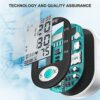
The listing states that each unit is calibrated before delivery, that the error is within 3 mmHg when the correct measurement method is followed, and that the product has been highly recommended by doctors and by people with high blood pressure. Those are the seller’s statements. We do not test products and we will not describe any monitor as accurate in our own voice, and a general assertion of recommendation with no source attached carries no weight either way. No independent validation protocol and no assessing body is named, so check an independent validation listing for this model if that matters to you.
There is also a correction to make to our own previous summary of this product, which described clear verbal feedback and implied a speech function. Nothing in the listing data we hold describes a voice or talking feature on this model. We have removed the claim. If spoken readings are what you need, choose a device that states the feature explicitly.
Limits and gaps
No irregular heartbeat detection is described anywhere in the listing. There is no app, no Bluetooth and no averaging function, so a short series has to be averaged by you. No display dimension is published and no AC wall adapter is included, only the USB cable. The dependence on external USB power is the practical limit for most buyers, and it deserves more prominence than the listing gives it.
A further point about the extra large cuff, since it is the reason most buyers will look at this listing. Very large cuffs are physically longer and stiffer than standard ones, and getting one seated evenly on your own arm single handed takes practice. Work the cuff up the arm rather than sliding it down from the shoulder, check that the tubing runs down the inside of the arm toward the hand, and make sure the lower edge sits clear of the elbow crease. A large cuff that has been wrapped unevenly is one of the more common reasons a monitor reports an error rather than a reading.
Alternatives worth comparing
Within the same brand, the KIKEANG FC-BP201, the KIKEANG AES-U131 and the KIKEANG BP362A are the sibling listings, and they differ mainly in cuff provision and power. For another two cuff device, the AlphaMed U80A, which covers 9 to 21 inches across two cuffs is the direct comparison, and the CHANI A01 is a single cuff alternative at a similar level. Our index of home monitors and cuffs publishes the cuff range for each listing.
Who should buy it and who should not
Buy it if a standard cuff does not fit and you need coverage up to about 21.7 inches, and you are content to power the device from a USB source every time. Do not buy it if you need battery operation, if you expected a talking monitor, or if you want irregular heartbeat flagging or app syncing. Take your readings to a clinician.