

Description
Who this cuff is for, and what it settles
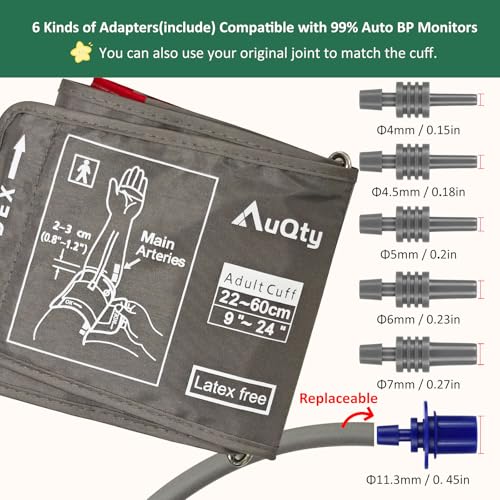
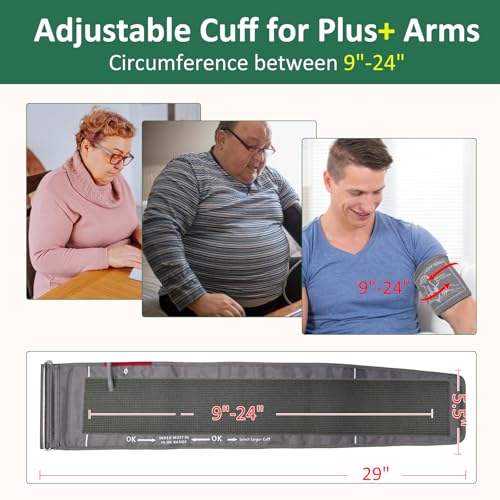
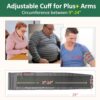
This is a replacement cuff, not a monitor. There is no pump, no screen and no electronics in it. It exists to solve one problem: the cuff that shipped with your home blood pressure machine does not go around your arm, or it only just does, and you need a wider band that still plugs into the machine you already own. AuQty publishes a range of 9 to 24 inches, which the listing also gives as 22 to 60 centimeters, and ships six connector fittings so the same cuff can be adapted to different monitors.
Cuff size is not a comfort preference. A band that is too small for the arm it is wrapped around, or one that is loose because it has run out of adjustment, will change the numbers a monitor that is working correctly produces. That is why a replacement cuff is worth taking seriously, and it is also why the rest of this review spends most of its time on fit and compatibility rather than on materials. Nothing here is medical advice, and a cuff swap does not replace a conversation with the clinician who manages your care.
The specifications that matter
The published range, and how to use it
The stated 9 to 24 inch span is unusually wide, and the top end is well beyond what a standard adult cuff covers. Measure the midpoint of your upper arm, halfway between shoulder and elbow, with the arm relaxed at your side, and use a soft tape held snug but not tight. Buy on that number rather than on shirt size. If your measurement lands comfortably inside a standard cuff range, a cuff this large is the wrong purchase, because a band with far more length than the arm needs is harder to seat evenly and the excess has to go somewhere. Buyers whose arms sit in the middle of the adult range are better served by a conventional wide range band such as the Omron wide range replacement cuff.
Connectors, and a data problem worth naming
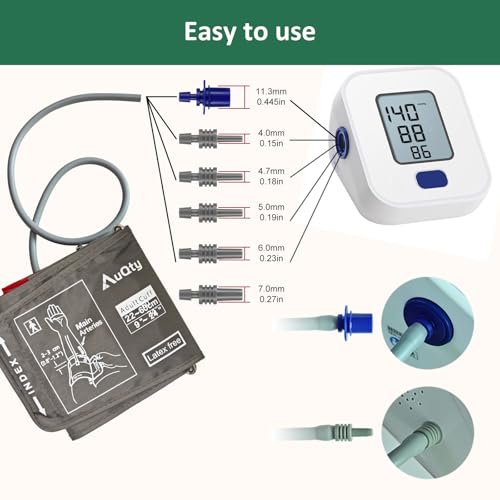
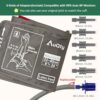
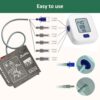
The listing advertises six common connectors and says the connector part is removable, so the original fitting from your own monitor can be swapped onto this cuff. That is the feature that makes a universal cuff plausible at all. The trouble is that the connector sizes in our imported data are unreadable. They appear as three bare numbers, 0.16, 0.2 and 0.28, with the unit marks stripped out somewhere in the import, and no third figure is paired with a fourth. We are not going to guess whether those are inches, and we are not going to invent a millimeter equivalent. Before ordering, look at the fitting on your existing cuff, measure it, and confirm with AuQty that one of the six supplied connectors matches. If you would rather buy a connector kit on its own, the ZIQING six connector cuff set covers similar ground.
Materials and build
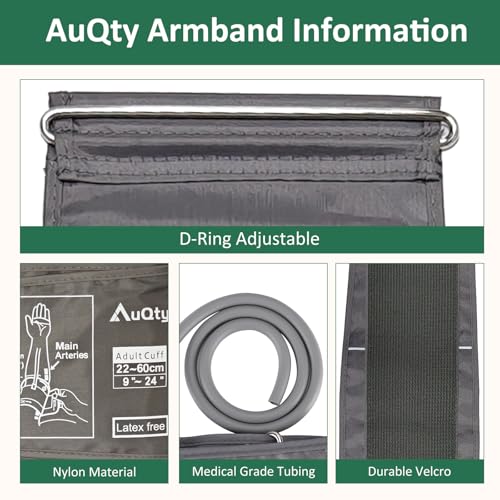
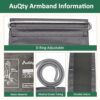
AuQty describes a nylon sleeve fabric with a TPU air bladder and states that the hook and loop closure is chosen for holding power on a long band. Listed weight is 5.93 ounces, which the same listing also gives as 0.17 kilograms, and the two agree. Listed packaged dimensions are 3.94 by 1.18 by 3.15 inches, which is the folded cuff rather than the extended band.
Contradictions in the listing
Three fields in this listing describe hardware that a replacement cuff does not have, and we would rather name them than quietly drop them. The listing states a display type of LED. A bare cuff has no display. It states a power source of battery powered and specifies one CR2032 cell as required. A bare cuff has no battery compartment and needs no power. It also states a band size of 24 inches as a single figure, which conflicts with the 9 to 24 inch range given in the title and the feature bullets, because 24 inches is the maximum rather than the size.
Our reading is that these fields were inherited from a monitor listing rather than describing this product, which is a common artifact in this catalog. We are not resolving them on your behalf. If a CR2032 cell or a display matters to your purchase, that is a question for the seller before you order, and the answer should be in writing.
One further claim needs care. The title says the cuff is compatible with all automatic blood pressure monitors. That is the manufacturer’s phrasing, not ours, and it is broader than six connectors can support. Some monitors use proprietary fittings, some tubeless designs have no detachable cuff at all, and some machines are calibrated to the cuff they shipped with. Treat compatibility as something to confirm for your specific model.
Using it correctly
Wrap the cuff around the bare upper arm, not over a sleeve, with the lower edge roughly an inch above the elbow crease. Most cuffs carry an artery marker that should sit over the inside of the arm. Snug the band so that two fingers slide under the edge with mild resistance. Sit with your back supported, feet flat and the arm resting so the cuff is level with your heart, then stay still and stay quiet through the measurement.
After swapping a cuff, take a few readings under the same conditions you used with the old cuff and note whether the pattern is broadly similar. If the new band produces results that look very different from what you have been recording, stop and raise it with your clinician or pharmacist rather than assuming either cuff is right. A pharmacy will often check a reading against their own equipment, and that comparison is more useful than any specification sheet. Nothing about a wider cuff changes the fact that a home reading is one data point for a professional to interpret, and this cuff does not replace professional medical care.
Alternatives worth comparing
AuQty also sells a plain extra large band without the connector kit, covered in our AuQty extra large cuff review, which is the simpler buy if you already know your fitting. For arms at the very top of the range, the Alcarefam BD66 XXXL cuff is the direct competitor. Buyers who would rather stay inside a single brand ecosystem, where fit and fitting are both guaranteed by the maker, should look at the iHealth extra large cuff instead. Our wider catalog of home blood pressure equipment groups the cuffs next to the machines they attach to, which makes it easier to check a range and a fitting in one place.
Who should buy it, and who should not
Buy this cuff if your measured upper arm circumference is genuinely at the large end, if you have checked the fitting on your existing monitor against the connectors supplied, and if you accept that the compatibility claim is broad and needs confirming for your model. Do not buy it if your arm sits mid range, if your monitor uses a tubeless or sealed cuff, or if you are hoping a new cuff will explain a reading that concerns you. That last question belongs with a clinician, not with a piece of nylon and a bladder.