Description
What this product is
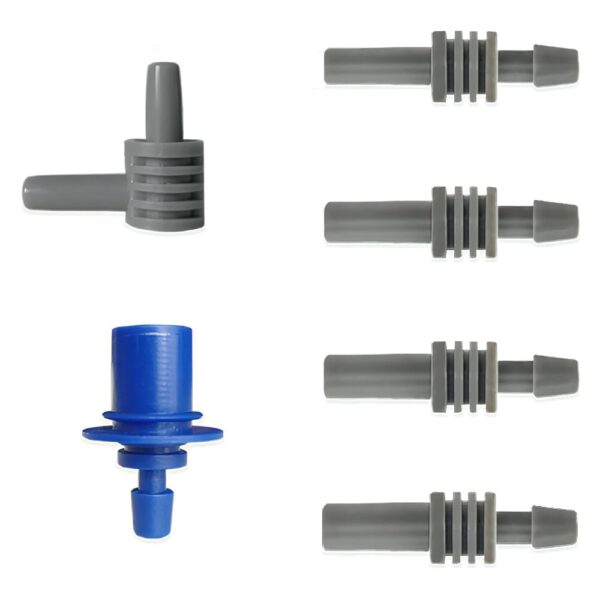
Six connector plugs. Nothing else. No cuff, no hose, no monitor, and the listing says so plainly in its final bullet: six types of connector only. It weighs 0.35 ounces and arrives in a box a couple of inches across.
It exists for one situation. The plastic plug that joins your cuff’s hose to your monitor has cracked, split or worn until it leaks, and rather than replacing the whole cuff you replace the fitting. ZIQING’s own description makes the case for doing it promptly: a damaged connector leaks air, and a leaking connector means the cuff cannot hold pressure properly, which changes the number the machine reports.
Because there is no cuff here, there is no circumference range to publish. The band that determines whether your readings mean anything is the one you already own, and this product does not change it. Nor does it diagnose anything or replace professional medical care.
Why this listing is the most useful accessory page in this catalog
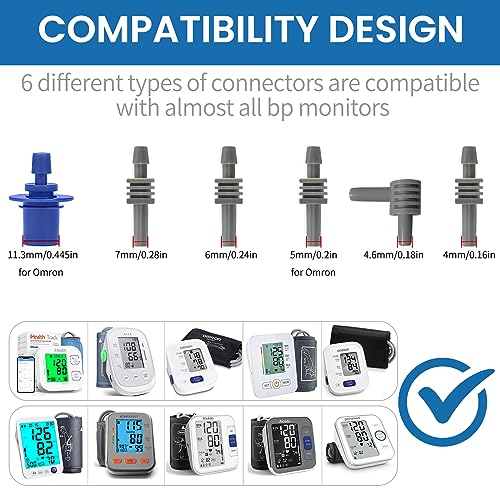
Almost every universal cuff we have reviewed advertises a set of connectors and then fails to tell you what sizes they are. Some publish bare decimals with the unit marks stripped out by the import. Some say various. Some say six connectors and list three numbers.
This one publishes all six, in both units, twice: 4 mm which is 0.16 inches, 4.6 mm which is 0.18 inches, 5 mm which is 0.2 inches, 6 mm which is 0.24 inches, 7 mm which is 0.28 inches, and 11.3 mm which is 0.445 inches.
That is not just useful for buying this kit. It is a decoder for the rest of the category. When a cuff listing shows you 0.16, 0.19 and 0.28 with the inch marks missing, those are almost certainly inch figures for connectors of roughly 4, 5 and 7 millimeters, and the set of six on offer is probably this same standard family. We are not going to assert that about any particular product, since we cannot verify a seller’s kit from another seller’s page, but if you are trying to make sense of a garbled connector list, this is the yardstick to hold it against. Our RAXSEG extra large cuff review covers a band whose connectors are never specified at all, and our MAYMOCON XXXL cuff review covers one where only half the sizes survive.
How to work out which one you need
Take the cuff off your monitor and look at the plug at the end of the hose. What you are measuring is the outside diameter of the barrel that pushes into the socket on the machine. A digital caliper is ideal. A ruler will get you close enough to distinguish 4 mm from 7 mm, which is usually all you need, and the 11.3 mm fitting is obviously different from the rest.
Compare that figure against the six sizes above. If your fitting matches one, this kit contains it. If you are between sizes, do not force a plug that is slightly too large or accept one that is slightly too small, because both leak, and a leaking connector produces the same wrong readings the damaged one did.
ZIQING claims compatibility with almost all blood pressure monitors. Six sizes covers most consumer machines, but some manufacturers use proprietary fittings that no third party kit will match, some tubeless monitors have no removable cuff at all, and some devices have the connector permanently bonded to the hose. Check yours before ordering.
What a new connector will and will not fix
It will fix a cracked or perished plug that is leaking at the joint. It will not fix a split hose, a perished bladder, a worn hook and loop closure or a cuff that is the wrong size for your arm, and those are all more common failures than a broken fitting.
If your readings have started looking odd and you are hoping a connector will explain it, work through the more likely causes first. Is the cuff the right size for your measured arm. Does the band still close firmly. Does the hose have a permanent kink in it from being folded into a drawer. Is the fabric holding pressure, or does the machine take noticeably longer to inflate than it used to. If any of those is the problem, a new plug will not help, and a replacement cuff is the answer. Our ZIQING small cuff review and our CareLiving small cuff review cover bands in that territory, and our AQESO universal cuff review covers a band whose own connector is removable so the original fitting can be transferred.
And if the readings themselves are what concern you rather than the equipment, that is a conversation with a clinician rather than a hardware problem.
Fitting one, and checking it afterwards
Pull the old connector off the hose. Most are a push fit onto the tube and come away with steady pressure, sometimes with a twist. Push the new one on until the tube seats fully against the shoulder of the fitting, not just far enough to grip. A plug that is only half seated will hold air for a while and then work loose.
Then check it. Connect the cuff, wrap it around your arm and run a normal measurement. Listen for a hiss at the joint during inflation, and watch whether the machine reaches pressure as quickly as it used to. If the device reports an error, or if inflation takes noticeably longer than before, reseat the connector before assuming the kit was wrong.
Once it is working, take several readings under exactly the conditions you were using before the connector failed, and compare the pattern with what you had been recording. If the numbers look meaningfully different, raise it with your clinician or a pharmacist who can compare against their own equipment rather than deciding for yourself which set to believe.
A note on keeping a spare
Connectors are the cheapest part of a home monitoring setup and among the more likely to fail, because they are plastic, they take repeated push and pull loads, and they sit at the point where the hose flexes most. A spare in the drawer means a failure on a Sunday does not become a week without readings, which matters if a clinician has asked you for a continuous log. Keep the kit with the monitor rather than somewhere sensible, because somewhere sensible is where things go to be forgotten, and note on your log if you change a fitting so the date sits alongside the readings that follow it.
Who should buy it, and who should not
Buy this kit if your connector specifically has failed, if you have measured the fitting on your machine, and if one of the six sizes matches. It is also a reasonable thing to keep in the drawer alongside a monitor you rely on. Skip it if the actual problem is the cuff, the hose or the fit, in which case a replacement band is what you need, and our home blood pressure equipment section lists those alongside the machines they attach to.