
Description
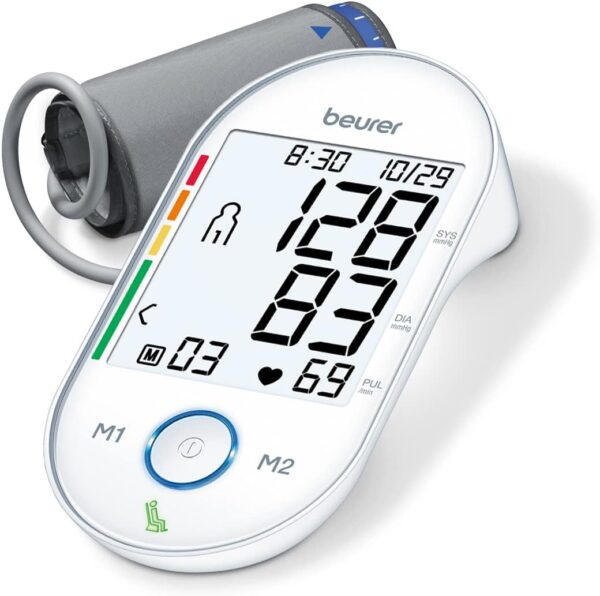
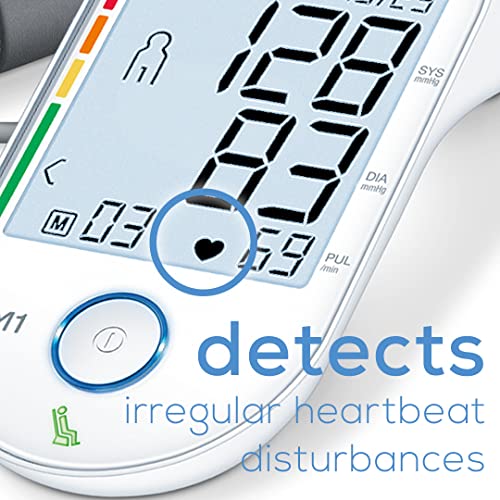
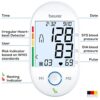
The Beurer BM55 is an upper arm blood pressure monitor with an extra large backlit display, two user profiles sharing 120 storage spaces, a resting indicator and an irregular heartbeat alert. This review describes it from the published listing data. It is not medical advice, it does not tell you what any reading means, and a home monitor does not replace professional medical care. Readings belong in a conversation with a clinician who knows your history.
The cuff range, published in metric only
Cuff fit determines whether a reading is worth recording, because a cuff too small or too large produces wrong numbers on a device that is working perfectly. Technique does not compensate for it.
Beurer publishes the range consistently: the structured band size field reads 22 to 42 centimeters and a feature bullet gives the same figures, describing the cuff as universal and made to fit large upper arm circumferences. No inch equivalent appears anywhere on the listing, which for an American audience is an unnecessary obstacle. Twenty two to forty two centimeters is roughly 8.7 to 16.5 inches.
Measure your upper arm at the midpoint between shoulder and elbow before ordering. If you measure above that range, a device supplied with a larger cuff is what you need. The Greater Goods complete kit publishes both units in a single field, which is the standard every listing here should meet.
Who this monitor is for and what it settles
The BM55 settles the legibility question at a mid range price. The extra large backlit display is the headline, and one button operation with automatic shut off keeps the interface simple enough for anyone.
Two features go further than most competitors. Beurer publishes an averaging function that combines morning and evening results, rather than simply averaging the last few readings taken in one sitting. Morning and evening measurement is the pattern most home monitoring routines are built around, and a device that keeps those separate and then combines them produces something more useful to a clinician than a single running average.
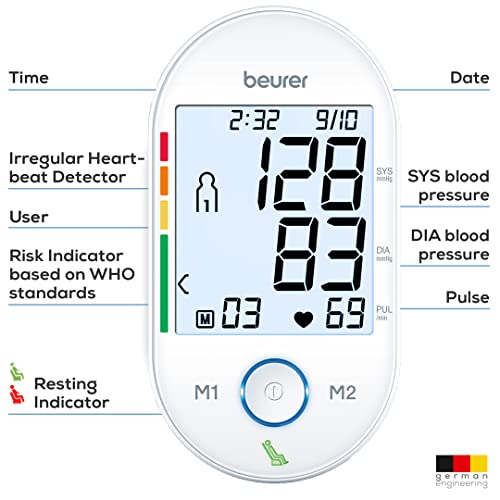
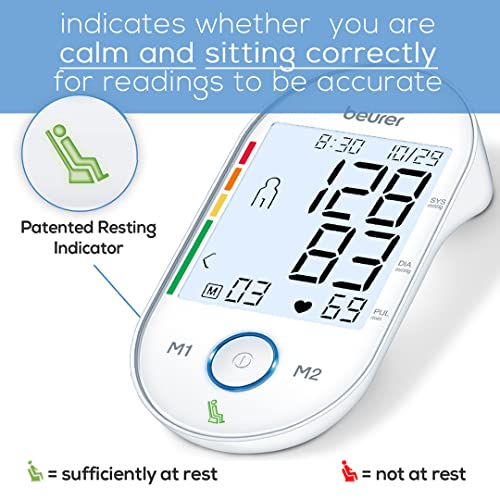
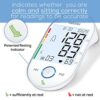
The second is what Beurer calls a patented resting indicator. The bullet describes it as displaying when your arm is in the correct position for a reading. Whatever the mechanism, a device that tells you the measurement conditions were right is doing something valuable, because the main failure of home monitoring is a bad reading that looks exactly like a good one.
Storage is 120 spaces shared across two users. The listing does not say whether that is 60 each or a shared pool, so if two people will use it, ask Beurer before buying. Nothing in the listing describes Bluetooth or an app, so the on device memory is your complete record. Four AA batteries, a universal cuff, an instruction manual and a storage case are included, and published weight is one pound.
Using it correctly
Home readings are useful when the routine never changes. Sit with your back supported and feet flat on the floor, rest quietly for several minutes before starting, support the arm at roughly heart level, fit the cuff on bare skin rather than over a sleeve, and stay still and silent while the measurement runs. Take readings at the same times each day so they can be compared with one another, which is what the morning and evening averaging is designed around. Follow the manual for the exact fitting the device expects, and follow any protocol your clinician has given you in preference to a general routine.
Two of the device’s outputs report rather than interpret, and both are described on the listing in language that overstates them.
The color coded risk indicator is described as helping you interpret the result at home. It does not interpret anything. It sorts a single reading into a fixed band, knowing nothing about your history, your medication, the time of day or how you were sitting. A color is not a diagnosis and it is not a reason to change what you are doing.
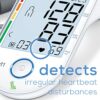
The irregular heartbeat feature is described as arrhythmia detection that beeps when the heart rate appears irregular during a reading. That is a flag for a clinician to assess. It does not identify what the irregularity is, whether it matters, or what to do about it, and it diagnoses nothing. Arrhythmia is a clinical diagnosis made with clinical tools. If the beep occurs, note it and raise it at an appointment. This page will not tell you what any reading, color or alert means.
Where it sits in the Beurer range
Beurer sells several monitors in this catalog and they differ mainly in display, connectivity and memory rather than in the measurement itself. The Beurer BM81 is the model to compare against if you want more than the BM55 offers. Between the two, decide on memory and connectivity, not on which page uses the word accurate more often.
What the accuracy claims actually say
The first feature bullet is headed “ACCURATE” and rests that claim on the resting indicator and the averaging function. Those are sensible design features and they are not a validation. No validation protocol is named anywhere on this listing, no independent validation body is cited, and there is no statement about FDA clearance or registration. No warranty term is published either.
Compare that with the iHealth Track, which names the ESH 2010 protocol outright. Naming a protocol lets a reader check the claim; describing a helpful feature does not. If validation status matters to your decision, the device listings published by validation programs and the FDA’s own databases are the places to look rather than a product page. We do not test devices and we will not describe any monitor as accurate, clinically accurate or medical grade in our own voice.
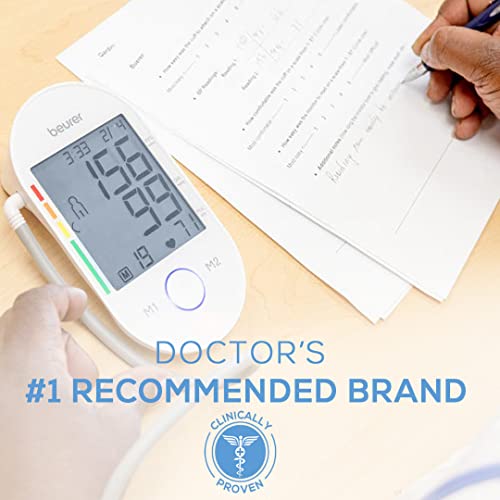
Feedback is recorded at 4.3 out of 5 across 26,436 ratings, which is a large sample and measures buyer satisfaction rather than measurement performance.
Two small notes on the listing’s quality: the included components field spells universal as “Unviversal”, and the irregular heartbeat bullet spells arrhythmia as “arrythmia”. Neither affects the device, and both are a reminder that the page was not proofread.
Who should buy it and who should not
Buy it if you want a large clear display, morning and evening averaging and a positioning indicator from an established European brand, and your upper arm measures within 22 to 42 centimeters. Do not buy it if you want app syncing, if you need to know exactly how the 120 storage spaces are divided between two users, or if a published validation protocol matters to your decision. It sits alongside other monitors in the mixed shortlist section rather than in the main blood pressure monitor listing, which is worth knowing when comparing.