
Description
Who the Beurer BM81 is for, and what it settles
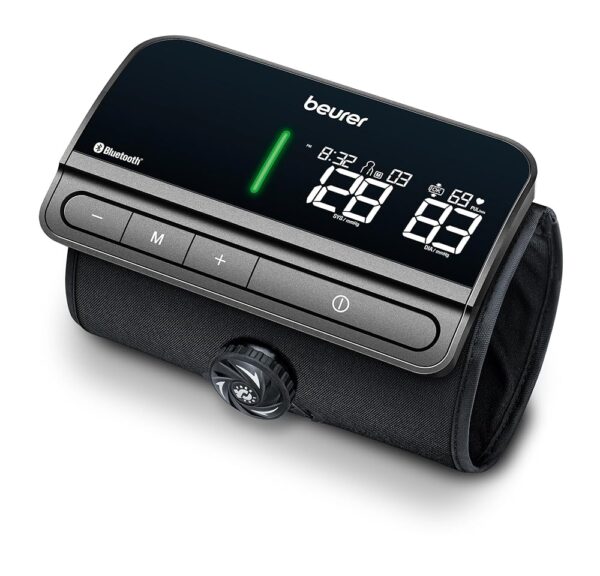
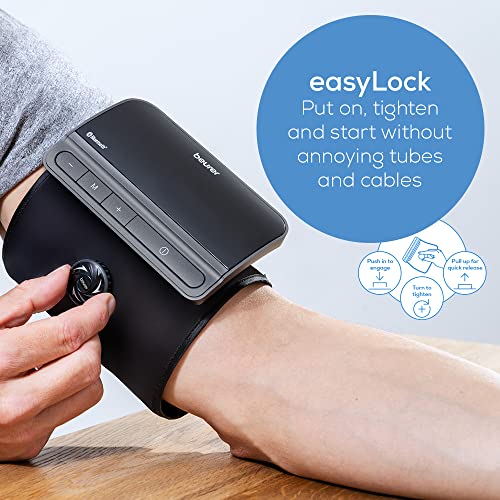
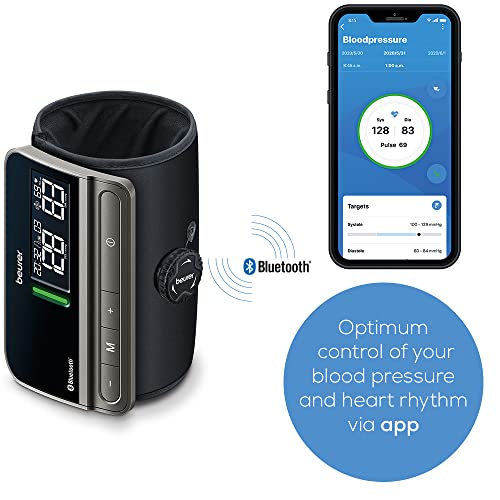
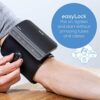
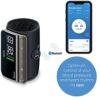
The Beurer BM81 is an automatic upper arm monitor built around a tubeless cuff. There is no hose running to a separate box, because the electronics sit inside the cuff itself and the whole assembly locks around the arm with what Beurer calls an easyLock closure. That single design decision is the reason to consider it and the reason to hesitate. If the thing that has stopped you monitoring at home is the fiddle of a tube, a base unit and a table to put it on, this layout removes all three.
It is a home device and nothing more. It does not replace a clinician, a cuff reading taken in a consulting room, or any advice you have already been given. Readings from any home monitor, this one included, are information to bring to the person who looks after your health, not a substitute for seeing them.
The specifications that matter
Beurer lists a Bluetooth link to its HealthManager Pro app, on device storage of two blocks of 120 readings for a stated 240 total across two users, an LCD display, and four AAA batteries in the box. The listed dimensions are 5.63 by 0.87 by 3.55 inches and the listed weight is 9.92 ounces. Power is battery only in the published data. No AC adapter is named anywhere in the listing, and no adapter appears as an optional accessory, so plan on batteries.
The cuff range is not published, and that is the problem
This is the single most consequential gap in the listing. Beurer describes the cuff as adjustable and suitable for adults and seniors, but nowhere in the product data is there a circumference range in inches or centimeters. A cuff that is too small or too large will produce wrong numbers on a monitor that is working exactly as designed, so an unpublished range is not a minor omission. Measure the midpoint of your upper arm with a tape before you order and confirm the range with Beurer directly. If you would rather buy from a listing that states a range up front, the A&D Medical UA-651 and its wide range cuff puts figures on the box, although as that review sets out, it puts two different ones there.
Two features that need careful reading
The listing advertises a color coded risk indicator on the side of the unit that, in Beurer’s words, lets you self check whether a result is high, lower or normal according to World Health Organization guidelines. That is Beurer’s description of a hardware feature, not a judgment we are making, and a colored band is not an assessment of your health. What a given reading means for you is a question for a clinician who knows your history.
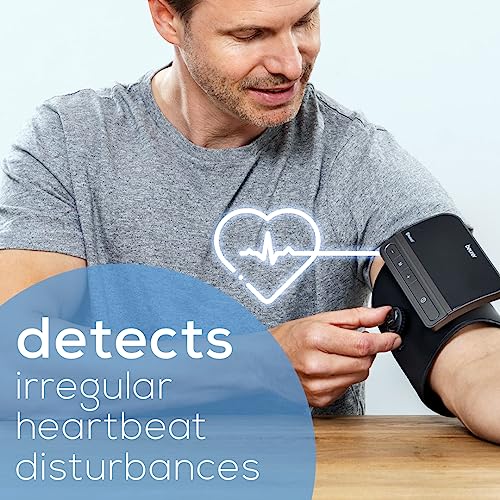
The listing also advertises arrhythmia detection, shown as a heart icon when the device registers an irregular heartbeat during a measurement. Treat that icon as a flag rather than a finding. It tells you the device saw something irregular in that one measurement and that a clinician should be the one to look at it. It does not diagnose an arrhythmia, and Beurer does not claim that it does.
The inflation method
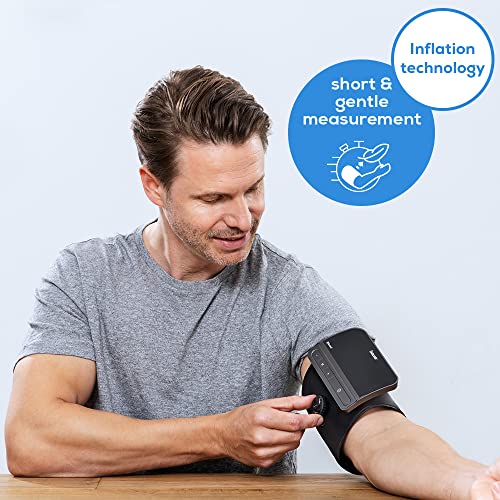
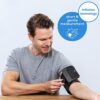
Beurer states the BM81 measures while the cuff is inflating rather than on the way back down, and that the device works out how far it needs to inflate rather than pumping to a fixed pressure. The claimed benefits are a shorter measurement and less squeeze. Both are manufacturer statements about the mechanism. We have not measured either.
Using it correctly
Technique moves home readings more than the choice of device does. Sit with your back supported and both feet flat for several minutes before you start. Rest the arm on a surface so the cuff sits level with your heart. Do not talk during the measurement.
A tubeless cuff introduces one habit worth building. Because the display sits on the cuff, the natural instinct is to twist the arm to look at the screen while the measurement is running. Position the unit so you can read it without moving, or simply wait and read the result afterwards. Any movement partway through a measurement, including turning the wrist, can affect the result on any oscillometric device.
Record what the device shows, along with the date and time, even though the app stores it for you. If your clinician wants a week of readings, a written log with times is easier to discuss than a phone screen. The Bluetooth link needs a phone, the Beurer app and an account, so if you do not want an app in the loop, note that the device still holds readings locally.
Limits and gaps in the published data
Beyond the missing cuff range, the listing contains internal inconsistencies worth naming rather than smoothing over. The model number field reads BM81, but a separate model name field reads only BPM, which is a placeholder rather than a model. The product dimensions appear twice in slightly different formats. Neither affects how the device works, but both are a reminder that this catalog data comes from an import and is not a manufacturer specification sheet.
There is no clinical validation claim in the listing data we can see. No validation protocol is named, no clearance number is given and no accuracy figure is quoted. That is not evidence against the device, but it does mean there is nothing here for us to attribute. Validation status for any home monitor can be checked independently through the published lists maintained by medical societies, and it is worth running that check yourself for any device you intend to rely on. We do not test devices, and we make no accuracy claim about this one in our own voice.
Finally, the whole unit is the cuff. If the fabric wears out or the closure fails, you are not replacing a small accessory, you are replacing the monitor. Buyers who want a device where the cuff is a serviceable part should look at conventional two piece designs instead, where something like an Omron wide range replacement cuff can extend the life of the base unit.
Alternatives worth comparing
If the appeal is a clean, connected device with no clutter, the Withings BPM Connect takes the same cable free idea further and syncs over Wi-Fi as well as Bluetooth. For a more conventional upper arm unit with a wireless link and a large installed base, the Omron BP7350 wireless upper arm monitor is the obvious comparison, and its listing does publish a cuff range. Buyers who mainly want app history without paying for a premium badge should read the Greater Goods Bluetooth monitor, which covers the same ground with a plainer feature set. Our full shelf of home blood pressure monitors lists two piece designs alongside tubeless ones, so cuff ranges can be compared side by side.
Who should buy it, and who should not
Consider the BM81 if a tubeless cuff is the feature that will actually get you measuring, if you are comfortable using a phone app for history, and if you are willing to confirm the cuff range with Beurer before you commit. Skip it if your arm sits near either end of the adult size range and you want a published circumference figure before you buy, if you need a device whose cuff can be replaced separately, or if you want a listing that names a validation protocol. Whichever you choose, the device is a measuring instrument and not a source of medical advice, and every reading belongs in a conversation with your clinician rather than in a decision made alone.