



Description
Who the KIKEANG AES-U131 is for, and what it settles
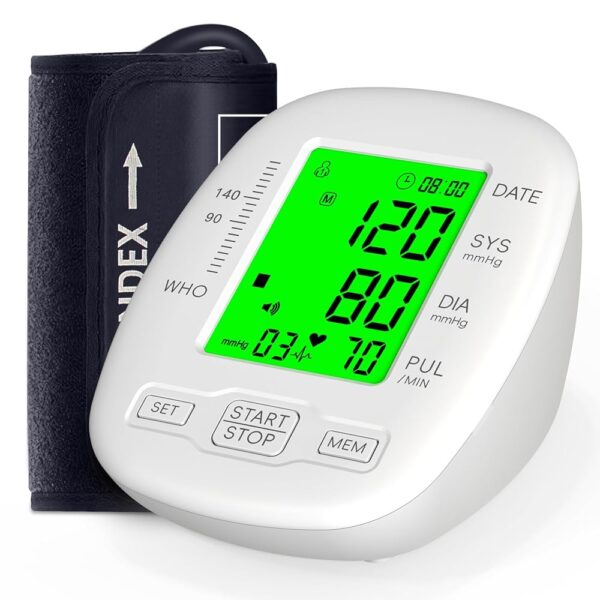
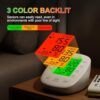
This is a compact upper arm monitor for a two person household: a wide range cuff, two user profiles holding 99 readings each, a colored backlight, and power from either four AAA cells or a plug in cable. It weighs 13.12 ounces and measures 4.5 by 2.6 by 3.6 inches, which is small enough to live in a drawer rather than on a counter.
The device measures and records. It does not diagnose, it does not replace professional medical care, and every reading is an input for the clinician who manages your health rather than a conclusion in itself. That distinction matters more on this listing than on most, because of what the colored screen is said to do.
The color coded screen, and the sentence that follows it
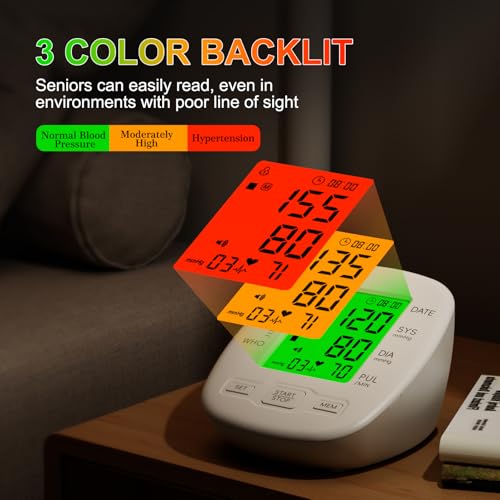
KIKEANG describes a three color backlight: green when the reading is normal, yellow when it is slightly high, red when it is high. The listing then adds that this is convenient for you to make a judgment on the blood pressure value.
Do not make a judgment on your blood pressure from a color. That is the clearest thing this review can say. A backlight sorts one measurement into one of three bands using a threshold the manufacturer has chosen. It knows nothing about your history, your medication, the time of day, how you slept, whether the cuff was seated properly, or whether you had been sitting quietly for five minutes beforehand. All of those change a reading, and all of them are part of what a clinician weighs when interpreting a series of measurements.
Treat the color as a display convenience and nothing more. If a reading concerns you, that is a reason to speak to a clinician rather than a reason to change anything yourself, and it is certainly not a reason to keep measuring until the light turns green.
The clinical trials claim
The first feature bullet states that these monitors have undergone multiple rounds of rigorous clinical trials to ensure their reliability and accuracy in various environments, and that each device has been fine tuned and rigorously tested.
That is a strong claim and it comes with nothing attached. No trial is named, no protocol is identified, no registration number is given, no results are published and no clearance number appears anywhere in the listing. A clinical trial that cannot be located is not something a buyer can weigh. We are attributing the claim to KIKEANG rather than repeating it, and we make no accuracy claim about this device in our own voice. Validation status for any home monitor is checkable independently through the lists that medical societies publish, and that lookup is the thing to do if accuracy is why you are considering this device.
The specifications that matter
Cuff range
The product title gives 22 to 42 centimeters. The structured band size field gives 16.5 inches, which is 41.9 centimeters and matches the upper figure, but it is a single number with no lower bound. Work from the full 22 to 42 range.
Measure the midpoint of your upper arm with a soft tape, arm relaxed at your side, and buy on that number. A band that has run out of adjustment, or one so oversized it cannot lie flat, changes the numbers on a monitor that is working exactly as designed. No alternative cuff size is offered on this listing, so an arm outside the range means a different machine.
Memory and users
Two profiles with 99 readings each, stored separately, which is around seven weeks of twice daily measurements per person.
Power, stated honestly
Four AAA batteries, supplied, or a Type-C cord connected to a power source. KIKEANG then adds a note most sellers would leave out: it is plug in and not rechargeable. The cable powers the machine, it does not charge a cell inside it, and knowing that before you buy saves a frustrated evening looking for a charge indicator that does not exist.
Contradictions in the listing
The packing list appears twice and does not agree. The structured components field names the monitor, a USB cord, four AAA batteries and a user manual, with no cuff at all. A feature bullet names the monitor, the cuff, a Type-C cord, four AAA batteries and a manual. A monitor shipping without its cuff would be unusable, so the structured field is plainly incomplete rather than accurate, but it is one more reason to ask for a packing list rather than assume.
Our own previous description of this product claimed a voice function that announces readings. Nothing in the listing mentions audio of any kind, so that claim has been removed rather than carried forward. If a spoken result is what you need, this is not the machine, and our BESTEK arm monitor review covers a talking device from the same manufacturer.
No irregular heartbeat flag is described, no averaging mode is mentioned and no positioning check is named, all of which cheaper machines in this catalog publish.
Where this design comes from
The manufacturer field names Alicn Medical of Shenzhen, and the AES model prefix runs across several unrelated brand names here. The same AES-U131 code appears under a different brand in our Guaever AES-U131 review, and related machines appear in our Greetmed AES-U522 review and our LongevousiOO AES-U382 review.
Shared platforms are ordinary in this category and none of it reflects on the hardware. What it does mean is that a clinical trials claim made under one brand does not transfer to the same device sold under another, and that customer feedback pooled under one label is not evidence about a different one. Compare the published figures. KIKEANG itself appears on machines from other factories again, including the two cuff machine in our KIKEANG BP362A review.
Using it correctly
Rest for five minutes before measuring, sitting with your back supported, both feet flat on the floor and legs uncrossed. Bare the upper arm rather than pushing a sleeve up, since a rolled sleeve acts as a second cuff. Place the lower edge of the band about an inch above the elbow crease with the artery marker over the inside of the arm, tightened so two fingers slide underneath with mild resistance, and rest the arm on a table so the cuff sits level with your heart. Stay quiet and still until the result appears.
Take readings at consistent times of day rather than whenever you notice the machine, and confirm the correct user profile before pressing start. Write results down with dates and times, because the pattern across a fortnight is what a clinician can use and a single colored screen is not.
Who should buy it, and who should not
Buy the AES-U131 if two people with arms inside 22 to 42 centimeters need one small, simple machine, and if the honesty about the cable not being a charger appeals as much as it should. Skip it if you need a spoken result, an irregular heartbeat flag or an averaging mode, and skip it if the clinical trials sentence is what convinced you, because nothing in the listing lets you check it. The alternatives are listed with their cuff ranges in our home blood pressure monitor section.