

Description
Who This Monitor Is For and What It Settles
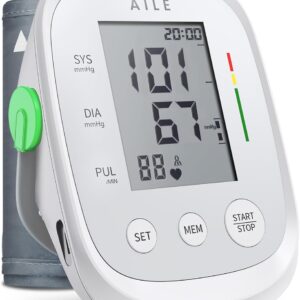
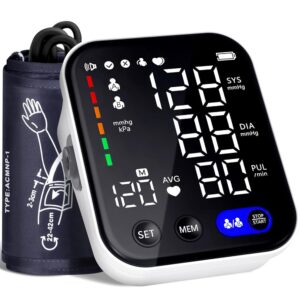
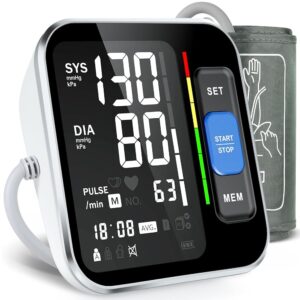
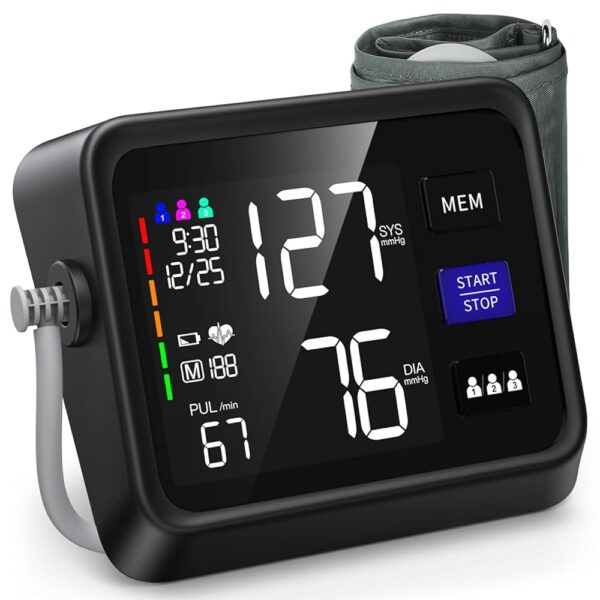
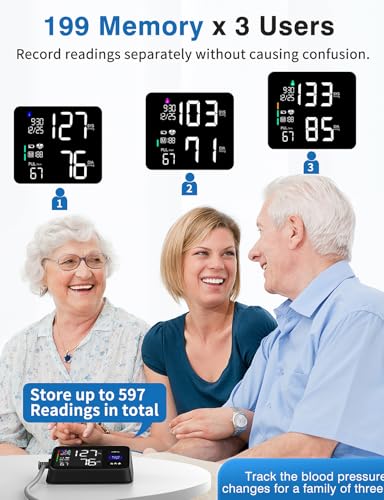
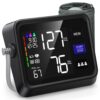
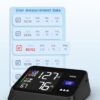
The VERWINT U80AH is an upper arm blood pressure monitor with a large backlit LED screen, three user banks holding 199 readings each, and a wide range cuff. It is a plain device with no app and no connectivity, aimed at a household of up to three people who want separate records without a phone in the loop.
Three user banks is the practical argument for it. Most competitors stop at two, which forces a third person in a household to share a bank and produce a log nobody can untangle later. Before the specifications, the standing point: this review describes a device and its published data, it does not interpret readings, and a home blood pressure monitor does not replace professional medical care.
The Specifications That Matter
Cuff circumference decides whether this monitor works for a given arm, because a cuff that is too small or too large produces wrong readings on hardware that is behaving perfectly, and nothing on the display warns you. Here the range is published consistently in the product title, the structured band size field and a bullet: 8.7 to 16.5 inches. Three places, all agreeing, which is more than most listings in this catalog manage.
Measure the bare upper arm at the midpoint between shoulder and elbow before ordering. One point worth knowing: this device ships a single cuff. Other monitors carrying the same U80AH model designation in this catalog ship as two cuff kits covering 9 to 21 inches, so a buyer matching on model number alone could end up with very different arm coverage. The AQESO U80AH is the two cuff version, and it is the one to look at if 16.5 inches is not enough reach.
Memory, display and power
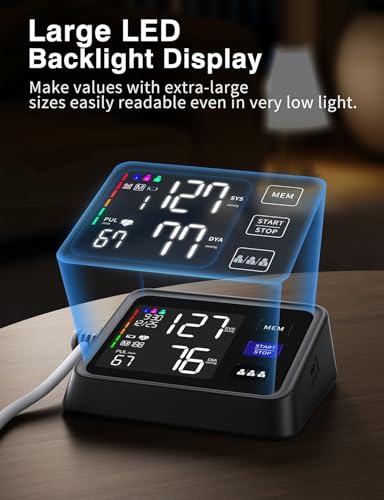
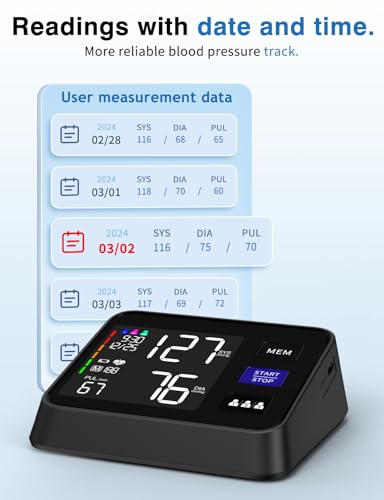
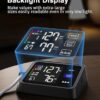
Memory is 199 readings for each of three users, 597 in total, which is deep enough that most households will never overwrite anything. The display is a large LED backlit panel with oversized numbers, described as readable at night and in poor light. No digit height is published, so the character size has to be judged from photographs.
Power is four AA batteries, included, plus a USB-C cable described as providing real-time power. That last phrase is worth reading carefully: real-time power means the cable runs the device while connected rather than charging an internal cell, so this is not a rechargeable monitor. Note also that other monitors sharing this model number use four AAA cells rather than AA, another reason not to assume two pages describing a U80AH describe the same hardware.
The Claims That Need Naming
The lead bullet states that an inbuilt inductor displays an error if you get wrong posture or wrap the cuff wrongly, and that a high sensitivity sensor detects pressure changes from the rubber tube to get the most accurate results.
The posture part is the claim to flag. A blood pressure monitor senses pressure in the cuff. It has no way of knowing whether the person is sitting with their back supported, whether their feet are flat on the floor, or whether their arm is level with their heart, and those are the posture variables that actually change a reading. A pressure sensor can flag a cuff that is loose, unwrapped or moving, which is useful, but it cannot assess posture and describing it that way could lead someone to trust a setup the device has not checked. Get the posture right yourself; the device will not do it for you.
The accuracy superlative is the seller’s and not ours. We do not test devices and we do not verify manufacturer claims. No accuracy figure, no tolerance, no validation protocol and no regulatory clearance appears anywhere in the listing data. Validation status for home monitors can be checked independently through the registries medical bodies maintain, and that check is worth making before purchase.
The previous copy on this page claimed readings that consistently match medical grade devices. Nothing in the listing supports a comparison of that kind, and it is not a statement this site makes about any product, so it has been removed rather than repeated.
The Classification Strip
A bullet describes a colorful light strip on the left of the display that indicates a World Health Organization blood pressure classification for reference. A color strip on a home monitor compares a measured value against thresholds stored in firmware. It does not diagnose, it knows nothing about the person being measured, and no reference document, edition or date is cited for the classification it names. This review does not tell anyone what any color means. Record the numbers, disregard the strip, and take the log to a clinician.
Using It Correctly
Fit the cuff to the bare upper arm rather than over a sleeve, with the tubing running down the inside of the arm toward the palm and the lower edge roughly an inch above the elbow crease, closed so one finger slides underneath with mild resistance. Sit with the back supported and both feet flat on the floor, rest the arm so the cuff sits level with the heart, and stay silent and still through inflation and release.
Rest for several quiet minutes before the first reading rather than measuring straight after activity, and use the same arm at the same times each day so the record compares with itself. Assign the user slot before the first measurement. With three banks of 199 there is no reason for anyone to share, and separating them from the start avoids a record nobody can read later.
Limits and the Wider Model Family
The description field is empty, so five bullets and a specification table carry everything, and one of those bullets is about customer service. Nothing is published about the pressure or pulse measurement range, tolerance, averaging across readings, irregular heartbeat detection, digit height or battery life. The unit measures 5.2 by 4.5 by 1.85 inches at a listed 1.15 pounds, and the size field contains the words large LED screen rather than a cuff size.
The manufacturer of record is Shenzhen Urion Technology, which supplies many brands in this catalog. The U80AH designation alone appears on an AlphaGoMed U80AH, a Urion U80AH and a second AQESO U80AH page, with cuff counts, battery sizes and memory arrangements that differ between them. Confirm the configuration on the specific page you are buying from.
The point that outranks the rest: this device produces numbers and stores them. It does not diagnose, it does not check your posture, it does not replace professional medical care, and nothing in this review is guidance about anyone’s health. The full selection sits in our blood pressure monitor category.
Who Should Buy It, Who Should Not
Buy it if your arm falls inside 8.7 to 16.5 inches, three separate user banks is genuinely what your household needs, and a large LED screen with no app suits you. Skip it if anyone in the household needs a cuff above 16.5 inches, if you expected a rechargeable device, if you need documented accuracy or validation, or if you were relying on the monitor to correct your posture, because it cannot.