


Description
Who This Cuff Is For and What It Settles
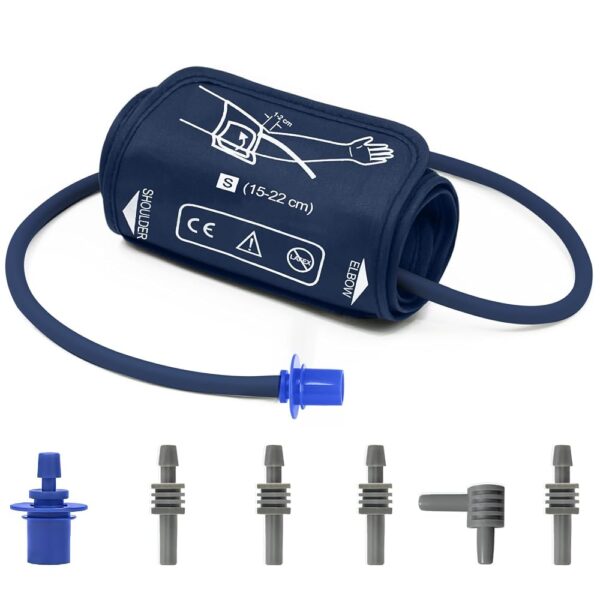
This is a replacement cuff, not a monitor. The ZIQING small cuff fits arm circumferences of 15 to 22 cm, given in the listing as 5.9 to 8.7 inches, and it is sold explicitly as a pediatric or child size. It ships with a hose and six connectors and nothing else.
That size class exists because a cuff that is too large does not squeeze enough and one that is too small squeezes harder than it should, and neither failure produces an error. The monitor reports numbers either way. On a small arm, a standard adult cuff is not a marginal compromise; it is a setup that cannot work.
Because this is a pediatric product, one thing has to be said before anything else and it is not a hedge. Choosing a cuff for a child, deciding whether to measure a child’s blood pressure at home, how often, and what to do with the results, are all decisions for the child’s clinician. This page describes an accessory and its published specifications. It does not interpret readings, it gives no guidance about measuring children, and neither a monitor nor a cuff replaces professional medical care.
The Specifications That Matter
The circumference range is published consistently in the product title, the description, the structured band size field and a bullet: 15 to 22 cm, which the description converts to 5.9 to 8.7 inches. Four places, all agreeing, which is more than most listings in this catalog manage.
Note that this is a genuinely different range from the small adult cuffs on this shelf. The AQESO small cuff, for instance, covers 5.9 to 9.5 inches, reaching nearly an inch further at the top. Small is not a standard size in this category, it is a marketing word, so compare published centimeter ranges rather than labels. Measure the arm at the midpoint between shoulder and elbow before ordering, and take that measurement to the clinician who asked for the readings.
Connectors and compatibility
Six connector sizes ship with the cuff, and unusually the listing publishes them in both units: 4 mm, 4.6 mm, 5 mm, 6 mm, 7 mm and 11.3 mm, with the inch equivalents alongside. Publishing both is a small courtesy that most sellers skip and it makes checking against your own monitor’s fitting far easier.
Compatibility is claimed as almost all blood pressure monitors, which is a broad claim rather than a list. A connector that physically fits is not the same as a cuff a monitor manufacturer has validated with its own hardware, and a bladder with different dimensions can shift results even when the fitting is mechanically correct. On a pediatric measurement this matters more, not less, so confirm the pairing with your monitor’s manufacturer and with the clinician who will read the numbers.
The Sensor Claim Is Wrong
The first bullet states that the cuff employs advanced sensor technology, ensuring accurate and reliable measurement results.
A cuff does not contain a sensor. It is a fabric sleeve, an inflatable bladder and a hose. The pressure sensor, the pump, the valve and the algorithm all live in the monitor, and the cuff’s contribution is to be the right size, to sit flat against the skin and to hold pressure without leaking. Those things matter enormously, but none of them is sensing.
We name this rather than paraphrase it because on a pediatric accessory a claim of built-in sensing could lead a buyer to think the cuff itself is a validated measuring component. It is not. No accuracy figure, tolerance, protocol or clearance appears in the source data, which is normal for a cuff: the correct expectation is that it fits properly, not that it measures anything.
Credit where it is due
The description, by contrast, contains one of the most useful sentences in this whole catalog. It says that an improperly sized or damaged cuff will affect the reading of the device, and that replacing it with an appropriate cuff in good time makes the measurement more accurate. That is exactly right, it is the reason this product category exists, and it is stated more plainly here than on most listings selling complete monitors.
Materials and Build
The cuff is nylon with a latex free hose, and the material feature field records latex free, which is a meaningful specification on an item worn against skin. Packed size is 5.2 by 4.5 by 0.9 inches at 3.56 ounces, and the listing carries a UPC. The included components are given as the cuff and the tube.
Two bullet claims are the seller’s rather than ours: that the ergonomic design ensures comfortable wear, and that the workmanship ensures outstanding durability. Neither carries a figure, test or service life estimate behind it.
Using It Correctly
Fit the cuff to the bare upper arm, not over a sleeve, with the hose running down the inside of the arm toward the palm and the lower edge roughly an inch above the elbow crease. Align the artery marker over the inside of the arm rather than wrapping by eye, and close it so a finger slides underneath with mild resistance. The person being measured should be seated with the back supported, feet flat, and the arm supported so the cuff is level with the heart, silent and still through inflation and release.
For a child, the technique above is the general shape of a measurement, not a set of instructions to follow unsupervised. Positioning, timing, how many readings to take and what to do with them should come from the clinician who asked for the monitoring. After changing to a correctly sized cuff, treat the log as starting fresh, note the date of the change, and mention it rather than merging the old and new numbers into one series.
Limits and Data Quality
Nothing is published about bladder dimensions, which is the figure that actually governs whether a cuff suits a given arm circumference, and nothing about pressure rating or expected service life. There is no compatibility list naming specific monitor models. The description field in the source data is truncated mid sentence and contains stray escape tokens where symbols and line breaks were meant to appear, which is an import defect rather than a product fault.
The previous copy on this page described the cuff as ideal for small arms in terms this site does not use, and that framing has been rewritten. What can be said honestly is narrower and more useful: it fits 15 to 22 cm, it comes with six connectors, and whether it is the right cuff for a particular child is not a question a product page can answer.
To restate the part that carries the most weight: a cuff is a measuring accessory. It does not diagnose, it does not replace professional medical care, and no reading taken with it should be interpreted at home.
Alternatives Worth Comparing
Among pediatric options here, the Pro Comfort pediatric arm cuff and the Elera pediatric cuff are the comparisons to raise with a clinician, and the Omron 9515373-3 small cuff covers 17 to 22 cm with an explicit list of compatible and incompatible monitors. ZIQING also sells a connector-focused cuff in this catalog. The full selection sits in our blood pressure monitor category.
Who Should Buy It, Who Should Not
Buy it if a clinician has specified a cuff in the 15 to 22 cm range, your monitor’s hose fitting matches one of the six connectors, and you understand no monitor is included. Skip it if the arm measures above 22 cm, if your monitor manufacturer sells its own pediatric cuff, if you need published bladder dimensions, or if nobody has yet advised you on whether home measurement is appropriate for the person it is intended for.