
Description
Who this cuff is for, and what it settles
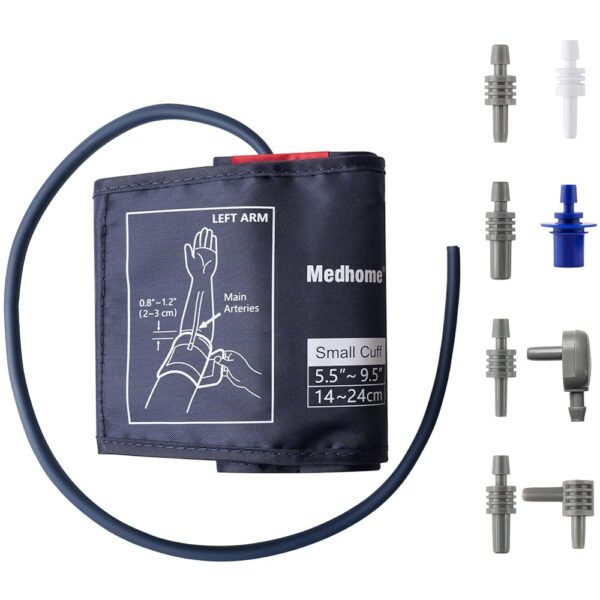
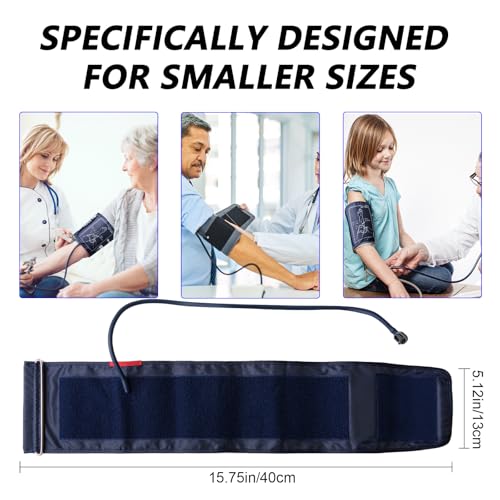
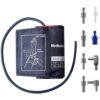
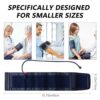
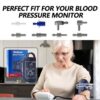
This is a replacement band, not a monitor. There is no pump, no screen and no electronics in it. It exists for one situation: the cuff that came with your machine is too big for the arm you are measuring, it will not tighten enough to sit flat, and you need a smaller band that still connects to the monitor you already own. Medhome publishes a range of 5.5 to 9.5 inches, given as 14 to 24 centimeters, and supplies a set of connectors so the band can be adapted to different machines.
Undersized arms are a real and under served problem. A great many home monitors ship with a band starting at 8.6 or 8.7 inches, which leaves anyone below that with a cuff that has to be pulled tight to close. That is not a comfort complaint. A band that cannot be seated evenly, or one so long that the bladder does not lie squarely over the artery, changes the numbers a monitor produces even when the monitor is working correctly. A properly sized small cuff is the fix.
Nothing here is medical advice, and changing a cuff does not replace a conversation with the clinician who manages your care.
The published range, and how to use it
Measure the midpoint of your upper arm, halfway between shoulder and elbow, with the arm relaxed at your side and a soft tape held snug but not tight. Compare that number against 14 to 24 centimeters. Buy on the measurement, not on a clothing size or an impression.
Note the overlap. If your arm measures between 22 and 24 centimeters, you sit at the top of this small band and at the bottom of a typical standard band, and either could work. Where two bands overlap, the one that closes with a comfortable margin rather than at its limit is the better choice.
One thing in the listing is plainly wrong and worth naming rather than smoothing over. The first feature bullet describes this 14 to 24 centimeter cuff as delivering a more precise and comfortable fit for users with larger arms. That is a copy and paste error from a different product. This is a small cuff. If you have a large arm you need the opposite end of the range, and our CareLiving XL cuff review is the place to start.
Connectors, and a count that does not add up
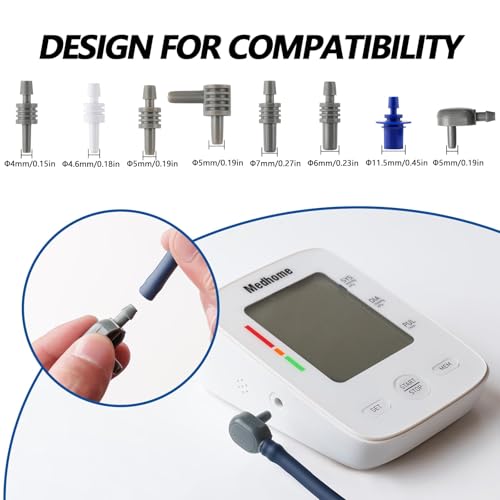
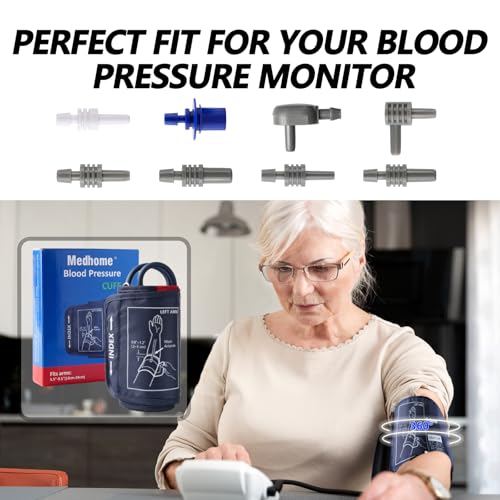
The title and the compatibility bullet both say eight connectors are included. The packing bullet then lists them as 0.15, 0.18, 0.19, 0.23, 0.27 and 0.45, which is six, and the unit marks in that list are inconsistent in the source data, mixing straight and curly quotation marks so that it is not certain every figure is in inches.
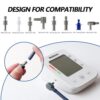
We are not going to guess. Before ordering, look at the fitting on your existing cuff, measure the outside diameter of the plug that goes into your monitor, and ask Medhome to confirm which of the supplied connectors matches and how many there actually are. A universal cuff is only universal to the extent its adapters cover your machine.
The compatibility claim itself is broad. The title names Omron and other brands, and the bullet says most brands. Some monitors use proprietary fittings, some tubeless designs have no detachable cuff at all, and some machines are calibrated around the band they shipped with. Treat compatibility as something to confirm for your specific model rather than assume. If you own a machine from a manufacturer that sells its own small band, buying that one removes the question entirely, as our Microlife replacement cuff review explains.
Materials and build
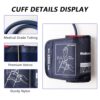
Medhome describes odorless TPU airbags and nylon fabric. Listed weight is 4.66 ounces, which the same listing also gives as 0.13 kilograms, and the two figures are close enough to be the same object. Listed dimensions of 6.69 by 4.12 by 1.15 inches describe the folded cuff rather than the extended band. The package includes a user guide.
Fields that describe hardware this product does not have
The listing states a power source of battery powered and a display type of digital. A bare replacement cuff has neither a battery compartment nor a screen. Those fields have been inherited from a monitor listing rather than describing this product, which is a common artifact across this catalog. We are naming them rather than quietly dropping them, because if a buyer is expecting a display, they should know before ordering that nothing in the actual product description supports one.
There is also no validation claim of any kind here, no protocol named and no accuracy figure. That is unremarkable for a cuff, but it does mean the phrase more precise in the marketing copy is an assertion rather than a measurement, and we are not repeating it in our own voice.
Using it correctly
Wrap the cuff around the bare upper arm, not over a sleeve, with the lower edge about an inch above the elbow crease. Most cuffs carry an artery marker that should sit over the inside of the arm. Snug the band until two fingers slide under the edge with mild resistance. Sit with your back supported, both feet flat, and rest the arm on a table so the cuff is level with your heart. Stay still and quiet through the measurement.
After swapping a cuff, take a few readings under exactly the conditions you were using before and see whether the pattern looks broadly similar to what you had been recording. If the new band gives results that look very different, do not assume either band is right. Raise it with your clinician or a pharmacist who can compare against their own equipment. A pharmacy check takes minutes and is worth more than any specification sheet, including this one.
Alternatives worth comparing
The CareLiving small cuff covers the identical 14 to 24 centimeter range and publishes its connector sizes in millimeters rather than ambiguous decimals, which makes matching easier. The AQESO small cuff and the ZIQING small cuff are the other direct comparisons. Our home blood pressure equipment section lists the bands alongside the machines they attach to.
Who should buy it, and who should not
Buy this cuff if your measured upper arm is genuinely between 14 and 24 centimeters, if you have checked your monitor’s fitting against the connectors supplied, and if you accept that a broad compatibility claim needs confirming for your model. Do not buy it for a large arm, whatever the first bullet says, and do not buy it hoping a new band will explain a reading that worried you. That question belongs with a clinician.