



Description
Who the Alcedo AE176 is for, and what it settles
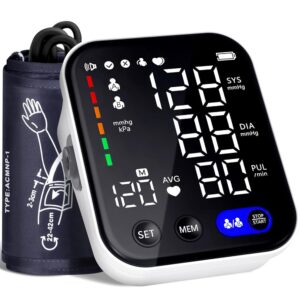
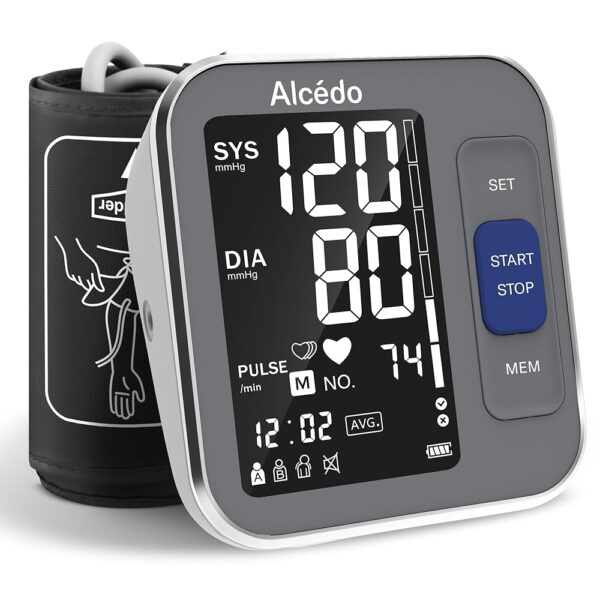
The Alcedo AE176 is a conventional two piece upper arm monitor: a base unit with a large LCD, a hose, and a wide range cuff. It settles one specific question well, which is whether a household can share a single machine and still keep two sets of records apart, while giving a spoken result to whoever cannot comfortably read the screen. Alcedo lists two user profiles with 120 readings stored for each, a live voice broadcast with adjustable volume, and one button operation from a cold start.
That combination points at a fairly clear buyer. It suits an older household, a shared kitchen counter, or anyone who has previously given up on a monitor because the display was too small or the menu system needed a manual. It is not a connected device. There is no Bluetooth, no app, and no cloud history in the published data, so everything lives on the unit or in whatever log you keep by hand.
Whatever it shows, this is a home instrument. It does not replace professional medical care, and a reading taken on it is something to discuss with your clinician rather than something to act on alone.
The specifications that matter
Cuff range
Alcedo publishes a cuff range of 8.7 to 15.7 inches of upper arm circumference, and the band size field agrees with the top of that figure. That is a genuine wide range band, wider at the bottom end than many standard cuffs, which makes it a reasonable choice for a household with two adults of different builds. Measure the midpoint of the upper arm before ordering. If either person measures above 15.7 inches, this cuff is the wrong size and no amount of pulling will fix it, because a cuff that has run out of adjustment will change the numbers on a machine that is otherwise working correctly. Larger bands are covered separately in our home blood pressure equipment section, which lists cuffs next to the monitors they fit.
Display, voice and controls
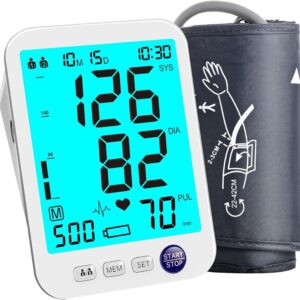
The unit uses an LCD, and the product title describes a black backlit screen. The feature bullets describe clear numerals appearing during the measurement and a spoken announcement of the result with a volume setting. The voice feature is the reason many buyers look at this model, and it is worth checking what language the unit speaks before ordering, because the listing does not say. Operation is a single push button, with no menu to navigate for a basic reading.
Memory and averaging
Two user modes each hold 120 readings, which is a genuinely useful depth if you are keeping a log over weeks rather than days. Alcedo also states the device automatically averages three values into a single result. Averaging modes vary between manufacturers in how they space the individual measurements, and the listing does not describe the interval used, so if that detail matters to a log your clinician has asked for, confirm it with Alcedo.
Power and what is in the box
The listing specifies four AAA batteries, included. No AC adapter is named anywhere, and no adapter is offered as an accessory in the published data, so treat this as a battery only device unless the seller confirms otherwise. Listed dimensions are 6.25 by 4.75 by 3 inches, and listed weight is 1.21 pounds, which puts it in the normal range for a counter top unit rather than a travel one.
Contradictions in the listing
Two fields do not line up. The model number and the model name fields both read AE176, which matches the title, but a separate attribute field on the same product reads B21. B21 is a different Alcedo monitor, one we cover in our Alcedo B21 review, so this looks like data from a neighboring listing that has leaked into this one. We are not choosing between them. If you are buying to match an existing cuff or an existing machine, confirm the model on the box.
The included components field lists only a cuff, while the feature bullets describe a complete kit with everything needed to take a reading. Those cannot both be a full description. Check the packing list with the seller if the presence of a storage case or a manual matters to you.
There is also no validation claim here at all. No protocol is named, no clearance number is quoted and no accuracy figure appears in the listing. We are therefore not attributing an accuracy claim to Alcedo, and we are certainly not making one ourselves. If validation status matters to you, and for a device you intend to rely on it reasonably should, check it independently through the lists that medical societies publish rather than taking any retail listing at its word.
Using it correctly
Sit down five minutes before you start, back supported, feet flat, legs uncrossed. Put the cuff on the bare upper arm with the lower edge about an inch above the elbow crease and the artery marker over the inside of the arm. Rest the arm on a table so the cuff sits level with the heart. Do not talk, and do not check your phone, while the measurement runs.
The cuff position and movement detection features Alcedo describes are helpful precisely because they catch the two mistakes people make most often. If the unit shows a positioning symbol, reseat the cuff rather than repeating the measurement on top of a bad fit. If you are using the two user memory, get into the habit of confirming which profile is selected before you press the button, because a mixed log is worse than no log.
Keep a written record with dates and times alongside the on device memory. If a clinician has asked for a week of home readings, they will usually want to know when each was taken, and 120 stored values with no timestamps in your hand is harder to discuss than a sheet of paper.
Alternatives worth comparing
Within the same brand, the Alcedo ABP-2005-1 is the closest sibling and worth reading before you decide which generation you want. If the spoken result is the whole reason you are here, the LotFancy talking wrist monitor offers the same idea in a much smaller package, with the important caveat that wrist devices are far more sensitive to position and are not the usual recommendation for home monitoring. For a plainer upper arm unit from a brand with a long hospital supply history, the Medline MDS4001 covers similar ground without the voice feature. If your arm is near the top of the range, look at the Omron easy wrap cuff to understand how much difference a better shaped band makes.
Who should buy it, and who should not
Buy the AE176 if two adults in the house both measure inside 8.7 to 15.7 inches, if a spoken reading and a single button are what will keep the device in use, and if you are content with a machine that keeps its records to itself. Skip it if you want app history, if either arm falls outside the published range, or if you need the model identity on the listing to be unambiguous before you commit. And in either case, treat the numbers as something to bring to a clinician rather than something to interpret at the kitchen table.