



Description
Who This Is For and What It Settles
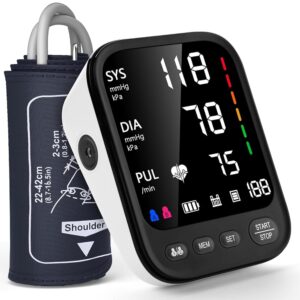
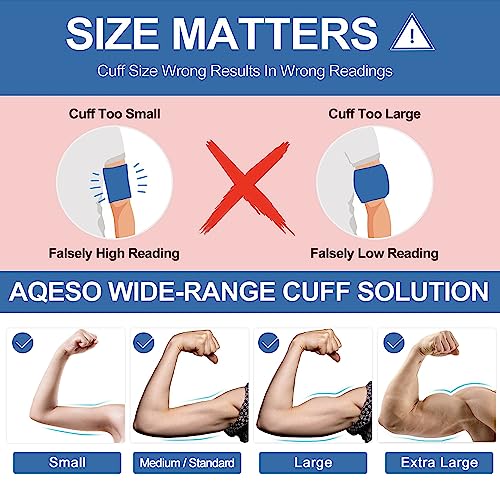
This is not a monitor. It is a pair of replacement cuffs, sold together, with a set of connectors and nothing else. The product title says cuffs only, and the pairing is what makes it interesting: a small cuff fitting arms of 5.9 to 9.5 inches and an extra large cuff fitting 9 to 21 inches, which between them cover almost every adult arm a household is likely to contain.
It exists to solve the most common failure in home blood pressure measurement, which is that the cuff supplied with a monitor does not fit the arm using it. A cuff that is too small squeezes harder than it should, one that is too large does not squeeze enough, and neither failure shows up as an error on the display. That silence is why cuff size is the most consequential specification in this category. This review describes an accessory and its published data; it does not interpret readings, and neither a monitor nor a cuff replaces professional medical care.
The Specifications That Matter
The two ranges are published consistently in the product title, the structured band size field, the components list and the lead bullet. Small is 5.9 to 9.5 inches. Extra large is 9 to 21 inches. They meet at 9 inches with no gap and no meaningful overlap, which is exactly how a two size set should be laid out.
Measure the bare upper arm at the midpoint between shoulder and elbow before ordering and choose the cuff whose range centers on that measurement rather than one whose extreme end merely reaches it. If only one size is needed, the same brand sells them individually, including the AQESO small cuff on its own. Arms above 21 inches fall outside even the extra large here, and something like the Maymocon XXXL cuff is the class to look at instead.
Connectors and compatibility
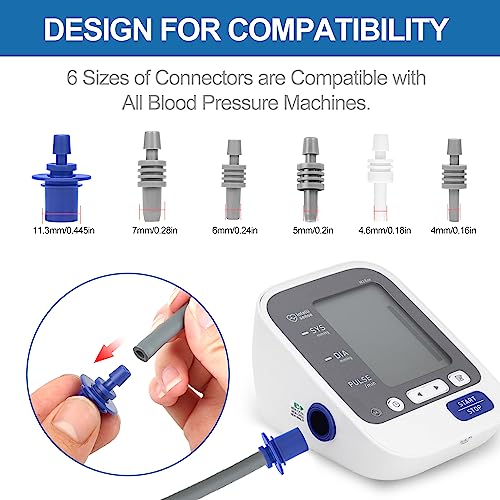
Both cuffs come with six connector sizes, with the 5 mm fitting already installed, and the connector part is removable so the original connector from your own cuff can be transferred if none of the six matches. Six sizes is the widest spread among the replacement cuffs in this catalog, which is the practical argument for this set.
Compatibility is claimed as a universal fit for most models of upper arm automatic monitors, with the product title naming Omron specifically. That is two claims of different strength, and it is worth being clear what a connector match does and does not buy you. A connector that physically fits is not the same as a cuff a monitor manufacturer has validated with its own hardware, and a bladder with different dimensions or inflation characteristics can shift results even when the fitting is mechanically correct. Check your monitor’s hose fitting against the six sizes, and check whether your monitor’s maker sanctions third party cuffs, before relying on readings taken with one.
Materials and the Placement Note
The cuffs are made from 210 denier nylon over a hypoallergenic TPU airbag, described as latex free, abrasion resistant and easy to clean, with a hook and loop fastener and an integrated D-ring. The set weighs 9.91 ounces packed and measures 6 by 4 by 1.6 inches.
The last bullet is the most valuable thing on the page, and it is worth reproducing because most listings never bother. It tells the buyer to place the cuff about one inch above the bend of the elbow, to make sure the air tube falls over the front center of the arm, to align the artery mark directly over the brachial artery, and to pull the end of the cuff so it is evenly tight around the arm. That is correct, specific and actionable, and following it will do more for a home reading than any feature on any monitor in this catalog.
One phrase in the lead bullet is the seller’s rather than ours. It says the integrated D-ring makes the cuff easy to self-adjust for greater accurate readings. Fitting a cuff correctly genuinely does matter, and a D-ring genuinely does make one handed wrapping easier, but a cuff contains nothing that can be calibrated or tuned, and describing an easier wrap as an accuracy feature blurs a sensible design point into a performance claim.
Using It Correctly
Fit the chosen cuff to the bare upper arm, not over a sleeve, following the placement instructions above. Sit with the back supported and both feet flat on the floor, rest the arm so the cuff is level with the heart, and stay silent and still through inflation and release. Rest for several quiet minutes before the first reading rather than measuring straight after activity.
After changing cuffs, treat the log as starting fresh rather than continuing. A different cuff is a different measurement setup, so readings taken before and after are not directly comparable. Note the date of the change and mention it to a clinician rather than merging both series into one. If two people in a household use different cuffs from this set, label them, because swapping cuffs mid record makes a log impossible to read later.
Limits and Data Quality
The description field is empty, so six bullets and a specification table carry everything. Nothing is published about bladder dimensions, which is the figure that actually governs whether a cuff suits a given arm circumference, and nothing about pressure rating or expected service life. There is no compatibility list naming specific monitor models.
Two fields do not belong. The display type field says digital, on an item with no display of any kind, which is a template leftover from a listing built for complete monitors. And the included components field is corrupted with raw JavaScript scraped from the retailer’s page ahead of the actual list. Neither is a hardware fault, but on a page whose title exists specifically to clarify that no monitor is included, a field claiming a display works against the message.
One more note about the previous copy on this page. It made a claim about value for money. This site does not make price claims, because they go out of date quickly, and that statement has been removed rather than repeated.
To restate the part that carries the most weight: a cuff is a measuring accessory. It does not diagnose, it does not replace professional medical care, and no reading taken with it should be interpreted at home. If readings shift noticeably after fitting a new cuff, that is information for a clinician rather than a conclusion to draw yourself.
Alternatives Worth Comparing
Buyers who need only the large end should compare the iProven BPC-901-XL, which uses a curved design for big arms, and those whose main worry is the fitting rather than the size should look at the AQESO universal cuff. Cuffs and the monitors they attach to are filed together in our blood pressure monitor category.
Who Should Buy It, Who Should Not
Buy it if a household spans arms from 5.9 to 21 inches, your monitor’s hose fitting matches one of the six connectors or your original connector can be transferred, and you have checked that your monitor’s maker does not object to a third party cuff. Skip it if you only need one size and would rather not pay for two, if your arm exceeds 21 inches, if your monitor manufacturer sells its own sized cuff, or if you thought this listing included a monitor, because it does not.