



Description
Who This Monitor Is For and What It Settles
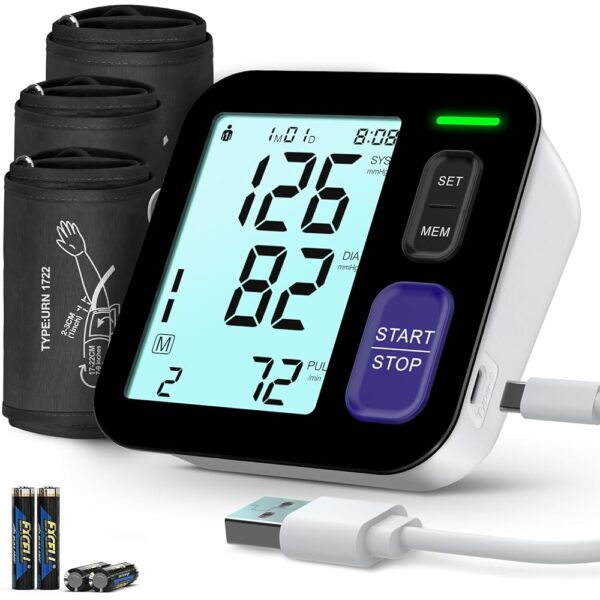
The AQESO U87E is an upper arm blood pressure monitor sold as a three cuff kit. Small covers arms of 7 to 9 inches, medium and large covers 9 to 17 inches, and extra large covers 13 to 21 inches. Between them they reach from a slim adult arm to an unusually large one, which is a wider span than almost anything else on this shelf.
That is the whole proposition and it is a good one. A cuff that is too small squeezes harder than it should, one that is too large does not squeeze enough, and neither failure shows up as an error on the display. Silent failure is why cuff size outranks every other specification in this category, and the listing itself says as much in its third bullet: accurate readings require the correct cuff size. Before going further: this review describes a device and its published specifications, it does not interpret readings, and a home blood pressure monitor does not replace professional medical care.
The Specifications That Matter
The three cuff ranges are published consistently in the product title, the included components list and two bullets, and they tile cleanly rather than overlapping awkwardly. Small runs to 9 inches, medium and large starts there and runs to 17, and extra large starts at 13 and runs to 21. Only the 13 to 17 inch band is covered by two cuffs, and there a buyer can pick whichever range centers closer to their measurement.
Measure the bare upper arm at the midpoint between shoulder and elbow before ordering and choose on that number rather than on a size label. Buyers below 7 inches or above 21 inches fall outside the kit; at the small end a purpose-made option such as the CareLiving small blood pressure cuff is the comparison to make.
Memory, display and power
Memory is 99 readings for each of three users, 297 in total, recalled with a dedicated button and stamped with date and time. Three user banks is unusual and genuinely useful in a household of three; most competitors stop at two. It is worth noting that other monitors from the same brand claim 500 readings for each of two users instead, so the memory arrangement varies across the range rather than being a house standard.
The display is a large backlit LCD with oversized digits, described as aimed at older users. No digit height is published, so the actual character size has to be judged from photographs.
Power is documented more honestly than most. The device runs on four AAA batteries or from a USB Type-C cable, and the listing states plainly that it is not rechargeable and must stay connected to a power source when running from USB. It also notes that a 5V 1A adapter is not included, and adds a restriction worth knowing: the monitor is described as compatible only with the Type-C cable supplied in the package. If that cable is lost, confirm a replacement with the seller rather than assuming any Type-C lead will work.
The kit includes the monitor, all three cuffs, a cloth bag, four AAA cells and a manual.
What the Listing Claims, and Who Is Making the Claim
The lead bullet states that upgraded accurate signal processing technology delivers greater precision and results in 30 seconds, that more than 100,000 data points were tested for reliability, that the unit is calibrated to the best performance, and that the buyer can rest assured about detecting a hypertension issue using the classification bar.
All of that is the manufacturer speaking and none of it is ours. We do not test devices and we do not verify these claims. No accuracy figure, no tolerance, no validation protocol and no regulatory clearance appears anywhere in the data. The identical claim language, including the same 100,000 figure, also appears on other pages in this catalog under different brand names and different manufacturers of record, which points to shared marketing copy rather than shared testing.
The classification bar deserves separating out. A color band on a home monitor compares a measured value against thresholds stored in firmware. It does not detect a condition, it does not diagnose, and treating it as a screening result is the seller’s suggestion rather than a supportable one. Record the numbers, disregard the bar, and take the log to a clinician. Validation status can be checked independently through the registries medical bodies maintain.
A second bullet makes a more specific engineering claim: that a proportional valve system adjusts deflation speed according to cuff size, improving comfort and repeatability across cuffs. That is a plausible design rationale and it is the kind of thing a three cuff kit would need. It is still the manufacturer’s assertion, with no test data attached, and the brand name is misspelled in the same sentence.
Using It Correctly
Choose the correct cuff first, then fit it to the bare upper arm rather than over a sleeve, with the tubing running down the inside of the arm toward the palm and the lower edge roughly an inch above the elbow crease, closed so one finger slides underneath with mild resistance. Sit with the back supported and both feet flat on the floor, rest the arm so the cuff sits level with the heart, and stay silent and still through inflation and release.
Rest for several quiet minutes before the first reading rather than measuring straight after activity, and use the same arm and the same cuff at the same times each day. Assign the user slot before the first measurement, and if three people are using three different cuffs, label them, because swapping cuffs mid record makes a log impossible to compare later.
Limits and the Wider Model Family
The description field is empty. Nothing is published about the pressure or pulse measurement range, tolerance, averaging across readings, irregular heartbeat detection, digit height or battery life. The included components field is corrupted in the source data, carrying raw JavaScript from the retailer’s page and then cutting off mid sentence, so it cannot be treated as authoritative. The unit measures 6.2 by 4.05 by 2.03 inches at a listed 1.66 pounds.
The manufacturer of record is Shenzhen Urion Technology, which supplies several brands in this catalog. Within the same brand, the two cuff AQESO U80AH and AQESO U80B cover a narrower span with deeper memory, and the AQESO A01-BL is a different design again. Their specifications do not always agree with each other, so confirm what a given page is actually selling.
The point that outranks the rest: this device produces numbers and stores them. It does not diagnose, it does not replace professional medical care, and nothing in this review is guidance about anyone’s health. The full selection sits in our blood pressure monitor category.
Who Should Buy It, Who Should Not
Buy it if a household spans several arm sizes from 7 to 21 inches, three separate user banks is what you need, and the honest power documentation is the kind of detail you value. Skip it if you need documented accuracy or validation, if 99 readings per user is too shallow for how you log, if being locked to one supplied cable bothers you, or if you were relying on the classification bar to interpret a reading.