


Description
Who the ARSIMAI BSX312 is for, and what it settles
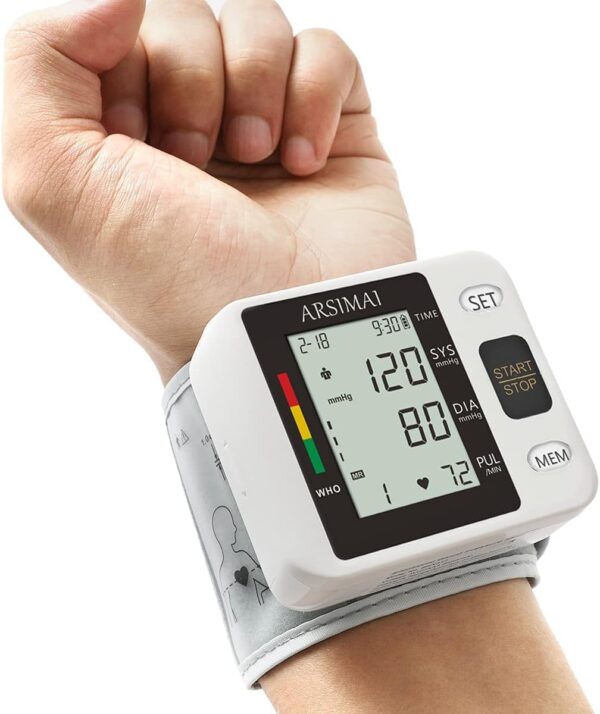
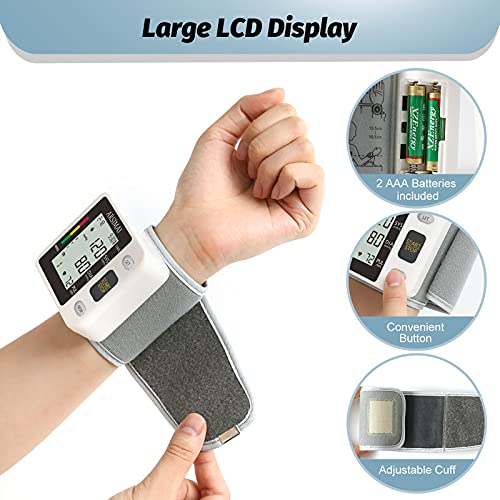
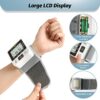
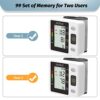
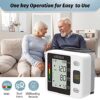
This is a plain wrist monitor with the essentials and nothing else: a large LCD, an irregular heartbeat symbol, two user profiles at 99 readings each, a storage case, and two AAA cells in the box so it works the moment it arrives. It weighs 7.05 ounces and folds into a case, which is the whole argument for it.
Before the specifications, the format. A wrist device is not equivalent to an upper arm device. The wrist sits further from the heart, the arteries there are smaller, and results move noticeably with how the hand is held. Upper arm monitors remain the usual recommendation for home monitoring, and a wrist unit is normally chosen when an arm cuff is impractical, uncomfortable or will not fit. If you have a free choice and no reason to avoid an arm cuff, read our HoMedics upper arm review before deciding.
The device measures and records. It does not diagnose, it does not replace professional medical care, and its readings belong in a conversation with the clinician who manages your health.
The specifications that matter
Band range
The published range is 5.31 to 7.68 inches, given as 13.5 to 19.5 centimeters, and the two convert correctly to each other. Note that the structured band size field gives only 19.5 centimeters, a single figure with no lower bound, so work from the feature bullet’s full range instead.
Measure your wrist just below the bone, where a watch strap would sit, using a soft tape held snug. Wrist bands have far less adjustment than arm cuffs, so a measurement near either boundary is a genuine risk rather than a rounding question. At 7.68 inches the ceiling here is typical rather than generous, so larger wrists will need something else.
Memory and users
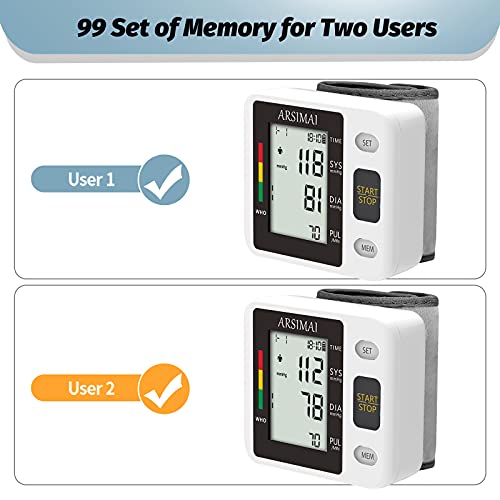
Two profiles with 99 readings each, timestamped, recalled with a button press. That is roughly seven weeks of twice daily measurements per person before anything is overwritten, and it is a genuine advantage over the single user wrist devices in this catalog.
Irregular heartbeat symbol
ARSIMAI states the device displays a symbol when an irregular heartbeat is detected during a measurement. Read that narrowly. It reports that something irregular occurred in one measurement, which is a prompt to mention it at an appointment. It does not diagnose an arrhythmia, and it is not a monitoring function you should rely on to catch anything. The listing also describes the machine as professional, which is a marketing word rather than a category, and we are not repeating it.
Power, size and returns
Two AAA cells, included. Listed dimensions are 3.15 by 2.68 by 0.98 inches, and the listed weight of 7.05 ounces agrees with the 200 gram figure given elsewhere in the same listing. ARSIMAI states a one year return window if you are unhappy with the device, which is longer than most sellers in this catalog offer and is worth knowing.
What the listing does not provide
No validation protocol is named, no clearance number is quoted, and no accuracy tolerance is published. The listing uses the word accuracy in a heading and then does not attach a figure to it. We make no accuracy claim about this device in our own voice, and validation status is checkable independently through the lists that medical societies publish.
There is also no averaging mode described and no positioning check mentioned. On a wrist device, where posture is the dominant source of variation, a positioning aid would be genuinely useful, and its absence here is worth weighing against devices that include one. There is no voice readout either, so if you were looking for a talking wrist monitor, this is not it.
Where this design comes from
The manufacturer field names ARSIMAI and Shenzhen BSX Technology Electronics together, and the BSX model prefix runs across a striking number of unrelated brand names in this catalog. Our Laukum BSX583 review and our CardioVantage BSX595 review both cover machines from the same family under different labels.
More directly relevant: this exact model code, BSX312, appears twice in our catalog under the same ARSIMAI brand on two separate listings. Our second ARSIMAI BSX312 review covers the other one. Before ordering, check which listing a seller is actually fulfilling and what is in the package, because two listings under one model code do not always ship the same contents.
Shared platforms are ordinary in this category and none of this is a criticism of the hardware. The practical consequence is that the brand name carries little information, and customer feedback under one label is not evidence about a device sold under another.
Using it correctly
Position is the whole game on a wrist device. Rest for five minutes first, sitting with your back supported and both feet flat on the floor. Put the band on the bare wrist with the display facing up, snug enough that it will not slide. Rest your elbow on a table and raise the wrist so that it sits level with your heart, roughly in line with the middle of your chest. Support the arm rather than holding it there under tension, because muscular effort changes the result.
Keep the wrist flat rather than bent forward or back. Stay quiet and still. If you take a second reading, wait a minute or two and repeat the identical posture, because a home log is only useful when it is comparable with itself.
Confirm the correct user profile before pressing start, since 99 readings per person is only worth having if they belong to one person. Write results down with dates and times regardless, because that is the format a clinician can scan in seconds.
Alternatives worth comparing
For a wrist device from a brand with a longer retail history and its own published band range, read our Care Touch wrist monitor review. Our home blood pressure monitor section lists the wrist devices alongside the arm ones, which is the comparison worth making first.
Who should buy it, and who should not
Buy the BSX312 if an arm cuff is impractical for you, if your wrist measures inside 13.5 to 19.5 centimeters, and if two people need separate records on one cheap device. Skip it if an arm cuff is workable, if your wrist is near either limit of that range, or if you want a positioning aid, an averaging mode or a spoken readout, none of which this device offers. And whatever the symbol on the screen shows, it is a flag for a clinician rather than an answer.