




Description
Who the Laukum BSX583 is for
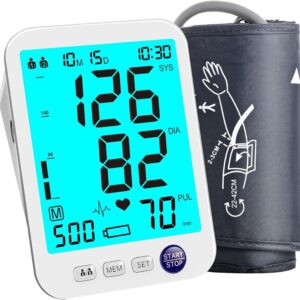
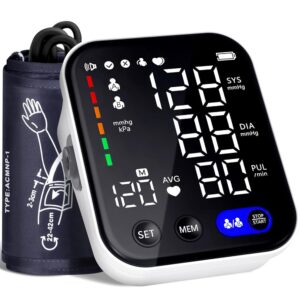
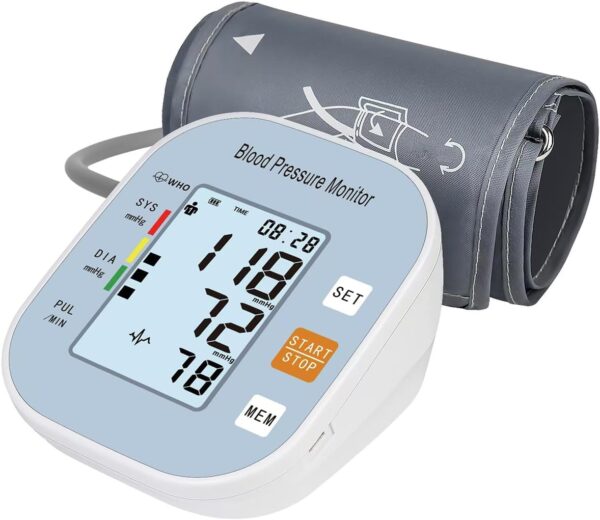
This is an entry level upper arm automatic blood pressure monitor with a backlit display, two user memories and a storage bag. It records numbers for a clinician to review. It is not a diagnostic device and it does not replace professional medical care.
It suits a household that wants a simple device for two people and will keep readings on the machine rather than on a phone. Before that, though, there is a fit question that the listing itself gets wrong, and it decides whether this monitor is usable for you at all.
The cuff is a standard cuff, whatever the title says
The product title describes a large wide cuff. The feature text and the stored attribute both give the actual figure: 22 to 32 cm. That is roughly 8.7 to 12.6 inches, which is a standard adult cuff and one of the narrower ranges in this catalog. Calling it large and wide is marketing that does not match the specification underneath it, and a buyer who reads the title and skips the bullets will order the wrong device.
A great many adults measure above 12.6 inches at the upper arm. If you are one of them, this monitor as supplied will not fit you, and no amount of pulling the cuff tighter fixes it. Measure the circumference of your bare upper arm with a cloth tape, midway between elbow and shoulder, before ordering. A cuff that is too small produces readings that do not match what the same device would record with a correctly sized one, and the display gives no warning that it has happened.
The rest of the specification
The device supports two users with 99 readings each. The display is a large backlit screen, legible in low light, though no dimension is published. There is a 60 second automatic shut off when the device is left idle, which the listing describes as both power saving and a safety measure. A mini storage bag is included, and the listing states that a user manual and instructions are supplied. The unit measures about 5.2 by 2.78 by 4.41 inches.
The included components field lists only a cuff and a user manual, with no batteries, no cable and no adapter confirmed, while the power source attribute records battery powered. Expect to supply your own cells and confirm the type before ordering.
Using it correctly, and what the readings are for
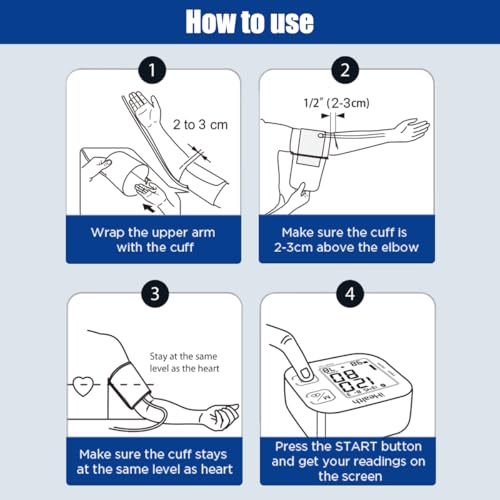
Sit with your back supported and your feet flat on the floor rather than crossed, and rest quietly for several minutes before measuring. Fit the cuff on a bare upper arm rather than over a sleeve, and support the arm so that the cuff sits at about the height of your heart. Do not talk during the measurement. Use the same arm at about the same time each day, because a series taken consistently is worth far more than scattered single readings.
Since this model has no averaging function, taking two or three measurements a minute apart and writing all of them down is worth the extra time. Single readings vary for ordinary reasons.
What you produce is a record for someone else to read. What a reading means, whether a pattern across your readings is significant, and whether anything about your care should change are questions for a healthcare professional who knows your history and your medication. This device does not replace professional medical care, and no reading from it should be used to start, stop or alter treatment on your own.
Claims, limits and gaps
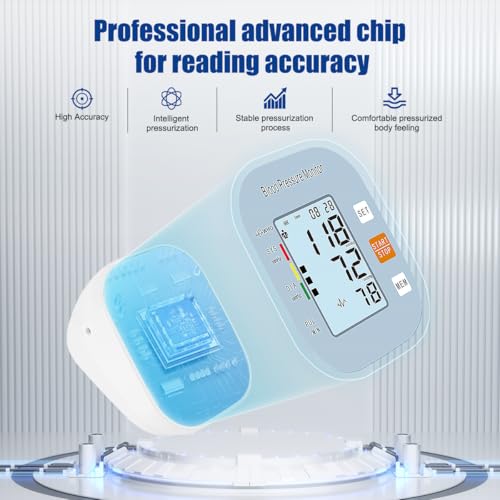
The listing states that an upgraded high tech chip provides accurate detection under correct posture and use conditions. That is the seller’s description, and the qualifier about posture is at least honest. We do not test products and we will not describe any monitor as accurate in our own voice. No accuracy figure, no independent validation protocol and no assessing body is named anywhere in this listing. Check whether this model number appears on an independent validation listing if that matters to you.
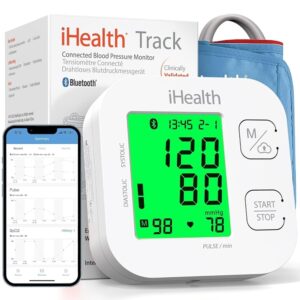
On gaps: no irregular heartbeat detection is described, there is no averaging function, no app and no wireless connection, no display dimension and no warranty term. A note on our own earlier summary of this product, which described its readings as comparable to professional medical equipment. Nothing in the listing supports that comparison, we did not measure anything, and it has been removed.
One catalog note. The BSX583 model number appears in our catalog under several listing codes and under more than one brand name, with the wider BSX series traced to a single manufacturer. Comparing those listings is mostly a matter of what is in the box and who supports it.
What the auto shut off does and does not do
The listing describes a 60 second automatic shut off as both power efficient and safe, and the second half of that deserves a plain explanation, because it is a real feature rather than marketing. A blood pressure monitor inflates a cuff around your arm and restricts circulation while it does so. If a device were to inflate and then fail without releasing pressure, the cuff would stay tight. Automatic shut off and automatic rapid deflation exist so that the cuff releases if anything interrupts a measurement, and any monitor you buy should have them.
Two practical habits follow. If a measurement feels uncomfortable, or the cuff inflates further than usual and stays there, remove the cuff rather than waiting for the device to sort itself out. And if you find the inflation genuinely painful rather than merely tight, that is worth mentioning to a clinician, because on some machines it points to a cuff that is the wrong size for the arm.
A separate practical note on batteries. Monitors in this class are typically powered by four AA or AAA cells, and inflation is the part that drains them. A set that has weakened will often produce measurement errors before it produces a low battery warning, so if a previously reliable device starts throwing errors, fresh cells are the cheapest thing to try first.
Alternatives worth comparing
The same model number appears as a second Laukum BSX583 listing and a third in our catalog, and under a different brand as the Maraawa BSX583. If the cuff range is your problem, the PLAYOUNG BSX525, which publishes a 22 to 42 cm cuff is a wider option on related hardware, and a larger replacement cuff is worth checking for compatibility. Our index of home monitors and cuffs publishes the cuff range each listing states.
Who should buy it and who should not
Buy it if your upper arm measures between 8.7 and 12.6 inches, two people will use it, and a simple backlit device is all you want. Do not buy it on the strength of the words large and wide in the title, because the cuff underneath is a standard one, and do not expect averaging, irregular heartbeat flagging or an app. Take your readings to a clinician.