




Description
What this device is, and the specification it does not publish
This is a wrist blood pressure monitor sold under the Ever Ready First Aid name, manufactured by Honsun and carrying the model designation LD-737. It has a backlit LCD, records the date and time of each reading, and ships with two AAA batteries. It records numbers for a clinician to review. It is not a diagnostic device and it does not replace professional medical care.
The most important thing about this listing is what is missing from it. Nowhere in the product title, the feature bullets, the description or our stored attributes is there a wrist circumference range. There is no band size field at all. For a device that measures blood pressure by compressing a limb, that is the single most consequential specification, and it has not been published.
Why it matters: a cuff that is too small or too large for the wrist produces a reading that does not reflect what the same device would record on a correctly fitted wrist, and nothing on the display warns you. Without a published range you cannot check the fit before ordering. Measure your bare wrist just above the wrist bone with a tape measure, then ask the seller for the cuff range and compare the two before you buy. Do not assume that a wrist monitor fits any wrist, because they do not: the devices in this catalog that do publish a range vary between about 5.3 inches and 8.5 inches at the top, and some stop at 7.7.
The wrist question
Wrist devices and upper arm devices are not interchangeable. On the wrist, the height at which you hold your arm relative to your heart changes the number, and the measurement site is smaller and more variable than the upper arm. Upper arm devices are the usual recommendation for home monitoring, and a wrist device is normally chosen for a specific reason. Nothing in this listing describes a heart level positioning aid or a cuff tightness indicator, so the whole burden of correct positioning falls on the user.
The listing describes the product as a wrist cuff watch wearable monitor. It is not a watch and it is not worn continuously. It is a wrist cuff that you fit for a measurement and take off afterward.
What the listing does publish
The screen is described as a backlit LCD with large, clear digits. The device records the date and time of each reading so that results can be reviewed over time, although no memory capacity is stated and no number of user slots is given. The feature text refers to alerts for elevated readings, detection of irregular patterns, and categorized feedback based on general guidelines.
Each of those three needs reading carefully. An alert for an elevated reading is a symbol driven by thresholds the manufacturer programmed in, and we are not reprinting those thresholds here as targets, because what a number means for a particular person depends on their history and their treatment. Detection of irregular patterns is a flag: it reports that the device noticed an irregularity during a measurement, it does not identify a rhythm, and it does not diagnose anything. Categorized feedback based on general guidelines is a band display, and the phrase general guidelines is doing a lot of work in that sentence, since the listing does not say which guidelines or from what year.
Two AAA batteries are included. The stored product dimensions of 8.5 by 3 by 1.5 inches describe the packaging rather than the device.
The manufacturer’s own limitation, which is worth quoting
One line in this listing is more useful than everything around it. The feature text states that the product is designed for home use and should not be used for professional or medical diagnostic purposes.
That is the manufacturer setting the boundary itself, and it is unusually direct for a retail page. Take it at face value. This is a device for collecting numbers that you then take to someone qualified to interpret them. It is not a device for deciding anything.
There is a correction to make to our own earlier summary of this product, which described its results as accurate and consistent and as verified by healthcare professionals. Nothing in the listing data supports either half of that, we did not measure anything, and no verification by any clinician is described anywhere in the record. We have removed it.
Using it correctly, and what the readings are for
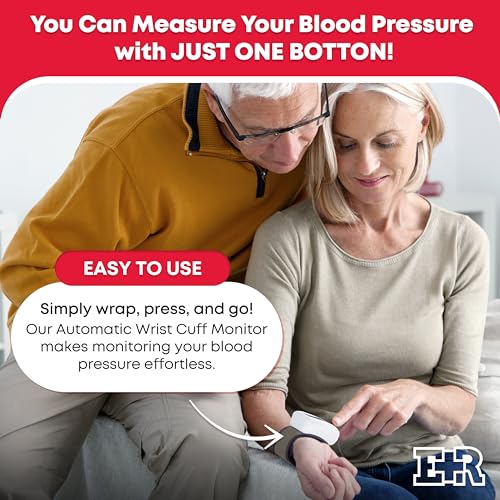
Sit with your back supported and your feet flat on the floor, and rest quietly for several minutes before starting. Fit the cuff on a bare wrist, snug rather than tight. Then support your forearm with the other hand or on a cushion so the device sits at about the height of your heart, and hold still and stay silent while it inflates. Holding the wrist too low or too high is the classic error with these devices and it changes the reading. Use the same wrist at about the same time of day, and write the numbers down, since no memory capacity is published.
What you collect is a record. What a reading means, whether a pattern across your readings is significant, and whether anything about your care should change are questions for a healthcare professional who knows your history and your medication. This device does not replace professional medical care, and no reading from it should be used to start, stop or alter treatment on your own.
Limits and gaps
The missing cuff range is the headline gap and it is a serious one. Beyond that, no memory capacity, no number of users, no measurement time, no accuracy figure, no display dimension and no warranty term appears anywhere in the record we hold. No independent validation protocol and no assessing body is named. That is a thinner specification than almost anything else in this catalog.
A catalog note: the LD-737 model designation also appears in our catalog under a different brand name, which is normal for hardware built by one manufacturer and badged for several sellers. Compare those listings, because one of them may publish the cuff range this one omits.
Alternatives worth comparing
The same model designation appears under another brand as the SCIAN LD-737 wrist monitor, which is the first place to look for the missing specification. Among wrist devices that do publish a range, the Omron BP6350, which fits 5.3 to 8.5 inch wrists and adds heart level guidance is the comparison on positioning, the HoMedics BPW-O300 publishes 5.3 to 7.7 inches, the AMZ VISION W1681 adds a voice function, and the SureLife WRS-35H is a long standing option. Our index of home monitors and cuffs lists what each publishes.
Who should buy it and who should not
Do not buy it until the seller has given you the wrist circumference range and you have checked your own measurement against it. If that range turns out to fit and you want a simple battery powered wrist device with a large backlit screen, it is a reasonable low cost option. Do not buy it if you want a published memory capacity, a positioning aid or any validation you can check, and take the manufacturer’s own statement seriously: this is not for diagnostic purposes.