

Description
Who the Greetmed FC-BP111 is for, and what it settles
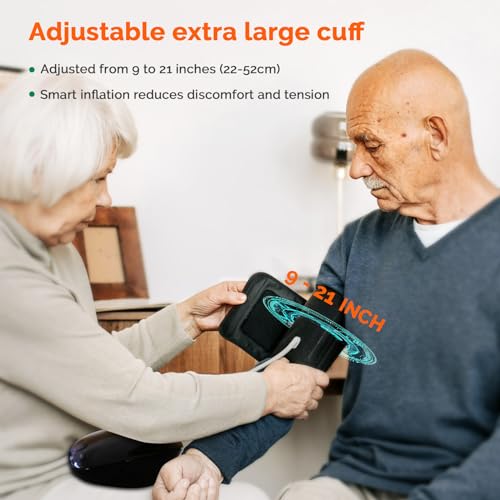
This is a monitor for large arms. The cuff is published at 9 to 21 inches, which the listing also gives as 22 to 52 centimeters, and that upper figure is well beyond what a standard adult band reaches. If you have been told your arm is too big for the machine you own, or you have been wrestling a cuff that runs out of hook and loop before it closes properly, that is the specification that decides this purchase.
Cuff fit matters more than any other variable a home user controls. A band that cannot close correctly, or one that closes only under tension, changes the numbers on a monitor that is working exactly as it should. Buying a device with a band that actually reaches around the arm is not a comfort upgrade, it is the difference between a reading worth keeping and one that is not.
The device itself does not diagnose anything and does not replace professional medical care. What it produces is a number for the clinician who manages your health to interpret.
The specifications that matter
The cuff, and a conversion worth checking
The published range is 9 to 21 inches. The centimeter equivalents given alongside it are 22 to 52 centimeters, and neither conversion is exact: 9 inches is 22.9 centimeters and 21 inches is 53.3. The gaps are small, roughly a centimeter at each end, but if your measurement is within a centimeter of either limit, buy on the inch figures and confirm with Greetmed rather than assuming the rounding is in your favor.
Measure the midpoint of your upper arm with a soft tape, arm relaxed at your side. If your measurement is comfortably in the middle of the adult range, this is more cuff than you need, and a band with a great deal of excess is harder to lay flat than one sized for the arm. Buyers in that position should look at the standard range machines in our home blood pressure monitor section instead.
Display and status colors
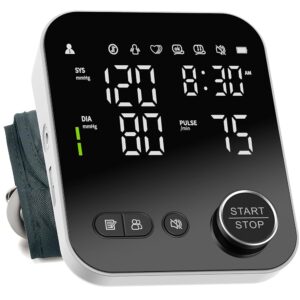
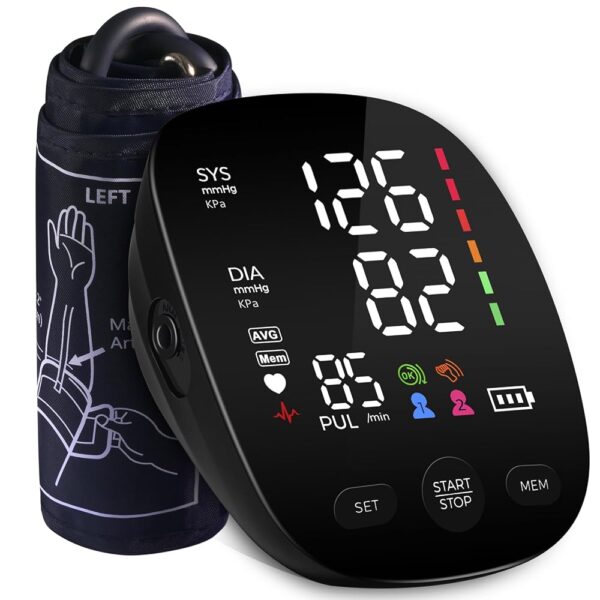
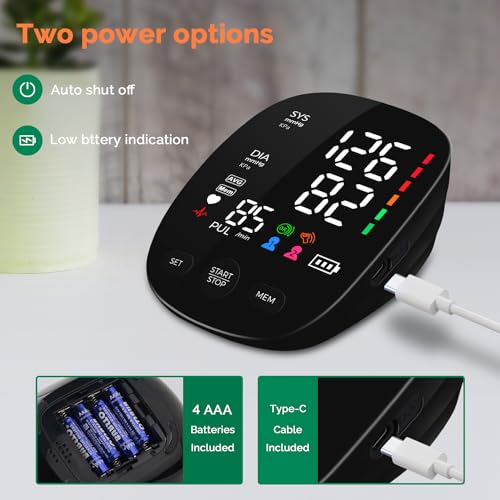
A 4.5 inch LED backlit display, given as 81 by 81 millimeters, with white numerals and colored icons. Greetmed states the screen shows blood pressure status in six colors described as complying with World Health Organization standards. Read that narrowly: it is a hardware feature that sorts one measurement into a colored band. It is not an assessment of your health, and what a reading means for you is a question for a clinician who knows your history, not a question a color answers.
Self check and movement detection
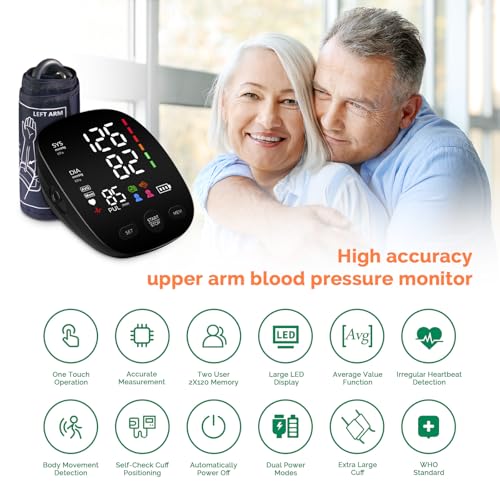
The cuff carries a self check that turns a green icon on the display when the band is worn correctly, and the screen shows a body movement icon if you move during the measurement. Those two features address the two most common causes of a strange home reading, and they are more useful than most extras at this level.
Memory and averaging
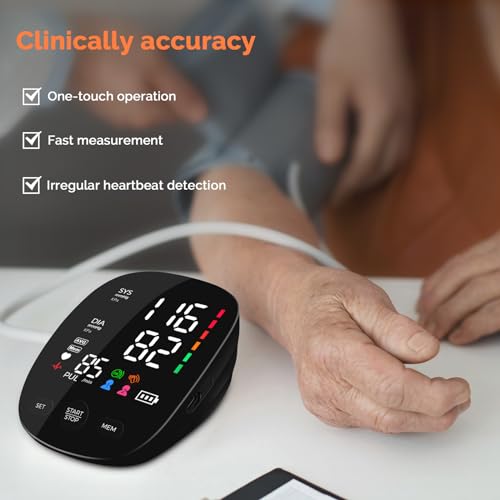
Two users with 120 sets each, which is 240 in total and matches the figure in the product title. The device automatically averages the last three measurements, which is a more defensible basis for a log than acting on one reading. The listing does not say how the three are spaced. Greetmed states a measurement finishes in about 30 seconds and that irregular heartbeat detection is included, which is a flag for a clinician to consider rather than a diagnosis of anything.
Contradictions in the listing
The battery count disagrees with itself. The structured battery field says two AAA cells are required and included. The contents list says four AAA batteries are supplied, and the feature bullet describing dual power also says four. Two against four, in the same listing. Ask before ordering, and do not buy replacements on the strength of the smaller figure.
The contents field is also corrupted, containing a block of raw page script left behind by the import with the real packing list appended after it. Read out of that mess, the list names the monitor, the extra large cuff, a Type-C charging cable, four AAA batteries and a carrying bag. Treat it as indicative and confirm with the seller.
Power is offered as either four AAA cells or a Type-C source, and the cable is listed. As with most devices in this catalog offering USB power, no wall adapter is named, so assume you supply your own plug.
The manufacturer field names Shenzhen Finicare. Greetmed’s other machine in this catalog, covered in our AES-U522 review, names a different manufacturer entirely. Two products under one brand from two unrelated factories is ordinary here, and it means experience with one Greetmed device tells you less about another than you might assume. The FC-BP model prefix also appears under other brand names, including the machines in our TESACOT FC-BP121 review and our KIKEANG FC-BP201 review.
No validation protocol is named, no clearance number is quoted and no accuracy tolerance is published, despite the marketing describing the readings as quick and accurate. There is nothing for us to attribute and nothing we will assert in our own voice. Validation status is checkable independently through the lists that medical societies publish.
Using it correctly
Rest for five minutes before measuring, sitting with your back supported, both feet flat on the floor and legs uncrossed. Bare the upper arm rather than rolling a sleeve, since on a large arm a rolled sleeve is a particularly effective second cuff. Place the lower edge of the band about an inch above the elbow crease with the artery marker over the inside of the arm, and tighten until two fingers slide underneath with mild resistance. Rest the arm on a table so the cuff sits level with your heart.
Watch for the green self check icon before you commit to a reading. If it does not appear, reseat the band rather than pressing on, because the icon is doing exactly the job that most often goes wrong. If the movement icon appears, discard that measurement instead of logging it.
Confirm the correct user profile first, let the averaging sequence finish, and write results down with the date and time. A short paper log is what a clinician can read at a glance, and it survives a flat battery.
Alternatives worth comparing
If you need a cuff even larger than this one, or you already own a monitor and want only a band, read our Alcarefam BD66 XXXL cuff review. For a machine built around an extra large band from a different supplier, the Qutryven extra large cuff monitor is the direct comparison.
Who should buy it, and who should not
Buy the FC-BP111 if your measured upper arm circumference is genuinely large, ideally between about 40 and 52 centimeters where standard bands give up, and if the self check and averaging features appeal. Skip it if your arm is mid range, if you need the battery count settled before you order, or if you were reading the six color display as a verdict on your health. It is a color scale, and the verdict belongs to a clinician.