


Description
Who the HealthSmart Premium talking wrist monitor is for
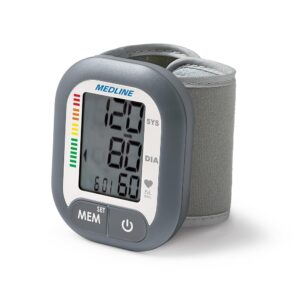
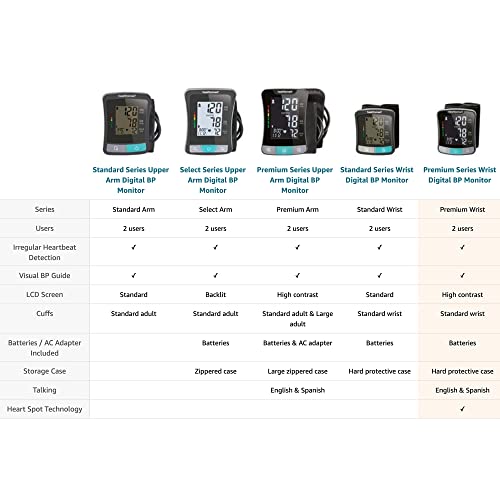
This is a talking wrist blood pressure monitor that announces readings aloud in English or Spanish. The speech function is the reason to consider it, because it gives the device a real accessibility case for a user with limited vision. It stores 120 readings across two users, includes a hard protective case and adds a positioning alert that tells you when your arm is at the right height. It records numbers for a clinician to review, and it does not replace professional medical care.
The category comes first, though. This is a wrist device, and wrist devices are not interchangeable with upper arm devices. On the wrist, how you hold your arm relative to your heart changes the number, and the measurement site is smaller and more variable than the upper arm. Upper arm devices are the usual recommendation for home monitoring, and a wrist device is normally chosen for a particular reason. Note also that talking upper arm monitors exist, so the speech function alone does not oblige you to choose a wrist device.
Wrist size and the specifications that matter
The listing states that the wrist cuff fits wrists measuring 5.3 to 8.5 inches, and the stored attribute agrees. Measure the wrist you intend to use, just above the wrist bone, with a tape measure before ordering. A wrist cuff that sits loose will not compress the artery as the device expects, and the display will report a number rather than an error.
The positioning alert, which is the feature that matters here
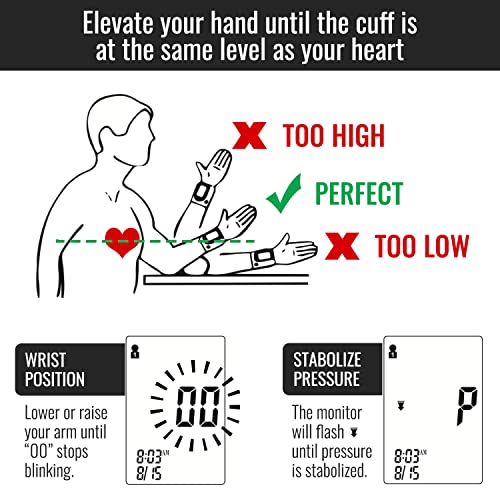
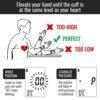
The description states that the monitor notifies you when your arm is at the optimal height for a reading. On a wrist device that is the single most valuable feature available, because arm height is the dominant source of error in wrist measurement, and it is the thing a user cannot easily judge for themselves. Combined with spoken output, it means someone who cannot read a small screen can still be told both that they are positioned correctly and what the reading was.
The device also averages the last three readings, stores 120 readings across two users with date and time stamps on a high contrast LCD, and includes a hard protective case. It measures about 3.03 by 2.52 by 1.26 inches and weighs a quarter of a pound.
A contradiction over the batteries
The record disagrees with itself about power. The specification block states that two AAA batteries are required and included. The feature text states that four AA batteries are not included. Those differ on both the size and the count and on whether anything is in the box. Assume you may need to buy batteries, and check the manual for which type before you do.
The claims in this listing need handling carefully
This is the most important section on this page. The listing text goes considerably further than a home blood pressure monitor can support, and we are not going to repeat it.
The listing describes the device as clinically accurate. We do not test products and we will not use that description in our own voice. No independent validation protocol and no assessing body is named anywhere in the listing. Where a home monitor has been assessed against a published protocol, the protocol is normally identified, so check whether this model number appears on an independent validation listing if that matters to you.
More seriously, the listing presents the irregular heartbeat function and the pulse reading as able to identify named conditions and to establish how well the heart is working, and it goes on to associate readings with specific serious outcomes and with a list of symptoms. Those statements are not appropriate to a consumer device description and we have not reproduced them. What the device actually does is this: it inflates a cuff, it reports systolic pressure, diastolic pressure and a pulse figure, and it shows a symbol when it detects an irregularity in the rhythm during a measurement. That symbol is a flag. It does not identify a rhythm, it does not diagnose anything, and it is a reason to mention the finding to a clinician rather than a finding in itself.
The listing also refers to a visual guide comparing measurements against established standards. Treat that as a category display driven by manufacturer thresholds. We are not reprinting those thresholds as targets, because what a number means for a particular person depends on their history and their treatment.
Using it correctly, and what the readings are for
Sit with your back supported and your feet flat on the floor, and rest quietly for several minutes before measuring. Fit the cuff on a bare wrist, snug rather than tight, then support your forearm with your other hand or on a cushion so the device sits at about heart height, and let the positioning alert confirm it rather than guessing. Hold still and stay silent while it inflates. Use the same wrist at about the same time each day.
What you collect is a record. What a reading means, whether a pattern across your readings is significant, and whether anything about your care should change are questions for a healthcare professional who knows your history and your medication. This device does not replace professional medical care, and no reading from it should be used to start, stop or alter treatment on your own, or to decide whether a symptom needs attention.
Limits and gaps
There is no app and no wireless connection, so 120 readings across two users is the complete history unless you write them down. No AC adapter is described and battery life is not published, on top of the battery contradiction above. No volume control or headphone option is described for the speech function, which is worth confirming if announcements aloud would be a problem in a shared household.
One classification oddity in the record. The retailer category path for this listing places it under arm monitors, while the product is a wrist device. That is a listing error rather than anything about the product, but it is exactly the sort of thing that leads someone to buy the wrong category of monitor.
Alternatives worth comparing
The closest relative is the Mabis Digital Premium talking wrist monitor, which comes from the same manufacturer and carries much of the same listing text. Among other wrist devices, the Omron BP6350, which adds heart level guidance and a cuff wrap guide is the comparison on positioning aids, the HoMedics BPW-O300 adds body motion detection, and the Care Touch digital wrist monitor and the SureLife WRS-35H are simpler options. Our index of home monitors and cuffs separates wrist listings from arm listings.
Who should buy it and who should not
Buy it if spoken readings and a height alert solve a real accessibility problem, your wrist measures between 5.3 and 8.5 inches, and two people will share it. Do not buy it on the strength of the medical language in the listing, which claims far more than any home monitor delivers, and do not choose it over an upper arm device unless there is a reason to. Take your readings to a clinician.