



Description
Who the HoMedics BPA-O200 is for, and what it settles
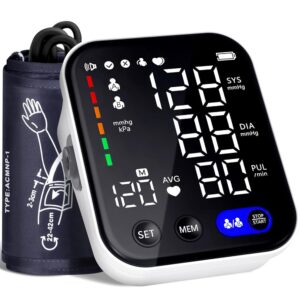
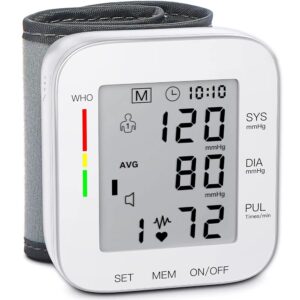
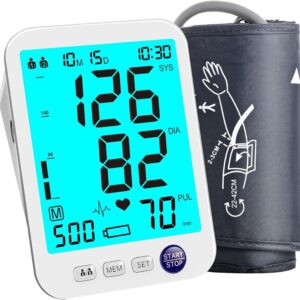
The BPA-O200 is HoMedics at its most deliberately plain: an upper arm monitor with one button, a standard sized cuff, two user profiles and a fabric storage bag. There is no app, no Bluetooth and no account to create. It settles the question of what to buy for a household that wants a record of readings on a device that will still work the same way in three years, without anyone having to keep a phone paired to it.
That makes it a reasonable first monitor, and a reasonable second one for a bag or a second home. It is a poor choice if you want history you can email to someone, because the only way data leaves this device is by being copied down by hand.
As with any home monitor, this one measures and records. It does not diagnose, and it does not replace professional medical care. What a set of readings means for you is a question for the clinician who knows your history, and a home log is most useful when it is brought to that conversation rather than interpreted alone.
The specifications that matter
Cuff range, and a wording problem in the listing
The specification field gives a band size of 23 to 33 centimeters. The feature bullet gives the same cuff as 9 to 13 inches, which converts to roughly 22.9 to 33 centimeters, so the two figures agree. The wording does not. HoMedics describes the cuff as measuring 9 to 13 inches in diameter. A cuff with a 13 inch diameter would wrap an arm well over three feet around. What is meant, and what every cuff specification in this category actually describes, is circumference: the distance around the arm at its midpoint. Read it that way, measure your arm with a tape rather than a ruler, and buy on the number you get.
Note also that this is described as a standard sized cuff, not a wide range one. At a 33 centimeter ceiling it will not fit larger arms, and HoMedics does not list a larger cuff as an accessory for this model in the published data. If your measurement is close to that limit, that is the deciding fact about this product, and a monitor with a wide range band such as the Omron BP5100 is the more sensible starting point.
Memory and users
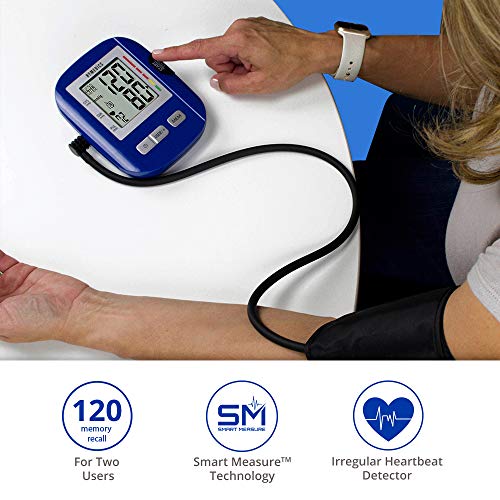
The device holds 120 readings in total, split as 60 per user across two profiles, and HoMedics states each user can also recall their last three readings directly. Sixty readings is about a month of twice daily measurements, which is enough for the kind of home log a clinician typically asks for.
Detection features, read carefully
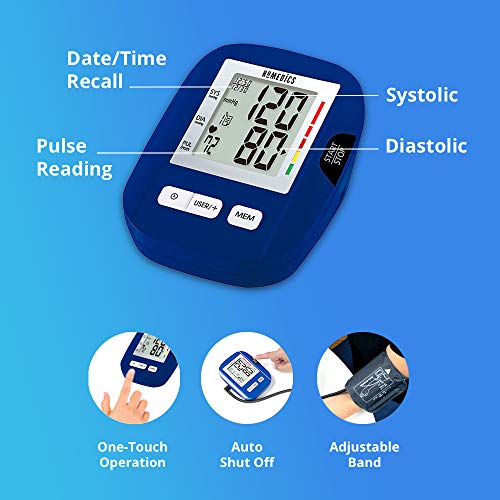
The listing advertises irregular heartbeat detection, excessive body motion detection, a risk category indicator, a date and time stamp, and auto shut-off. Two of those need care. The irregular heartbeat symbol is a flag that the device saw something irregular during a single measurement. It is not a diagnosis of anything, and HoMedics does not present it as one. The risk category indicator is a hardware feature that sorts a result into a colored band. It is the manufacturer’s classification, not an assessment of your health, and it is not a reason to change anything you are doing. Both belong in the conversation with your clinician, not in a decision made at the kitchen table.
Body motion detection is the useful one, because movement during inflation is one of the two most common causes of an odd reading, the other being a badly placed cuff.
Power, size and what is in the box
Four AAA batteries at 1.5 volts are supplied, along with the cuff and a storage bag. No AC adapter is named anywhere in the listing, so this is a battery device. Listed dimensions are 5.51 by 4.33 by 2.07 inches and listed weight is 1.15 pounds, which is compact for a base unit design and part of why the bag is included.
Limits and gaps in the published data
HoMedics calls the inflation system Smart Measure Technology and states that it inflates and deflates at an appropriate level for the individual. That is a description of a mechanism, and it is the manufacturer’s description rather than a measurement we have taken. The listing also repeatedly uses the word accurate about its own product. We are not repeating that in our own voice, because no validation protocol is named, no clearance number is quoted and no accuracy figure appears anywhere in the data. If validation matters to your decision, and for a device you intend to rely on it should, check the device against the lists that medical societies publish rather than against retail copy.
The imported listing text also carries broken characters where dashes and inch marks should be, showing raw escape sequences in the middle of sentences. That is an import artifact rather than anything about the product, but it does mean the bullets should be read for their numbers and not their punctuation.
One more thing to be aware of before ordering: HoMedics sells several closely related monitors with confusingly similar names. Our second HoMedics upper arm listing covers a near identical product under a different item number, and the BPW-O200 shares almost the same model code but is a wrist device rather than an arm one. Check the letters in the model code before you buy, because BPA and BPW are different products.
Using it correctly
Sit for five minutes before measuring, back supported, feet flat on the floor, legs uncrossed. Bare the arm rather than pushing a sleeve up, because a rolled sleeve acts as a second cuff. Place the lower edge of the band about an inch above the elbow crease with the marker over the inside of the arm, and tighten until two fingers slide under the edge with mild resistance. Rest the arm on a table so the cuff sits level with the heart.
Stay quiet and still through the measurement. If the motion symbol appears, discard that reading and start again rather than averaging a spoiled result into your log. Take readings at the same times each day, note the time next to each one, and bring the written record to appointments.
Select the right user profile before pressing the button. Sixty readings per person is only useful if they are the right person’s readings.
Alternatives worth comparing
If the standard cuff is too small for the arm you are measuring, start again from our home blood pressure monitor listings and filter on band size before anything else. For a comparable no frills upper arm unit from a brand with a clinical supply background, the Medline MDS4001 is the closest match in spirit. Buyers who want the same simplicity in a wrist format, with the position sensitivity that goes with it, should read the HoMedics BPW-O300 instead.
Who should buy it, and who should not
Buy the BPA-O200 if your upper arm measures inside 23 to 33 centimeters, if two people need separate records, and if you would rather have a device that does nothing clever than one that needs a phone. Skip it if your arm is near or above the 33 centimeter ceiling, if you want readings that can be shared electronically, or if you were hoping the risk indicator would tell you something. It will not, and that is what your clinician is for.