
Description
Start here: this listing describes two different cuffs
Normally a review opens with who a product suits. This one has to open with a warning, because the data attached to this product does not describe one cuff. It describes two, in different sizes, and for a blood pressure cuff that is the one specification you cannot afford to get wrong.
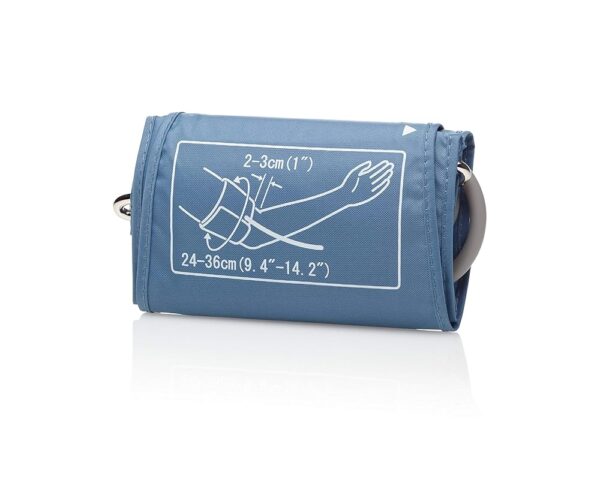
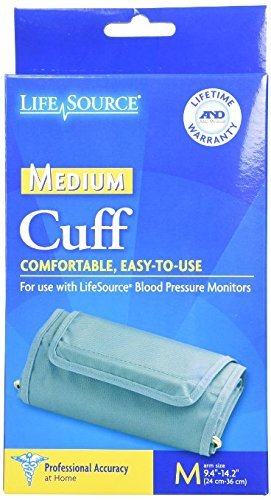
Here is what is actually on the page. The product name carries a medium designation. The imported specification block identifies the item as the LifeSource small replacement cuff, model UA-279, and gives a band size of 16 to 23.8 centimeters, with a feature bullet stating it fits upper arms of 6.3 to 9.4 inches. A separate set of stored attributes on the same product gives a size of medium and a band size of 24 to 36 centimeters. The two ranges do not overlap at all. Where one ends, the other begins.
We are not going to pick one and present it as the specification, because guessing on cuff size is exactly the failure this site exists to help readers avoid. Before you order anything from this page, confirm with the seller which model number and which circumference range they are actually shipping, and get the answer in writing.
Why the size question is the whole question
A cuff that is too small for the arm inside it, or too large for it, changes the numbers a monitor produces even when the monitor is faultless. The bladder inside the band has to sit squarely over the artery and cover an appropriate proportion of the arm’s circumference. Too small and the band has to be pulled tight to close, which is uncomfortable and shifts the result. Too large and there is so much excess that the band cannot be seated evenly.
Measure the midpoint of your upper arm, halfway between shoulder and elbow, with the arm relaxed at your side and a soft tape held snug but not tight. Write the number down. Then check it against whichever range the seller confirms. If your measurement is around 22 to 24 centimeters, you are sitting precisely in the gap between the two ranges published on this page, and the confirmation matters more for you than for anyone.
Compatibility is narrow, and that is a good thing
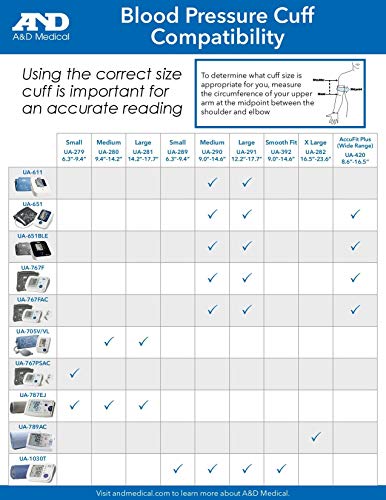
The imported specification block states that the cuff is only for use with the LifeSource UA-767PSAC or UA-787EJ upper arm monitors, and a model name field on the same product lists exactly those two machines. That is a much narrower compatibility claim than the universal cuffs elsewhere in this catalog make, and narrow is better here.
A manufacturer’s own cuff is developed alongside the algorithm inside the machine it fits. A band from another maker with a matching connector may attach without difficulty and still shift the readings, because the monitor infers pressure from oscillations picked up through a particular bladder in a particular sleeve. If you own one of the two named machines, this is the correct part. If you own something else, including another LifeSource model, do not assume it fits.
LifeSource is the long standing consumer label of A and D Medical, which is worth knowing if your machine carries one badge and your paperwork carries the other. Our A and D UA-767FAC review covers a machine in the same UA-767 family, and our UA-651 review and UA-651BLE review cover machines that take a different set of cuffs entirely, named by part number in their own listings.
The rest of what the listing says
The band is described as durable with a comfortable tapered fit. A tapered band is genuinely easier to seat on an upper arm, which narrows toward the elbow, than a plain rectangle. The listed dimensions of 13 by 4.5 by 0.3 inches describe the band laid flat, and the listed weight is 2 ounces, although the second set of attributes gives 7.2 ounces instead, which is another disagreement rather than a clarification.
The listing states a connector is supplied with the cuff. It has been on sale since August 2005, which makes it one of the oldest items in this catalog, and the listing states it is not discontinued.
Several fields are simply nonsense and worth naming so nobody tries to read meaning into them. The use case field says whole body. The material feature field says compostable warning in one place and compostable in another. Power source is given as manual in one block and battery powered in the other, and display type as manual in one and digital in the other, on a product that has neither a power source nor a display because it is a fabric band with a rubber bladder inside it.
There is no validation claim, no protocol named and no accuracy figure anywhere. That is normal for a cuff, and we make no accuracy claim about this product in our own voice.
Using it correctly
Fit the cuff on a bare upper arm rather than over a sleeve, with the lower edge about an inch above the elbow crease and the artery marker over the inside of the arm. Snug it until two fingers slide under the edge with mild resistance. Sit with your back supported, both feet flat on the floor, and rest the arm on a table so the cuff sits level with your heart. Stay quiet and still through the measurement.
After changing a cuff, take several readings under exactly the conditions you used before and compare the pattern with what you had been recording. If the results look very different, do not decide for yourself which band to believe. Take both the monitor and the question to your clinician or to a pharmacist who can compare against their own equipment. This cuff, like any part of a home monitoring setup, does not replace professional medical care.
Alternatives worth comparing
If your machine is not one of the two named models, a manufacturer specific band for your own platform is the safer purchase, and our Microlife replacement cuff review explains why. For a mid range band in the 24 to 36 centimeter territory, read our Luanerl medium cuff review. Our home blood pressure equipment section lists bands alongside the machines they fit.
Who should buy it, and who should not
Buy this cuff only after the seller has confirmed, in writing, both the model number and the circumference range of the band they are sending, and only if you own a LifeSource UA-767PSAC or UA-787EJ. Do not buy it on the strength of the size word in the product name, because the specification data on this page contradicts it. And do not buy a cuff at all without measuring your arm first, since that number is the only thing that makes any of these figures useful.